


























Views
Downloads

Essential Letter U Beginning Sound Worksheet | Grade K
Paste this activity's link or code into your existing LMS (Google Classroom, Canvas, Teams, Schoology, Moodle, etc.).
Students can open and work on the activity right away, with no student login required.
You'll still be able to track student progress and results from your teacher account.
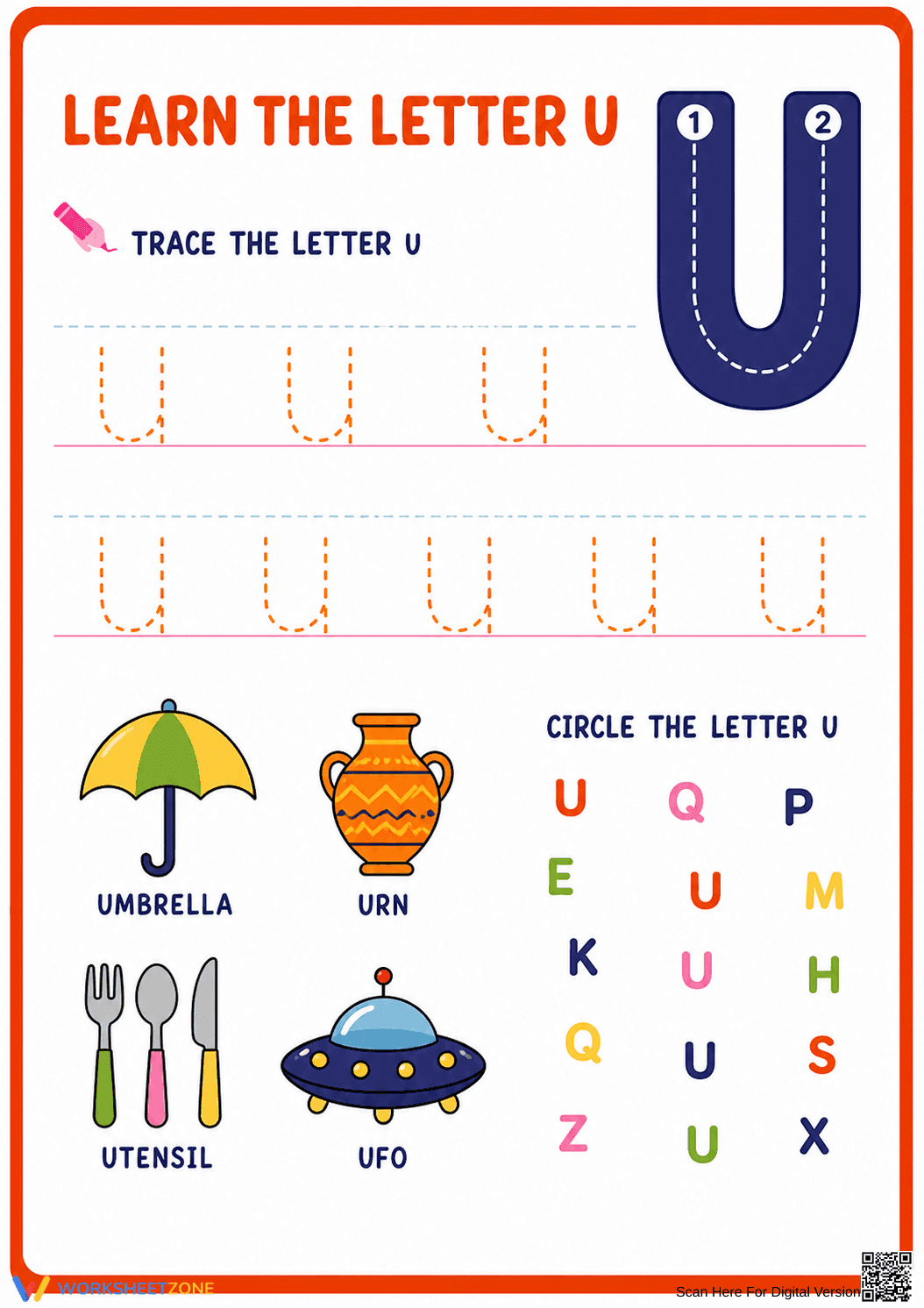
This Kindergarten letter U worksheet provides students with 15 structured tasks to master uppercase letter recognition and formation. By combining tactile tracing with visual discrimination, learners build the foundational phonemic awareness necessary for early reading success. The clear layout ensures students can work independently to identify the "u" sound in common vocabulary words.
At a Glance
- Grade: Kindergarten · Subject: ELA Phonics
- Standard:
CCSS.ELA-LITERACY.RF.K.1.D— Recognize and name all upper- and lowercase letters of the alphabet- Skill Focus: Letter U formation and identification
- Format: 1 page · 15 problems · Answer key included · PDF
- Best For: Independent literacy centers or morning work
- Time: 10–15 minutes
What's Inside: This single-page PDF features three distinct instructional zones. First, a large model of the letter U includes numbered stroke arrows to guide proper handwriting. Below, two rows of dotted-line tracing prompts allow for repetitive practice. The worksheet also includes a visual vocabulary section featuring an umbrella, urn, utensil, and UFO, alongside a letter-search grid containing 15 characters for discrimination practice.
Zero-Prep Workflow
- Print: Generate the single-page PDF in less than 30 seconds for your entire class.
- Distribute: Hand out the sheets during the transition to morning work or literacy blocks with no additional setup.
- Review: Check the letter search grid as a whole-class activity in under 2 minutes to verify student mastery.
This streamlined process ensures total teacher prep time remains under 2 minutes, making it an ideal choice for sub plans or last-minute literacy reinforcements.
Standards Alignment
This resource is primarily aligned with `CCSS.ELA-LITERACY.RF.K.1.D`, which requires students to recognize and name all upper- and lowercase letters of the alphabet. It also supports RF.K.3.A by connecting the visual symbol of the letter to its initial sound in spoken words. Both standard codes can be copied directly into lesson plans, IEP goals, or district curriculum mapping tools.
How to Use It
Use this worksheet as a formative assessment during the "You Do" phase of a direct instruction lesson on the letter U. Observe students as they trace to ensure they follow the numbered stroke order, which prevents the development of inefficient handwriting habits. It also serves as an excellent quiet-time activity for early finishers or as a simple homework assignment to reinforce classroom learning at home.
Who It's For
This resource is tailored for Kindergarten students beginning their phonics journey, though it provides valuable remediation for Grade 1 learners struggling with letter identification. It pairs naturally with alphabet anchor charts or a read-aloud of a letter-themed picture book. The inclusion of visual icons supports English Language Learners (ELL) in connecting sounds to meaning through clear, recognizable imagery.
According to the RAND AIRS 2024 report on early literacy, explicit instruction in letter-sound correspondence is a non-negotiable component of effective reading programs. This worksheet applies these findings by isolating the letter U, allowing students to focus on one phoneme-grapheme relationship at a time. Research from Fisher & Frey (2014) emphasizes that guided practice with immediate visual feedback, such as tracing with stroke guides, accelerates the transition from letter recognition to fluent writing. By engaging in the 15 discrete tasks provided here, students reinforce the neural pathways required for rapid letter naming, a key predictor of later reading proficiency. The structured format aligns with NAEP recommendations for foundational skill-building in early childhood education, ensuring that every student has the opportunity to achieve mastery through repetitive, high-quality practice.


