




























Views
Downloads

Lowercase Letter M Printable Worksheet | Grade K

Paste this activity's link or code into your existing LMS (Google Classroom, Canvas, Teams, Schoology, Moodle, etc.).
Students can open and work on the activity right away, with no student login required.
You'll still be able to track student progress and results from your teacher account.
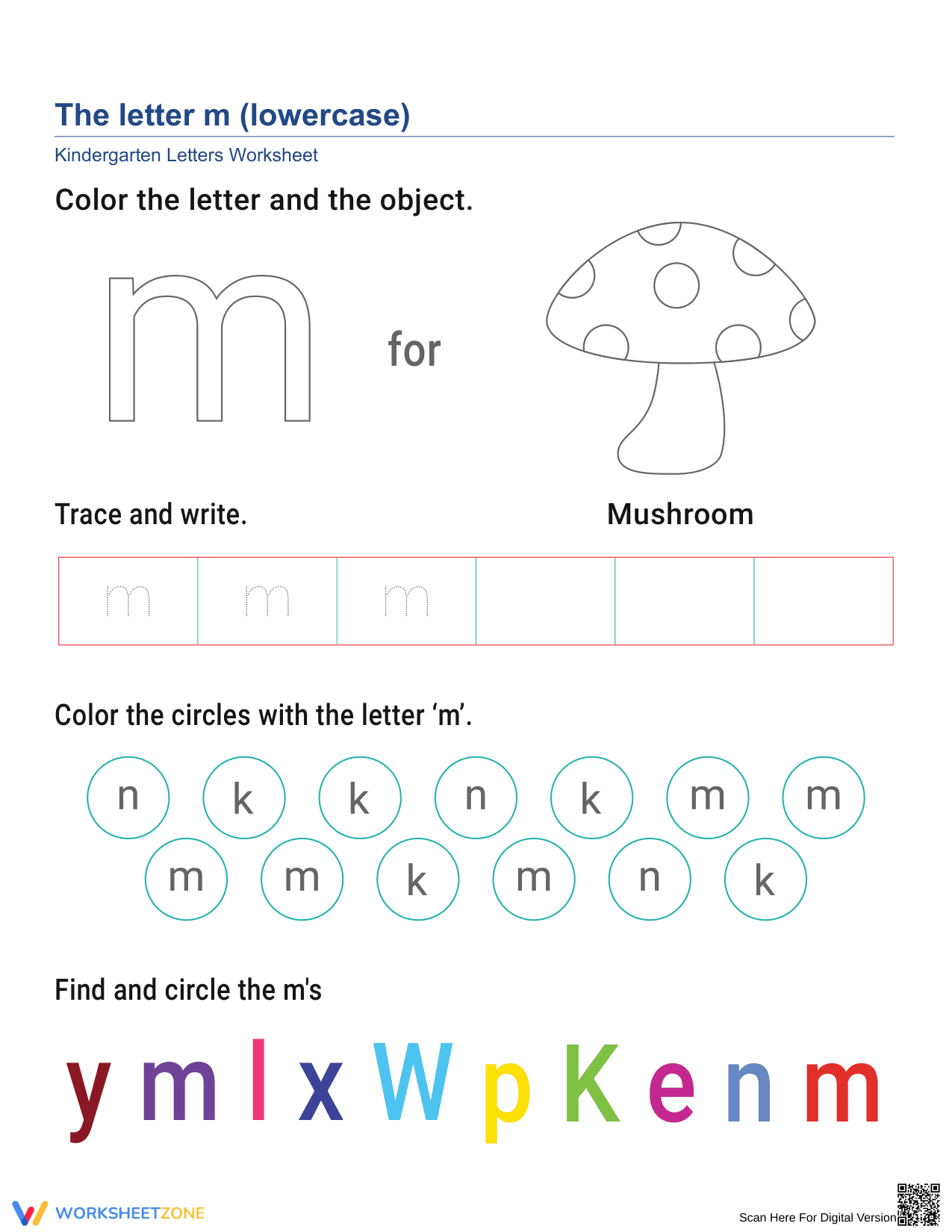
This foundational reading worksheet helps early learners master the lowercase letter m through targeted visual discrimination and handwriting practice. By isolating a single letter, students build the automatic recognition skills required for fluent reading while developing the fine motor control needed for proper letter formation.
At a Glance
- Grade: K · Subject: ELA
- Standard:
CCSS.ELA-LITERACY.RF.K.1.D— Recognize and name all lowercase letters- Skill Focus: Lowercase letter m recognition
- Format: 1 page · 4 tasks · No answer key needed · PDF
- Best For: Independent morning work
- Time: 10–15 minutes
This single-page resource features four distinct activity zones designed to reinforce letter familiarity. Students begin by coloring a large outline of the letter alongside a corresponding picture of a mushroom. Next, a five-box grid provides guided tracing and independent writing practice. The bottom half includes two visual discrimination tasks: coloring specific circles containing the target letter among distractors, and finding the letter hidden within a sequence of mixed-case, multi-colored text.
This resource offers a highly efficient workflow:
- Print (1 minute): Generate copies directly from the PDF file. The black-and-white design ensures crisp reproduction and minimal ink usage.
- Distribute (1 minute): Hand out to students during morning arrival or literacy centers. The intuitive layout requires almost no verbal instruction.
- Review (1 minute): Quickly scan completed pages to verify accurate letter formation and correct identification in the discrimination tasks.
Total teacher preparation time is under two minutes, making this an excellent option for emergency sub plans or spontaneous skill reinforcement.
This activity aligns directly with CCSS.ELA-LITERACY.RF.K.1.D: Recognize and name all upper- and lowercase letters of the alphabet. It also supports early handwriting standards by requiring students to form the letter correctly within provided guidelines. Both standard codes can be copied directly into lesson plans, IEP goals, or district curriculum mapping tools.
Deploy this worksheet as focused morning work as students settle in. The predictable structure allows children to work independently while the teacher takes attendance. Alternatively, use it as a targeted intervention tool during small group literacy centers for students struggling with letter confusion. As a formative assessment tip, observe students during the tracing section to ensure they are starting the letter stroke at the top rather than the bottom. Expected completion time ranges from 10 to 15 minutes.
This material is designed for kindergarten students mastering the alphabet, though it serves well for preschool enrichment. For differentiation, provide a tactile alphabet card for students who need sensory input before writing. This worksheet pairs perfectly with a direct instruction lesson on the /m/ sound or a read-aloud featuring a character whose name begins with the letter.
Mastering early alphabet skills, specifically the ability to recognize and name all lowercase letters as outlined in CCSS.ELA-LITERACY.RF.K.1.D, forms the critical foundation for future decoding and reading comprehension. According to a comprehensive 2024 report by EdReports, explicit and systematic instruction in letter recognition significantly reduces the likelihood of later reading difficulties in primary grades. When students practice isolating specific characters like the lowercase letter m through varied modalities—such as coloring, tracing, and visual discrimination among distractors—they actively strengthen the neural pathways associated with orthographic mapping. This targeted repetition ensures that letter identification becomes fully automatic, freeing up essential cognitive resources for more complex phonemic awareness and blending tasks. By integrating these focused, single-letter activities into daily literacy routines, educators provide the structured repetition necessary for long-term retention and ultimate reading success.


