




























Views
Downloads
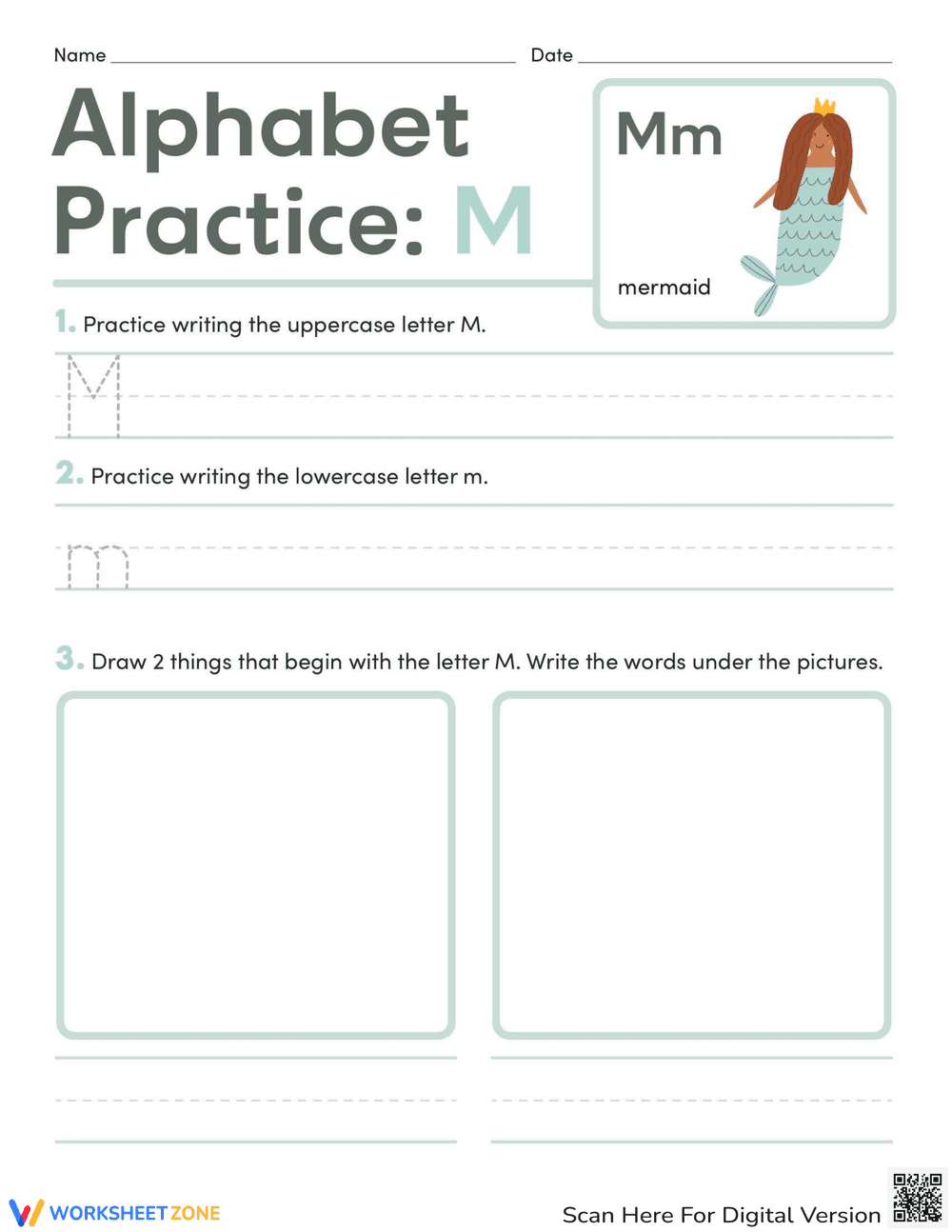

Letter M Practice Worksheet | Printable Kindergarten ELA

Paste this activity's link or code into your existing LMS (Google Classroom, Canvas, Teams, Schoology, Moodle, etc.).
Students can open and work on the activity right away, with no student login required.
You'll still be able to track student progress and results from your teacher account.
This printable letter M worksheet helps early learners master uppercase and lowercase letter formation through structured tracing and creative drawing tasks. Students practice fine motor control and phonics association by identifying and illustrating objects starting with the target letter. This resource ensures immediate engagement and builds foundational handwriting skills.
At a Glance
- Grade: Kindergarten · Subject: English Language Arts
- Standard:
CCSS.ELA-LITERACY.L.K.1.A— Print upper- and lowercase letters- Skill Focus: Letter M formation and beginning sounds
- Format: 1 page · 3 tasks · No answer key required · PDF
- Best For: Kindergarten morning work, handwriting practice, or phonics centers
- Time: 15–20 minutes
This single-page PDF contains three distinct activities designed for young learners. The top section features a friendly mermaid graphic to anchor the letter sound, followed by guided tracing lines for uppercase letter M. The second section provides lowercase letter m tracing practice with dotted guides. The final section prompts students to draw two objects starting with the letter M and write their corresponding names on primary writing lines.
This resource features a zero-prep workflow that integrates into any classroom routine. First, print the single-page PDF for your class, taking less than 1 minute. Second, distribute the sheets to students during morning arrival or center rotations, requiring only 30 seconds of transition time. Third, review student drawings and letter strokes individually or as a group, taking under 2 minutes. The entire setup requires less than 2 minutes of teacher preparation, making it an excellent option for emergency sub plans or quick phonics assessments.
Standards Alignment
This worksheet aligns directly with the Common Core State Standard `CCSS.ELA-LITERACY.L.K.1.A`, which requires students to print many upper- and lowercase letters. Additionally, the drawing and labeling task supports phonics development by connecting letter shapes to their corresponding initial sounds. Both standard codes can be copied directly into lesson plans, IEP goals, or district curriculum mapping tools.
How to Use It
Use this worksheet during direct instruction as a guided practice activity immediately following the introduction of the letter M sound. Alternatively, assign it as an independent center activity to assess fine motor skills. Teachers can perform formative assessment by observing pencil grip and stroke direction during the tracing tasks. Expect students to complete the page in 15 to 20 minutes.
Who It's For
This activity is designed for preschool, kindergarten, and first-grade students who are developing handwriting proficiency. It serves struggling writers needing extra motor support and early finishers seeking creative drawing tasks. Pair this worksheet with a read-aloud book about mermaids or an anchor chart displaying common letter M vocabulary words to reinforce the phonics lesson.
Early childhood literacy research emphasizes that handwriting instruction must combine motor practice with phonemic awareness to maximize orthographic mapping. According to a comprehensive analysis by Fisher & Frey (2014), integrating letter formation with vocabulary drawing tasks helps young learners establish stronger cognitive connections between graphemes and phonemes. This worksheet targets standard CCSS.ELA-LITERACY.L.K.1.A by guiding students through uppercase and lowercase letter M tracing before transitioning them to independent word generation. By drawing and labeling two objects that begin with the letter M, students apply their phonics knowledge in a creative, self-directed context. This dual-modality approach reinforces letter-sound correspondence while building the fine motor control necessary for fluent writing. Educators can utilize this structured layout to monitor student progress, identify letter reversals early, and provide targeted intervention during foundational literacy blocks.


