




























Views
Downloads
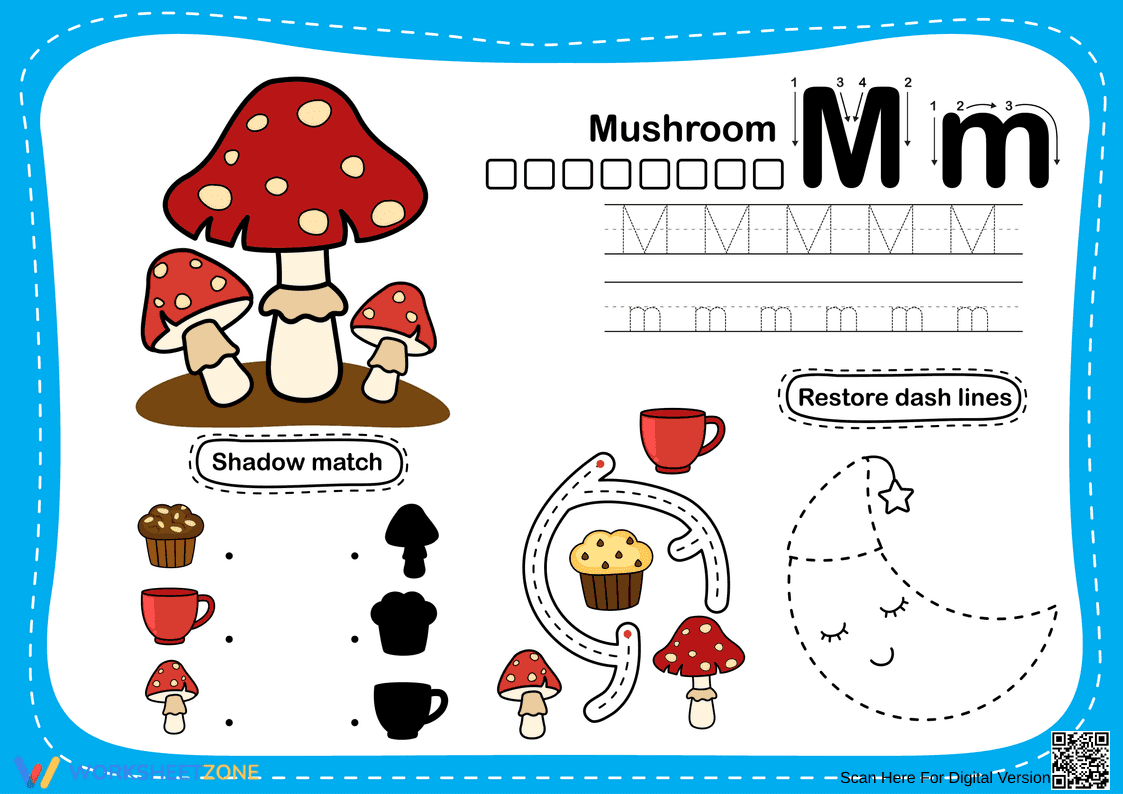

Letter M Alphabet Tracing — Essential Grade K Worksheet

Paste this activity's link or code into your existing LMS (Google Classroom, Canvas, Teams, Schoology, Moodle, etc.).
Students can open and work on the activity right away, with no student login required.
You'll still be able to track student progress and results from your teacher account.
This Grade K Letter M worksheet provides a comprehensive introduction to letter recognition and formation. Students engage in multi-sensory activities including uppercase and lowercase tracing, visual discrimination through shadow matching, and fine motor coordination. By completing these varied tasks, early learners build the foundational phonics skills necessary for reading readiness and handwriting mastery.
At a Glance
- Grade: Kindergarten · Subject: ELA Alphabet
- Standard:
CCSS.ELA-LITERACY.RF.K.1.D— Recognize and name all upper- and lowercase letters of the alphabet- Skill Focus: Letter M Formation
- Format: 1 page · 15+ tasks · No-prep · PDF
- Best For: Morning work or literacy centers
- Time: 10–15 minutes
This single-page PDF features four distinct activity zones designed to keep young learners engaged. It includes guided tracing for both "M" and "m" with directional arrows, a "Mushroom" vocabulary header, a three-item shadow matching game to boost visual processing, and a "Restore dash lines" section featuring a moon and a path. The layout is clean and visual-heavy, minimizing the need for teacher explanation.
The workflow for this resource is designed for maximum efficiency in busy classrooms. Teachers can print the single sheet in under 30 seconds, distribute it immediately to students during a transition period, and review the completed work in less than a minute. This makes it an ideal choice for emergency sub plans, quiet morning work, or as a quick formative assessment during alphabet introduction.
The primary focus is CCSS.ELA-LITERACY.RF.K.1.D, which requires students to recognize and name all upper- and lowercase letters of the alphabet. Additionally, the fine motor paths support pre-writing standards found in many state early childhood frameworks. Both standard codes can be copied directly into lesson plans, IEP goals, or district curriculum mapping tools.
Use this worksheet during the "You Do" phase of a gradual release lesson after introducing the "M" sound and shape. It works exceptionally well as a station in a literacy rotation. Teachers should observe students during the shadow matching task to identify those who may need additional support with visual discrimination or spatial awareness. Completion typically takes 10 to 15 minutes.
This resource is tailored for preschool, kindergarten, and first-grade students who are developing letter-sound correspondence. It is particularly effective for English Language Learners (ELLs) due to the heavy use of visual cues like mushrooms and muffins. Pair this with a physical alphabet manipulative or a Letter M anchor chart for a complete instructional experience.
According to the RAND AIRS 2024 report on early literacy, multi-modal engagement with letter forms—combining tracing with visual matching—significantly improves long-term retention of the alphabet. This worksheet implements these findings by requiring students to interact with the Letter M through three different cognitive pathways: motoric (tracing), visual (matching), and conceptual (vocabulary association). By aligning with CCSS.ELA-LITERACY.RF.K.1.D, the resource ensures that students are meeting the rigorous expectations of the Common Core State Standards for foundational reading skills. Research from Fisher & Frey (2014) emphasizes that such structured, independent practice is vital for moving students toward mastery in handwriting and phonemic awareness. This printable provides the necessary scaffolding to bridge the gap between teacher-led instruction and independent student application, making it a reliable tool for any early childhood educator looking to strengthen their literacy curriculum.


