




























Views
Downloads
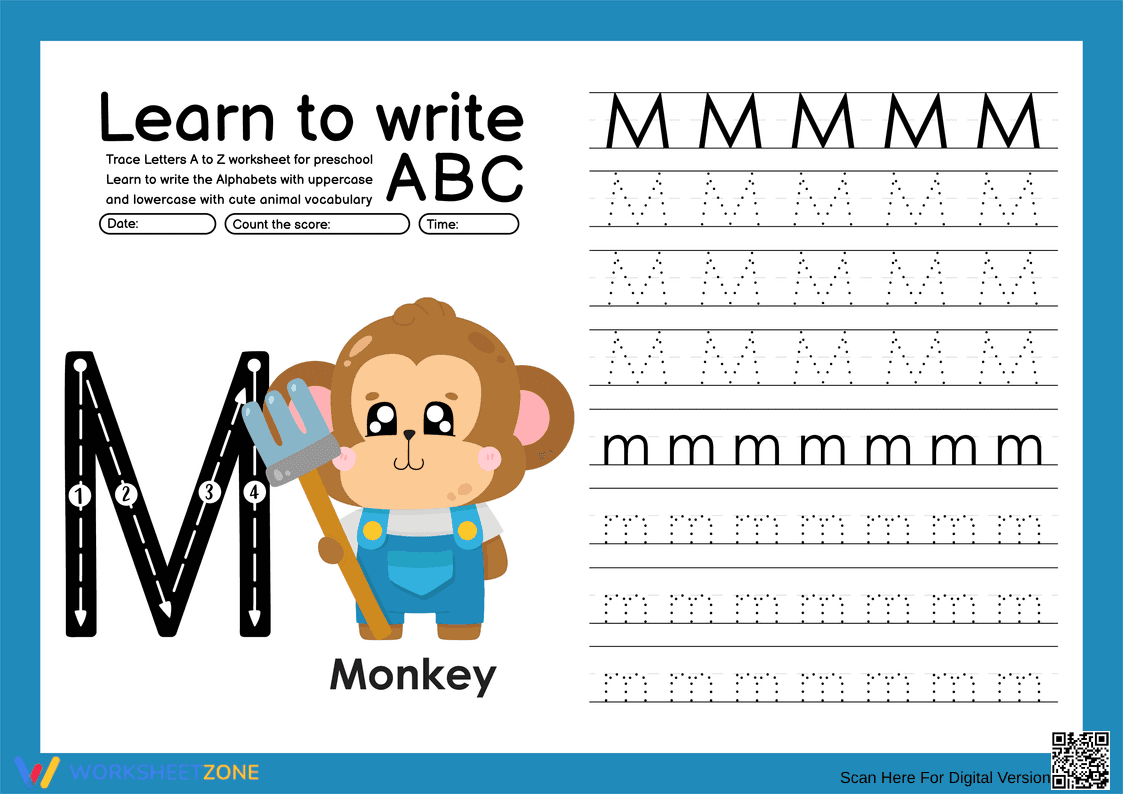

Learn to Write Letter M Worksheet | Essential Grade K Ready

Paste this activity's link or code into your existing LMS (Google Classroom, Canvas, Teams, Schoology, Moodle, etc.).
Students can open and work on the activity right away, with no student login required.
You'll still be able to track student progress and results from your teacher account.
Mastering letter formation is a foundational step in early literacy development. This Grade K alphabet worksheet provides structured practice for the letter M, helping students develop the muscle memory and fine motor control necessary for legible handwriting. By focusing on both uppercase and lowercase forms, learners build a complete understanding of this high-frequency consonant.
At a Glance
- Grade: Kindergarten · Subject: ELA / Alphabet
- Standard:
CCSS.ELA-LITERACY.L.K.1.A— Print many upper- and lowercase letters accurately and legibly- Skill Focus: Letter M formation
- Format: 1 page · 32 problems · Answer key not required · PDF
- Best For: Independent morning work or literacy centers
- Time: 10–15 minutes
What's Inside: This single-page PDF features a clear, guided layout designed for young learners. It includes a large directional model for the letter M with numbered stroke arrows to ensure correct formation. Students engage with four rows of uppercase M and four rows of lowercase m, transitioning from dotted tracing lines to independent writing. A friendly monkey illustration provides a mnemonic link between the letter sound and a familiar animal.
Zero-Prep Workflow: This resource is designed for immediate classroom implementation. First, print the required number of copies for your group (approx. 30 seconds). Second, distribute the sheets along with pencils or crayons; the intuitive layout requires less than 1 minute of teacher explanation. Finally, review student work during a quick walk-around to provide immediate feedback on stroke direction and letter sizing. It is an ideal choice for emergency sub plans or quiet-time activities.
Standards Alignment: This worksheet is specifically aligned to `CCSS.ELA-LITERACY.L.K.1.A`: "Print many upper- and lowercase letters." It focuses on the specific orthographic requirements of the letter M, ensuring students recognize the vertical and diagonal components of the uppercase form and the rounded humps of the lowercase form. This standard code can be copied directly into lesson plans, IEP goals, or district curriculum mapping tools.
How to Use It: Use this worksheet during the "You Do" phase of a gradual release lesson on the letter M. It serves as an excellent formative assessment tool; observe students as they trace to identify those struggling with top-to-bottom stroke order. Expected completion time ranges from 10 to 15 minutes depending on the student's fine motor development. It can also be laminated for use in a dry-erase center for repeated practice.
Who It's For: This resource is tailored for Preschool, Kindergarten, and early Grade 1 students who are beginning their handwriting journey. It is particularly helpful for students requiring extra fine motor support. Pair this worksheet with a letter M anchor chart or a phonics reader featuring the "m" sound to reinforce the connection between letter shape and phonemic awareness.
Handwriting instruction remains a critical component of early childhood education, as research from Fisher & Frey (2014) suggests that the physical act of writing letters by hand significantly improves letter recognition and long-term reading outcomes. This worksheet addresses the CCSS.ELA-LITERACY.L.K.1.A standard by providing 32 distinct opportunities for students to practice the letter M in both its uppercase and lowercase forms. By utilizing numbered stroke guides and a gradual transition from tracing to independent production, the resource supports the development of automaticity in letter formation. Such automaticity is essential for reducing the cognitive load on young writers, eventually allowing them to focus on composition and expression rather than the mechanics of penmanship. This printable PDF is a reliable tool for any literacy curriculum aiming to build strong foundational skills in a structured, accessible format that requires zero teacher preparation time.


