


























0
Views
0
Downloads

0.0
0
Save
0 Likes
Share
Letter Q Tracing Worksheet – Q is for Queen
0 Views
0 Downloads
Paste this activity's link or code into your existing LMS (Google Classroom, Canvas, Teams, Schoology, Moodle, etc.).
Students can open and work on the activity right away, with no student login required.
You'll still be able to track student progress and results from your teacher account.
Information
Description
What It Is:
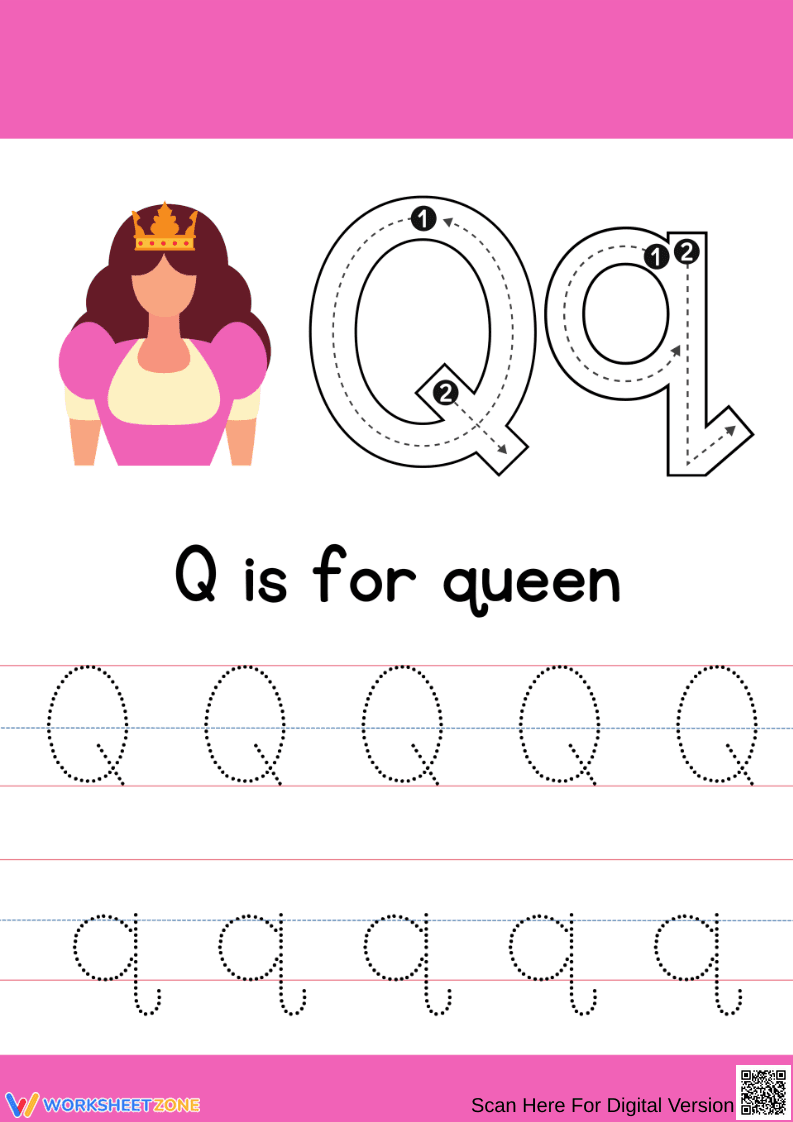
A handwriting worksheet that helps young learners practice writing the uppercase and lowercase letter Q using dotted tracing lines and simple stroke guides.
The worksheet features a queen illustration and the phrase “Q is for queen” to build letter–sound recognition while strengthening fine motor skills.
Students trace large guided letters and then complete multiple dotted-letter repetitions on primary handwriting lines.
Why Use It:
This worksheet supports early literacy development by combining phonics reinforcement with handwriting practice.
It helps young children improve pencil control, letter formation, and confidence in writing both forms of the letter Q.
How to Use It:
• Use during handwriting lessons or alphabet practice sessions.
• Encourage students to follow the numbered arrows for correct letter formation.
• Ideal for centers, morning work, or take-home practice.
Grade Suitability:
Best suited for preschool and kindergarten learners.
• Perfect for early writers developing fine motor and alphabet skills.
• Helpful for classroom, tutoring, and homeschool environments.
Target Users:
Early childhood educators, preschool students, kindergarten learners, and homeschool families.
A handwriting worksheet that helps young learners practice writing the uppercase and lowercase letter Q using dotted tracing lines and simple stroke guides.
The worksheet features a queen illustration and the phrase “Q is for queen” to build letter–sound recognition while strengthening fine motor skills.
Students trace large guided letters and then complete multiple dotted-letter repetitions on primary handwriting lines.
Why Use It:
This worksheet supports early literacy development by combining phonics reinforcement with handwriting practice.
It helps young children improve pencil control, letter formation, and confidence in writing both forms of the letter Q.
How to Use It:
• Use during handwriting lessons or alphabet practice sessions.
• Encourage students to follow the numbered arrows for correct letter formation.
• Ideal for centers, morning work, or take-home practice.
Grade Suitability:
Best suited for preschool and kindergarten learners.
• Perfect for early writers developing fine motor and alphabet skills.
• Helpful for classroom, tutoring, and homeschool environments.
Target Users:
Early childhood educators, preschool students, kindergarten learners, and homeschool families.


