


























Views
Downloads

Printable Letter Q Recognition Worksheet | Kindergarten ELA
Paste this activity's link or code into your existing LMS (Google Classroom, Canvas, Teams, Schoology, Moodle, etc.).
Students can open and work on the activity right away, with no student login required.
You'll still be able to track student progress and results from your teacher account.
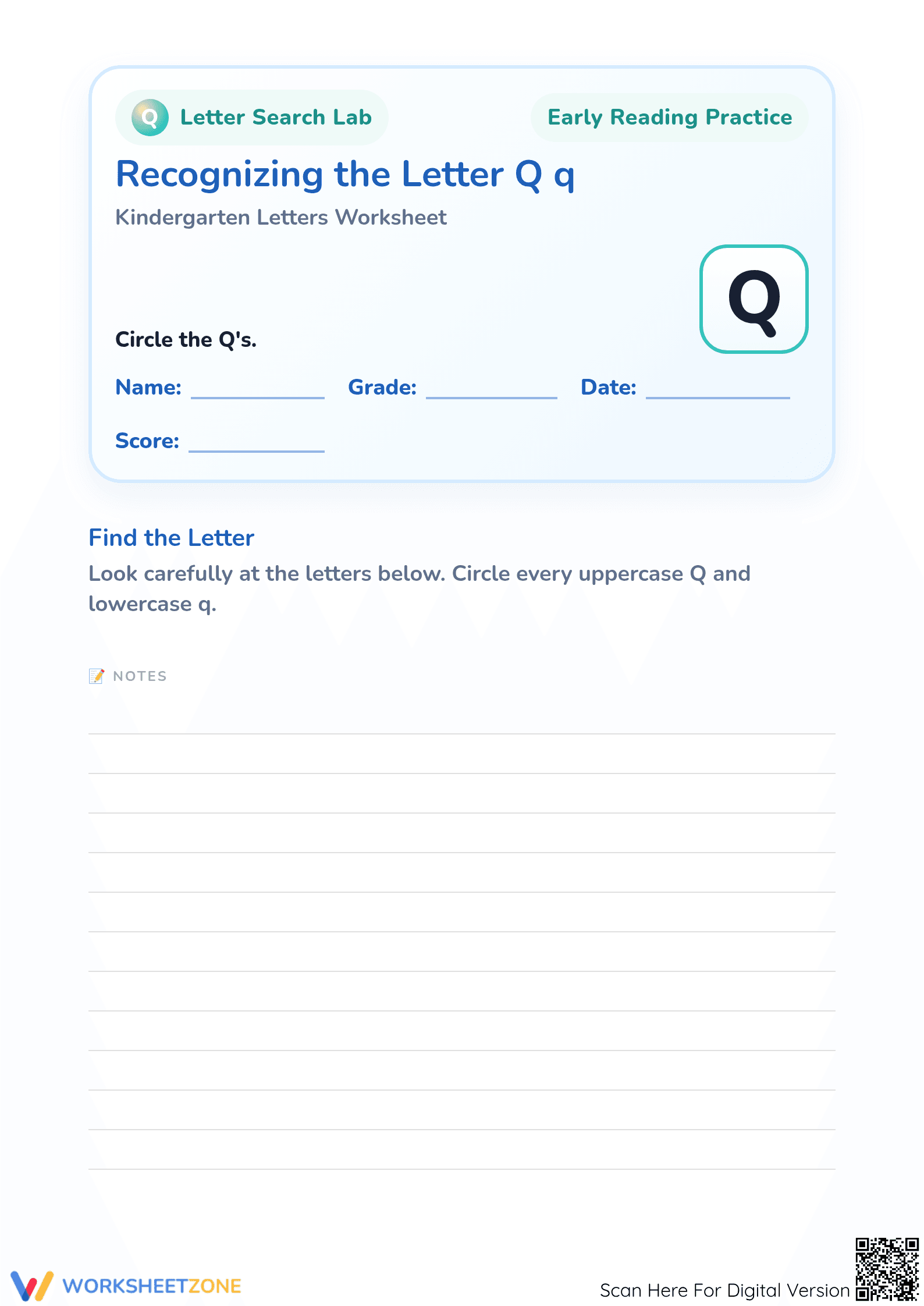
This printable Kindergarten ELA worksheet helps young learners master letter recognition for the letter Q. By engaging in a "Letter Search Lab," students develop visual discrimination skills to identify both uppercase Q and lowercase q among similar-looking characters. This essential practice builds the foundational phonemic awareness required for early reading success and confident handwriting.
At a Glance
- Grade: Kindergarten · Subject: English Language Arts
- Standard:
CCSS.ELA-LITERACY.RF.K.1.D— Recognize and name all upper- and lowercase letters of the alphabet- Skill Focus: Letter Q Recognition
- Format: 3 pages · 4 tasks · Answer key included · PDF
- Best For: Literacy centers and early morning work
- Time: 15–20 minutes
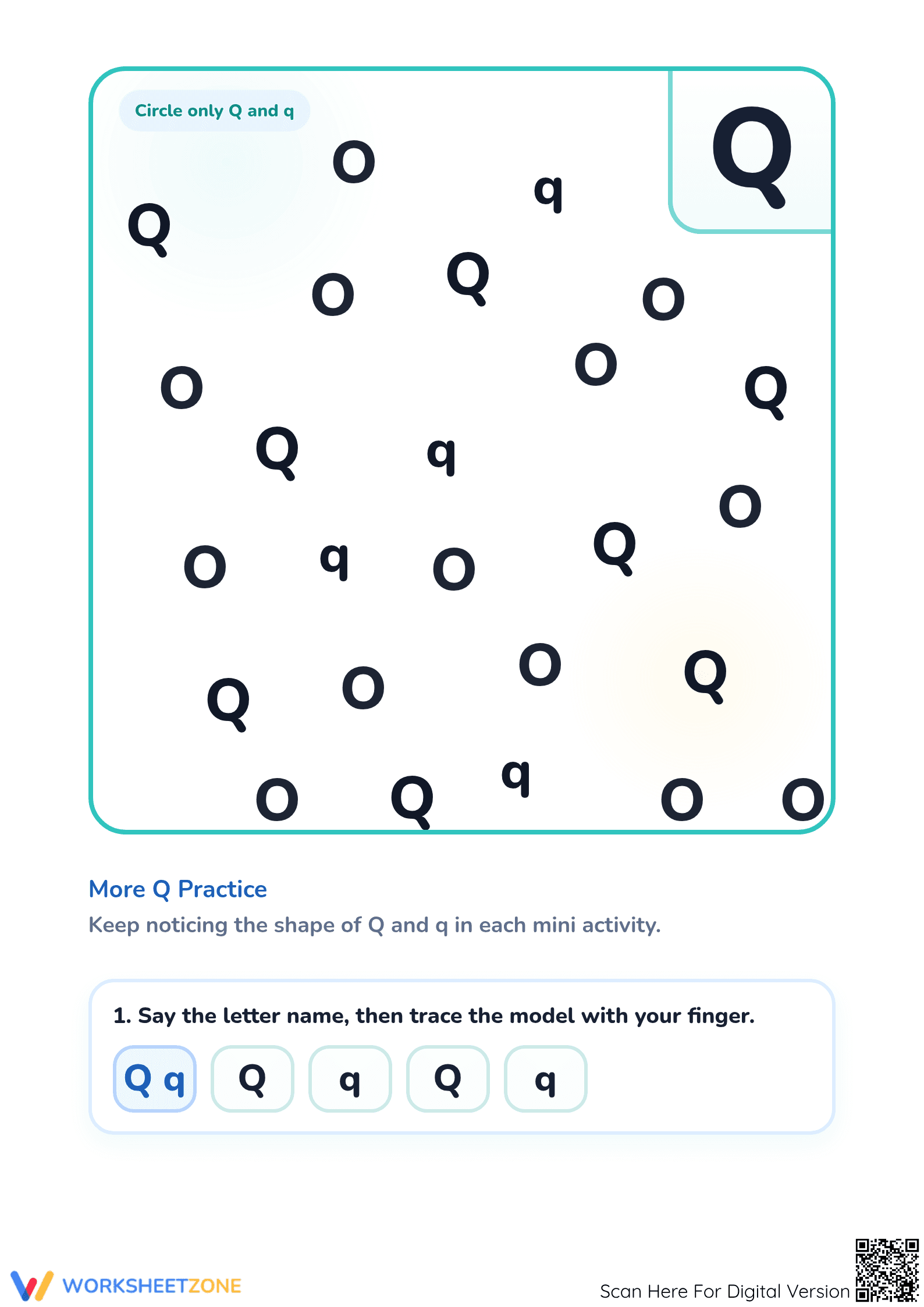
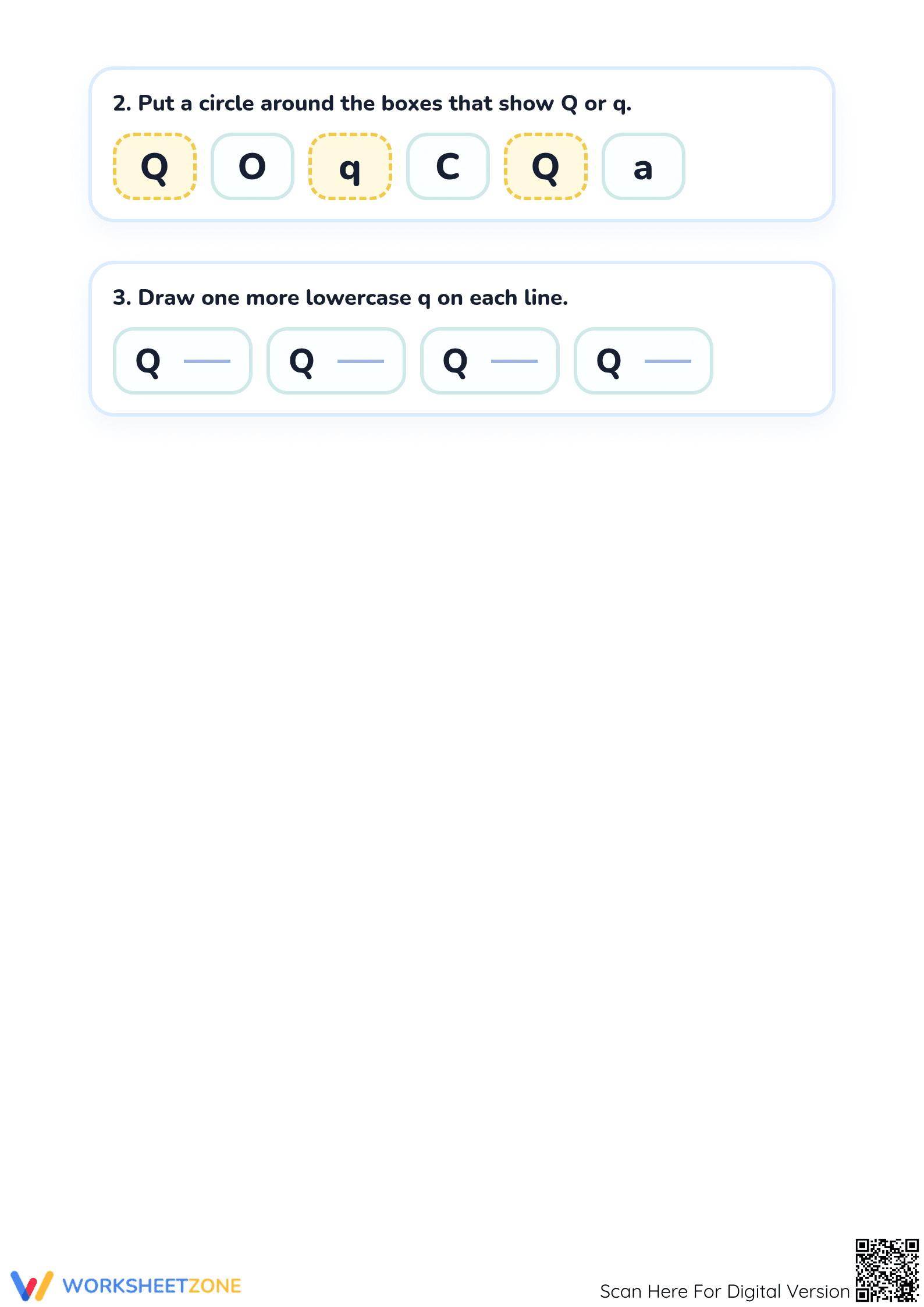
Inside this three-page packet, you will find a structured sequence of four unique activities designed to reinforce letter shapes. The "Letter Search Lab" features a large character grid for visual scanning, followed by tactile finger-tracing exercises. A discrimination task requires students to circle the correct letter in boxes, while a final writing prompt encourages the production of the lowercase q form alongside the uppercase model.
Skill Progression
- Guided Practice: Students begin with a 15-problem visual search, circling every "Q" and "q" they find in a cluttered field of similar shapes like "O".
- Supported Practice: Learners transition to tactile reinforcement by saying the letter name and tracing the model with their fingers to build muscle memory for the uppercase and lowercase forms.
- Independent Practice: The final tasks require students to distinguish "Q" from other letters like "C" and "a" before completing 4 lowercase letter strings independently.
This sequence follows the gradual-release model, moving from identification to discrimination and finally to basic production of the letter form.
Standards Alignment
This resource is directly aligned with CCSS.ELA-LITERACY.RF.K.1.D, which requires students to "Recognize and name all upper- and lowercase letters of the alphabet." By isolating the letter Q, this worksheet allows for targeted intervention and mastery check-ins. This standard code can be copied directly into lesson plans, IEP goals, or district curriculum mapping tools.
How to Use It
Use this worksheet during your initial direct instruction of the letter Q. It works best as a "You Do" activity after modeling the letter's shape on an anchor chart. As a formative assessment, observe students during the discrimination task; if they confuse "Q" with "O," provide a highlighter to emphasize the "tail" on the uppercase Q. Expect a 20-minute completion time.
Who It's For
This packet is designed for Kindergarten students, though it is also appropriate for Preschoolers showing early literacy readiness or Grade 1 students requiring remedial support. It pairs naturally with an alphabet song or a letter-of-the-week read-aloud focused on "Q" words like "Queen" or "Quilt."
According to the CCSS.ELA-LITERACY.RF.K.1.D standard, mastering letter recognition is a critical precursor to decoding and reading fluency. Research from Fisher & Frey (2014) emphasizes the importance of visual discrimination and tactile tracing in the early stages of literacy acquisition, particularly for letters with similar features like Q and O. This worksheet implements these proven strategies through its multi-step "Letter Search Lab" and finger-tracing components. By providing multiple opportunities to identify the letter Q in various contexts—including cluttered fields and isolated box sets—the resource ensures that students develop the robust mental models necessary for automaticity. Educators can use these structured tasks to collect data on letter-naming accuracy, which serves as a high-leverage predictor of future reading proficiency. The inclusion of both uppercase and lowercase forms addresses the full scope of the Kindergarten alphabet standards efficiently.


