


























Views
Downloads
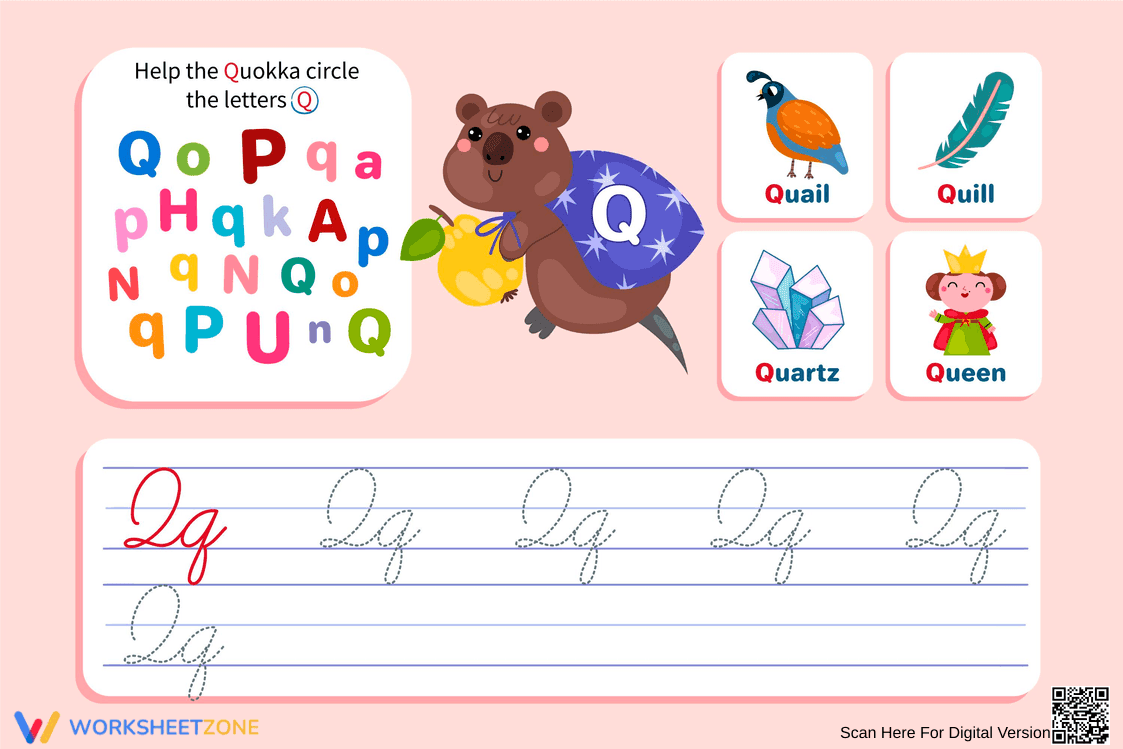

Cursive Q Tracing Worksheet | Grade 2 Printable
Paste this activity's link or code into your existing LMS (Google Classroom, Canvas, Teams, Schoology, Moodle, etc.).
Students can open and work on the activity right away, with no student login required.
You'll still be able to track student progress and results from your teacher account.
This Grade 2 cursive handwriting worksheet provides focused practice on forming the letter Q. Students develop fine motor control and muscle memory by tracing both uppercase and lowercase cursive letters. The engaging format helps young learners master proper letter proportions and fluid strokes while reinforcing letter recognition.
At a Glance
- Grade: 2 · Subject: Handwriting
- Standard:
CCSS.ELA-LITERACY.L.1.1.A— Print all upper- and lowercase letters- Skill Focus: Cursive Letter Q Formation
- Format: 1 page · 3 activities · No answer key · PDF
- Best For: Independent practice
- Time: 10–15 minutes
This single-page resource features three activities designed to build letter familiarity. Students begin with a visual discrimination task, helping a quokka character circle print versions of the letter Q. Next, a vocabulary section introduces four Q-words (quail, quill, quartz, queen) with illustrations to build phonetic connections. Finally, the core tracing section provides guided dotted lines for practicing uppercase and lowercase cursive Q, complete with directional cues.
This worksheet is designed for immediate classroom implementation with a streamlined workflow:
- Print (1 minute): The high-contrast PDF prints clearly in color or grayscale, requiring no special formatting.
- Distribute (1 minute): Hand out the single page to students; the intuitive layout means no complex instructions are needed.
- Review (1 minute): Quickly scan student tracing lines to ensure proper stroke direction and letter sizing.
With under three minutes of total teacher prep time, this resource is an excellent addition to emergency sub plans or morning work folders.
This activity aligns with foundational writing expectations, specifically supporting CCSS.ELA-LITERACY.L.1.1.A: Print many upper- and lowercase letters. While the standard focuses on print, this worksheet extends the expectation to cursive formation, ensuring students maintain legibility and proper spatial alignment on lined paper. Both standard codes can be copied directly into lesson plans, IEP goals, or district curriculum mapping tools.
Teachers can utilize this worksheet during dedicated handwriting blocks or literacy centers. As a morning work assignment, it allows students to settle into the day with a quiet, focused task. Alternatively, use it as a targeted intervention for students struggling with fine motor skills. While observing students complete the tracing section, watch for proper pencil grip and ensure they start strokes from the correct baseline. Expected completion time is 10 to 15 minutes.
This resource is primarily designed for first and second-grade students transitioning from print to cursive writing. The visual discrimination task provides a helpful scaffold for students who need to reinforce basic letter recognition before attempting complex cursive strokes. It pairs perfectly with a direct instruction lesson on cursive loops or a classroom anchor chart demonstrating the cursive alphabet.
Developing fluent handwriting is a critical component of early literacy that directly impacts a student's ability to express complex ideas. This resource supports CCSS.ELA-LITERACY.L.1.1.A by helping students print all upper- and lowercase letters, extending this foundational skill into cursive writing. According to Fisher & Frey (2014), explicit instruction in handwriting and letter formation significantly reduces the cognitive load required for basic transcription, allowing young writers to dedicate more mental resources to vocabulary selection and sentence structure. By combining visual discrimination tasks with guided tracing practice, this worksheet provides the repetitive, structured motor skill practice necessary for automaticity. The inclusion of phonetic vocabulary words further bridges the gap between isolated letter formation and meaningful word construction, ensuring that handwriting practice remains a highly contextualized and purposeful literacy activity.


