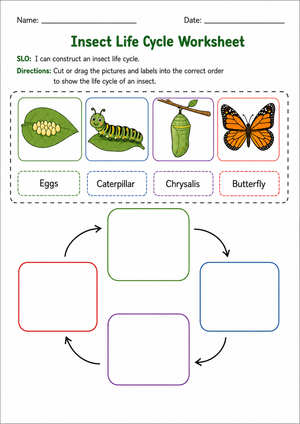
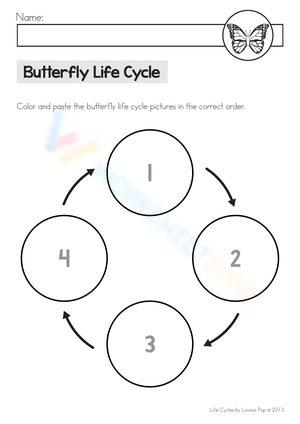
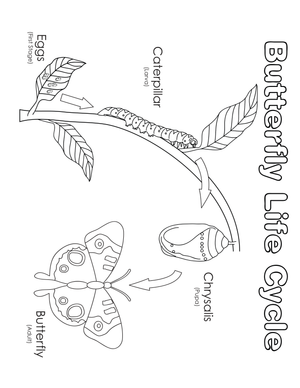
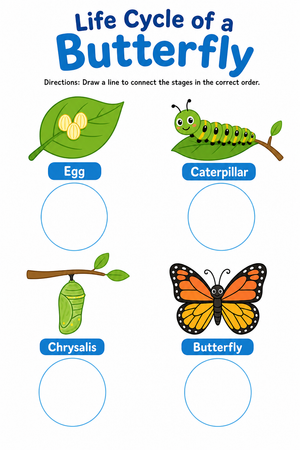
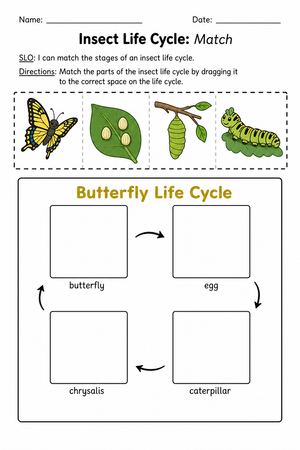
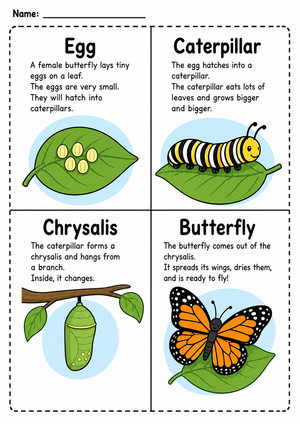
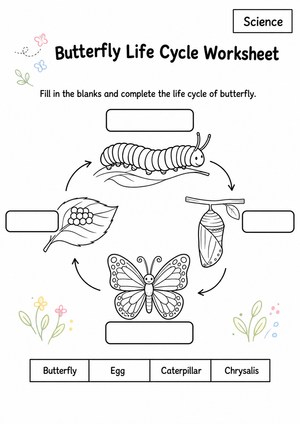
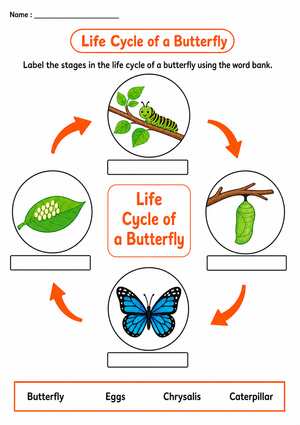
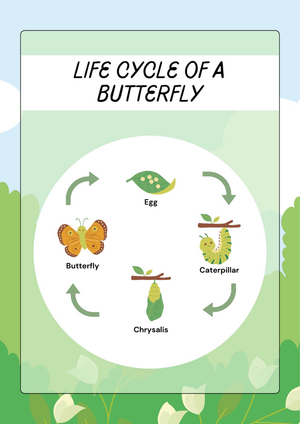
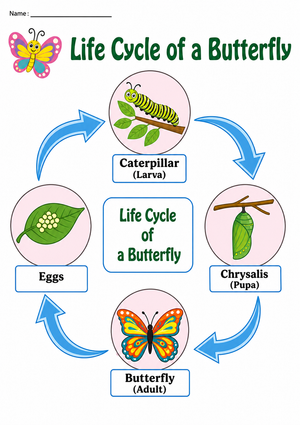
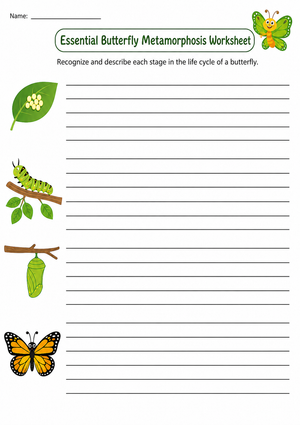
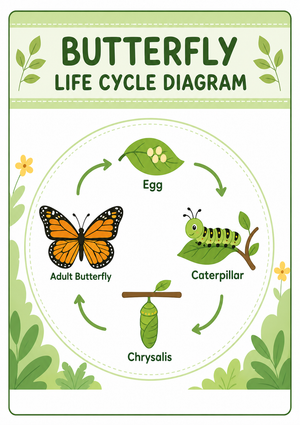
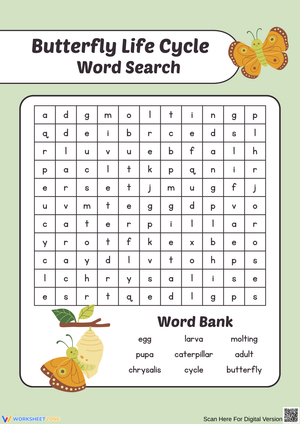
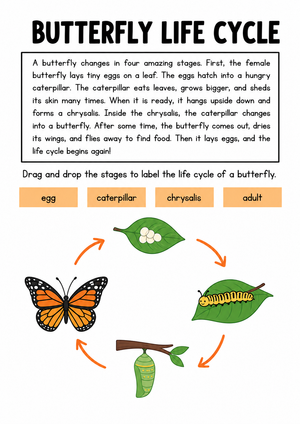
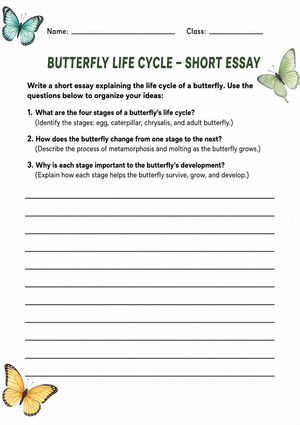
Butterflies go through complete metamorphosis, which means the young and adult forms look nothing alike and pass through four distinct stages: egg, larva, pupa, and adult. Strong worksheet sets label each stage clearly and ask students to connect specific behaviors or body changes to each one, rather than treating the cycle as a single generic loop. Most butterfly eggs hatch within four to five days, though some species can take up to three weeks, so if you are timing a worksheet sequence to a live classroom hatch, build in a flexible window rather than a fixed single day.
During the larva stage, the caterpillar does the bulk of its growing, and this is a detail worth pulling into a worksheet prompt or discussion question because students find it genuinely surprising.
Building Vocabulary With Labeling and Diagram Worksheets
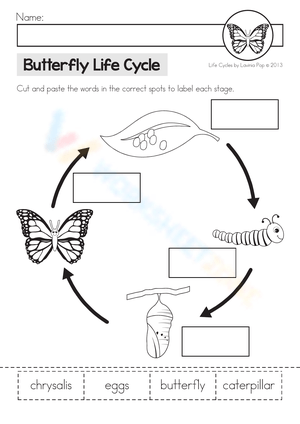
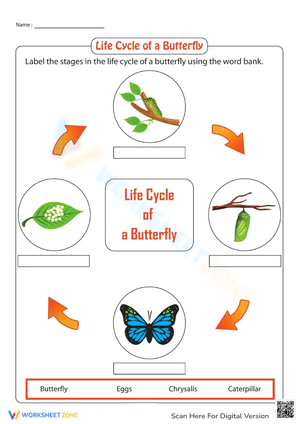
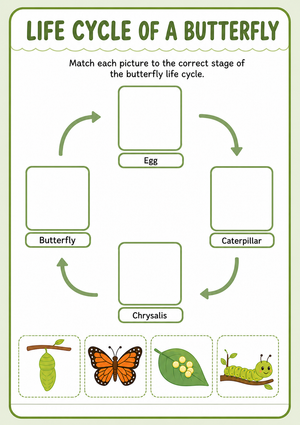
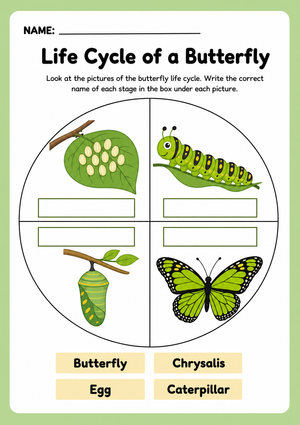
For early elementary students, labeling and coloring worksheets are the right entry point. A simple four-part diagram where students write egg, larva, pupa, and adult under each picture reinforces the sequence without asking for more reading or writing than a first or second grader can manage. Pair this with a word bank so students are matching vocabulary to images rather than generating spelling from scratch.
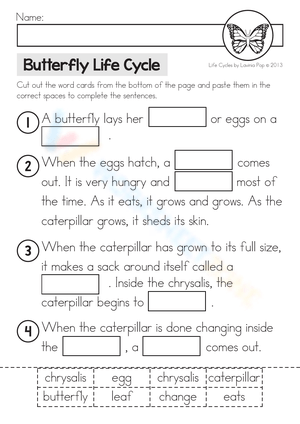
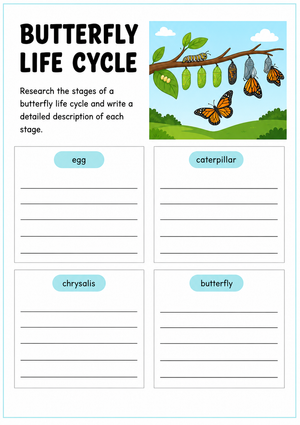
As students move into third and fourth grade, worksheets can ask for more independent labeling, short written descriptions of what happens at each stage, and simple cause-and-effect questions such as what has to happen before a caterpillar can become a chrysalis. This progression keeps the same core content accessible across a wider grade range while still building rigor.
Caterpillar Growth and Chrysalis Change: What to Highlight
Caterpillars can grow up to 100 times their original size during the larva stage, molting several times as their exoskeleton becomes too tight, and this is a strong candidate for a worksheet math or measurement extension where students track relative growth using simple ratios or drawings.
Inside the chrysalis, the caterpillar's body reorganizes into the structures of the adult butterfly. This stage is often the hardest for students to picture because nothing appears to be happening on the outside. A worksheet that asks students to predict what is happening inside the chrysalis before revealing the answer works well as a short formative check, since it surfaces misconceptions before you move on to the adult stage.
Sequencing and Sorting Activities for Review
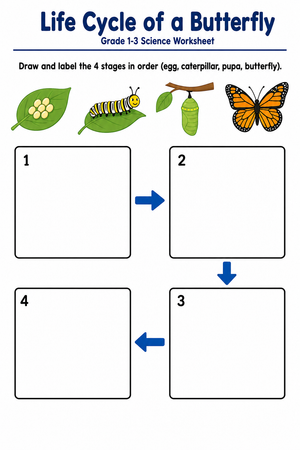
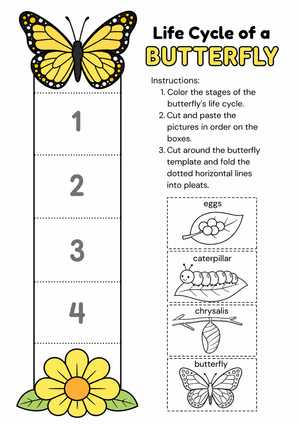
Once students know the four stages, sequencing worksheets are one of the most useful review formats you can hand out. Give students four unlabeled images and ask them to cut, sort, and glue them in order, then write one sentence describing what happens at each step. This format works equally well as a whole-class activity, an early-finisher task, or a small-group intervention station for students who need more repetition with the vocabulary and order.
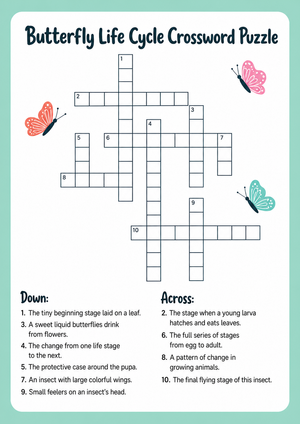
For upper elementary classes, you can extend sequencing worksheets into short constructed-response questions, such as asking students to explain why the pupa stage is necessary before an adult butterfly can emerge, or to compare the butterfly cycle with another insect's cycle they have studied.
Aligning Worksheets to NGSS 3-LS1-1
NGSS standard 3-LS1-1 asks students to develop models describing that organisms have unique life cycles with common stages of birth, growth, reproduction, and death. Butterfly life cycle worksheets that require students to build or complete a labeled diagram directly support this standard, since a completed diagram functions as the kind of model the standard describes. If your grade-level team is documenting standards alignment for a life science unit, a diagram-and-label worksheet paired with a short written explanation gives you a piece of student work that maps clearly to 3-LS1-1 for both instruction and assessment records.
According to entomology curriculum resources on insect life cycles, framing metamorphosis around observable, sequential stages helps young learners build accurate mental models before they encounter more abstract life science content in later grades. This kind of scaffolded sequencing is exactly what labeling and sorting worksheets are designed to reinforce.
Classroom Implementation
Start a butterfly life cycle unit with a pre-assessment worksheet that asks students to draw or label what they already know about how a caterpillar becomes a butterfly. This gives you a baseline and often reveals common misconceptions, such as the idea that the caterpillar simply grows wings rather than undergoing a full reorganization inside the chrysalis.
If you have access to a classroom butterfly kit or live caterpillars, pair daily observation journals with your worksheet set so students are recording real changes alongside the printed diagrams. On days without new visible changes, use a review or sequencing worksheet instead of a fresh observation entry to keep engagement high. For classes without live specimens, a set of photo-based diagram worksheets combined with a short video or read-aloud can substitute effectively for direct observation.
Use a final assessment worksheet that combines labeling, sequencing, and one short written response to check whether students can both identify the stages and explain the changes in their own words. This gives you a more complete picture of understanding than a labeling worksheet alone.
Frequently Asked Questions
1. What grade level are butterfly life cycle worksheets best suited for
These worksheets work well across grades 1 through 4. Early elementary students benefit most from labeling and coloring formats, while third and fourth graders can handle sequencing, cause-and-effect questions, and short written explanations tied to the same content.
2. How long does it take a caterpillar to become a butterfly in a classroom setting
Timing varies by species, but most butterfly eggs hatch within four to five days, and the full cycle from egg to adult commonly spans several weeks. Build flexibility into your worksheet and observation schedule rather than assuming a fixed number of days.
3. What are the four stages butterfly life cycle worksheets should cover
Worksheets should clearly label and explain the egg, larva (caterpillar), pupa (chrysalis), and adult stages, since these are the four stages of complete metamorphosis that make up the butterfly life cycle.
4. How can teachers use these worksheets for formative assessment or review
Sequencing and labeling worksheets make quick formative checks during a unit, while a combined labeling-plus-short-response worksheet works well as a final assessment. Both formats also double as small-group intervention tools for students who need extra repetition with the stages and vocabulary.












 Interactive Worksheet Maker
 Quiz Maker
 Word Search Maker
 Crossword Puzzle Maker
 Word Scramble Generator
 Sentence Scramble Generator
 Handwriting Worksheet Generator
 Name Tracing Generator
 Fill In The Blank Generator