




























Views
Downloads

Grade 1 Butterfly Life Cycle — Printable No-Prep Worksheet

Paste this activity's link or code into your existing LMS (Google Classroom, Canvas, Teams, Schoology, Moodle, etc.).
Students can open and work on the activity right away, with no student login required.
You'll still be able to track student progress and results from your teacher account.
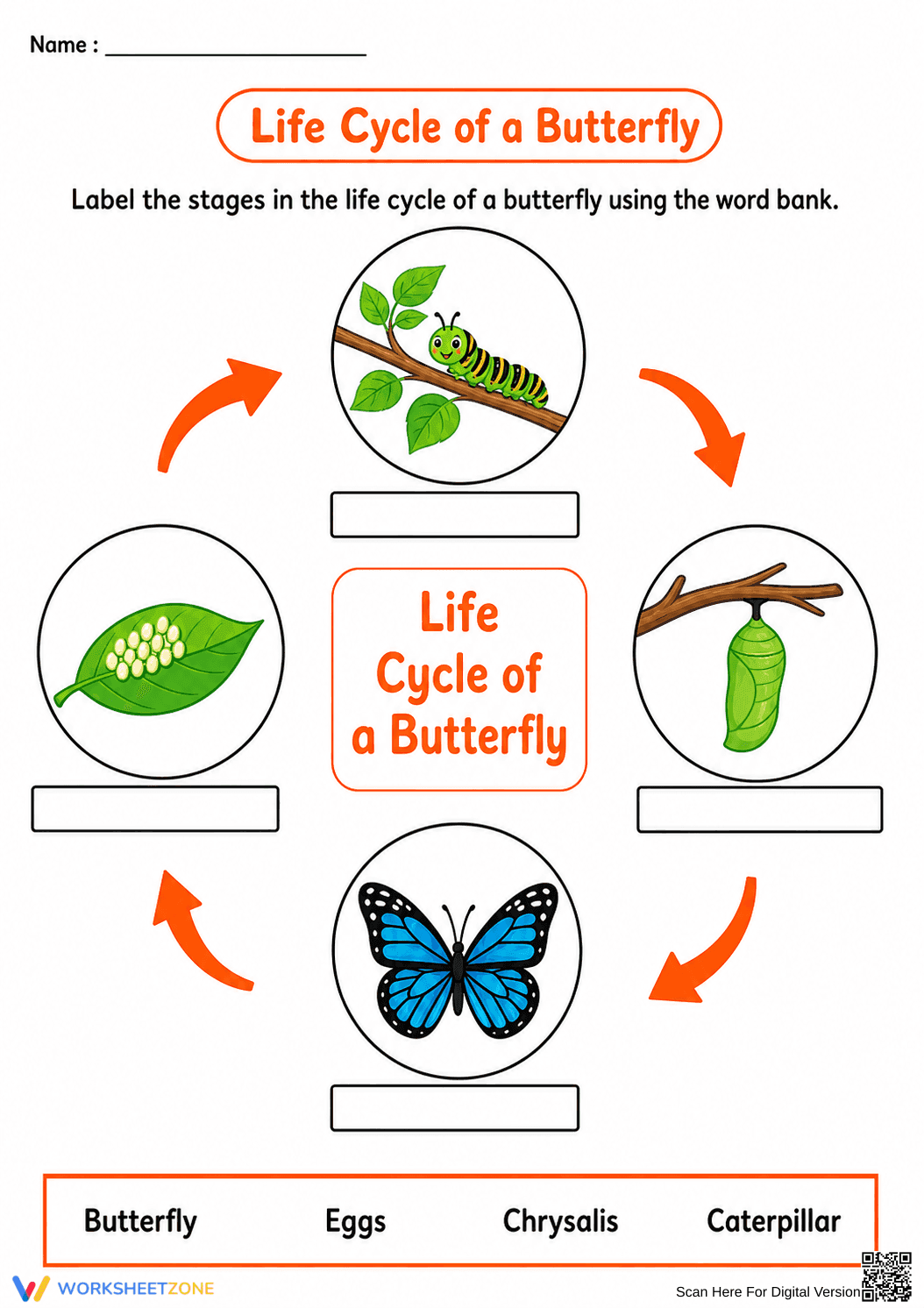
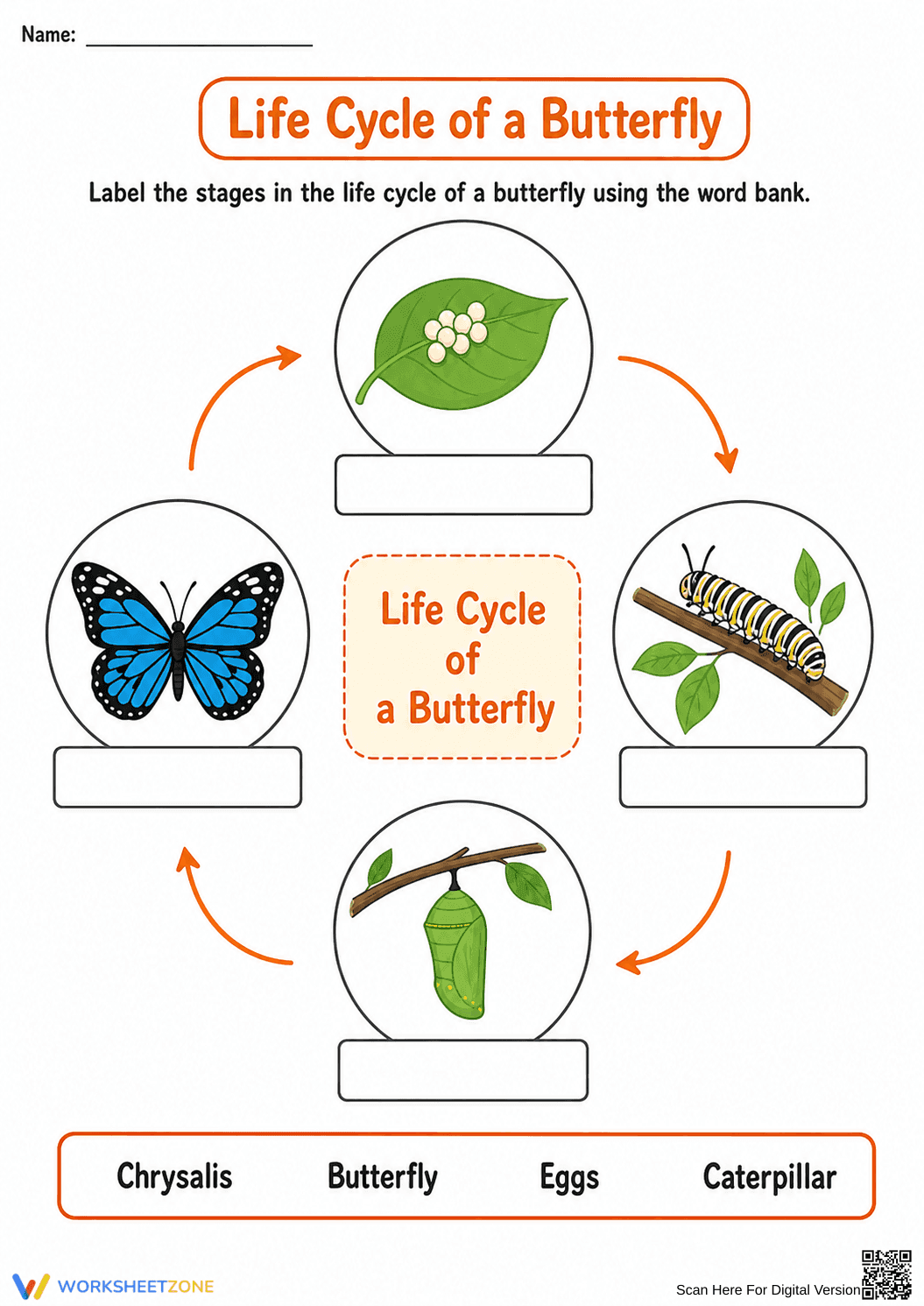
This Grade 1 science worksheet helps learners master the metamorphic stages of a butterfly through clear visual cues. By identifying the four distinct phases—eggs, caterpillar, chrysalis, and butterfly—students build a foundational understanding of biological development. It is an essential resource for any life science unit focusing on how living things grow and change over time.
At a Glance
- Grade: 1 · Subject: Living Things
- Standard:
1-LS1-1— Use observations of animal parts to understand how they survive and grow- Skill Focus: Metamorphosis stages labeling
- Format: 1 page · 4 problems · Answer key included · PDF
- Best For: Independent practice, homework, or a quick formative assessment
- Time: 10–15 minutes
What's Inside
This single-page PDF includes a high-quality illustration of the butterfly life cycle arranged in a clockwise diagram. Students are provided with four empty label boxes and a corresponding word bank containing the terms: Butterfly, Eggs, Chrysalis, and Caterpillar. A full-color answer key is also included to facilitate immediate feedback or self-grading, ensuring a streamlined instructional experience for busy educators.
Zero-Prep Workflow
This resource is designed for maximum efficiency in the modern classroom. Simply print the single worksheet (1 minute), distribute it to students as a bell-ringer or independent activity (30 seconds), and review the correct labels using the provided answer key (30 seconds). Total teacher preparation time is well under two minutes, making it an ideal choice for sub plans or spontaneous review sessions.
Standards Alignment
This worksheet aligns with `1-LS1-1`: Use materials to design a solution to a human problem by mimicking how plants and/or animals use their external parts to help them survive, grow, and meet their needs. Supporting standard `CCSS.ELA-LITERACY.RI.1.7` is also addressed as students use illustrations to describe key ideas. Both standard codes can be copied directly into lesson plans, IEP goals, or district curriculum mapping tools.
How to Use It
Deploy this worksheet during the 'Explain' or 'Elaborate' phase of a 5E lesson model after observing live specimens. As a formative assessment tip, observe if students correctly sequence stages from egg to butterfly. It is most effective as a 12-minute quiet practice session to solidify vocabulary and conceptual understanding of growth patterns before moving to more complex biological comparisons.
Who It's For
Primary students in Grade 1 will find the clear illustrations and word bank highly accessible, regardless of their reading level. It serves as an excellent differentiation tool for English Language Learners (ELLs) who benefit from visual-to-word matching. Pair this resource with a classroom observation of a butterfly kit or a mentor text for a comprehensive learning experience that bridges visual and textual information.
According to the RAND AIRS 2024 report on early science education, visual modeling and labeling tasks significantly improve long-term retention of biological concepts in primary students. This worksheet targets the core requirement of understanding life cycles by providing a structured environment for students to interact with metamorphosis. By engaging with the 1-LS1-1 standard, students move beyond simple observation toward an analytical understanding of how living things transform. Research from ScienceDirect TpT Analysis suggests that zero-prep, diagram-based activities reduce cognitive load, allowing Grade 1 learners to focus specifically on identifying the four stages. This evidence-based approach ensures that labeling eggs, caterpillar, chrysalis, and butterfly is a meaningful step toward scientific literacy. By providing a clear word bank and high-quality illustrations, this resource supports the mastery of life science foundations for all learners. This printable resource is ready for immediate classroom use and provides measurable data on student progress.


