Wasp Printable Worksheets for Science Lessons
These wasp printable worksheets give science teachers a focused set of activities covering insect anatomy, complete metamorphosis, species behavior, and ecological function — the four content areas that anchor a solid insect biology unit. Each worksheet is a standalone activity, so a teacher working with a compressed schedule can pull a single piece without committing to a full sequence.
The Specific Skills These Worksheets Build
Four content areas anchor the set. The anatomy worksheets ask students to label a dorsal-view diagram at two levels: first the three main body sections — head, thorax, abdomen — then a second pass identifying compound eyes, antennae, forewing, hindwing, and, on the female diagram, the stinger. A written-response prompt asks students to explain the function of the petiole, the narrow waist segment that is one of the clearest physical distinctions between wasps and bees.
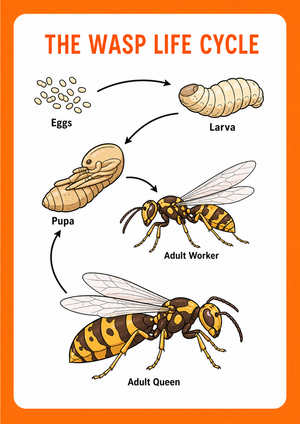
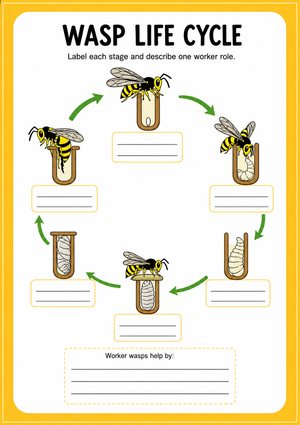
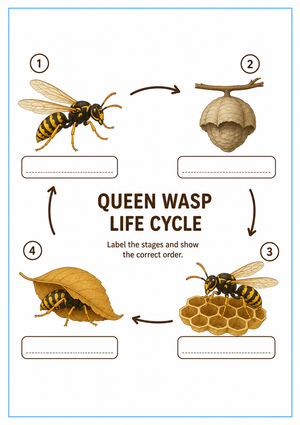
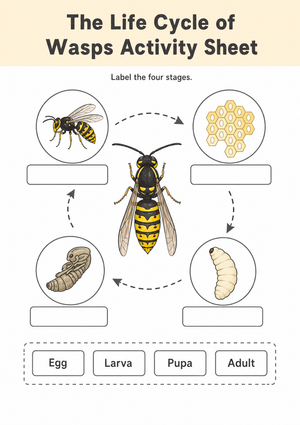
The life cycle worksheet uses a sequencing-and-describe format: students arrange four labeled images in order — egg, larva, pupa, adult — and write one explanatory sentence per stage. The social-versus-solitary worksheet builds a guided Venn diagram contrasting yellowjacket colony structure with the independent nesting behavior of mud daubers and cicada killers. The ecology worksheet pairs a short informational passage on wasp predation and incidental pollination with text-dependent questions that require students to cite sentence-level evidence before drawing any conclusions.
Student Errors Worth Watching For and Correcting
Two anatomy errors show up in student work with enough regularity to warrant a heads-up. Even after students correctly label the thorax as the leg-bearing segment, they place all six legs on the abdomen in their own sketches — a habit carried over from earlier insect drawings where the body segments looked less distinct. The diagram counters this directly by marking each leg's attachment point on the thorax, and the included answer key flags the error explicitly. The more consequential mistake involves terminology: students call the pupal stage a "cocoon," importing the word from butterfly and moth units. Cocoons are silk structures produced by moth larvae; wasp pupae develop inside a paper cell within the nest wall. The life cycle worksheet addresses this with a vocabulary sidebar that draws the contrast between the two terms, because students who carry the confusion into unit assessments lose points unnecessarily.
The wasp printable worksheets surface a third error pattern on the ecology piece — students write that wasps "help the environment by eating insects," treating predation and pollination as one undifferentiated benefit. The text-dependent questions separate these functions deliberately, requiring a cited sentence for each, which pushes students toward precise reading rather than loose paraphrase.
Lesson-Planning Strategies for Getting the Most From These Worksheets
The anatomy worksheet works best as a first-encounter activity, not a review. Run it on the day students are introduced to the insect body plan, and open with a short video clip — two to three minutes of live wasp footage showing the wings in motion. Students who have watched the hindwings fold beneath the forewings are significantly more accurate on the diagram than students working from a static image alone. That combined sequence fits cleanly into the first twenty minutes of a standard period.
Spacing the activities across the week produces stronger retention than running them back to back. Introducing the life cycle worksheet on Monday, the social-versus-solitary comparison on Wednesday, and the ecology piece on Friday creates three low-stakes retrieval moments across the same instruction block. That spacing applies the principle of distributed practice — material encountered across separate sessions is remembered longer than material massed in a single day. The wasp printable worksheets are sized specifically for this kind of mid-lesson insertion: each one accomplishes its learning target without running over, which makes fitting them into a week of instruction practical rather than aspirational.
Standard Alignment
The life cycle and anatomy worksheets address NGSS LS1.B: Growth and Development of Organisms, the standard that appears across grades 3–6 and asks students to construct explanations for how organisms develop and change over their life spans. The sequencing-and-describe format on the life cycle worksheet directly mirrors the performance expectation: students observe, order, and explain — three operations LS1.B requires explicitly. The ecology and species-comparison worksheets connect to LS2.A: Interdependent Relationships in Ecosystems, which in most state frameworks becomes a formally assessed standard in grades 5 and 6. Teachers at those grades building toward the LS2.A benchmark will find the ecology worksheet useful as a formative check on whether students can articulate one organism's role before the summative task asks them to construct a full food web.
Adjusting the Set for a Range of Learners
For students who need additional entry-level support, the anatomy worksheet with a word bank is the most accessible starting point — it removes the retrieval demand and lets students concentrate on spatial reasoning and vocabulary matching. Adding a physical step before the worksheet helps further: have students build a three-section wasp body from construction paper, assembling the head, thorax, and abdomen separately before labeling. That hands-on pre-activity reduces cognitive load without reducing the academic content of the labeling task. When differentiating the wasp printable worksheets for advanced students, the most effective modification to the ecology worksheet is removing the word bank and requiring a synthesizing paragraph that connects predation, pollination, and food web placement using only the passage as a source. That version turns a comprehension exercise into a short analytical writing task — appropriate for students who complete the standard version well inside ten minutes.
Frequently Asked Questions
Do these worksheets work within a broader insects unit, or only a wasp-specific lesson?
Each worksheet is designed around wasp biology specifically, but the anatomy and life cycle activities transfer naturally to any complete-metamorphosis insect. Teachers running a full insects unit often use the wasp materials alongside bee and butterfly equivalents, pointing to the anatomy worksheet as a model for how the same three-segment body plan appears across species. The social-versus-solitary comparison worksheet is unique to wasps and does not extend to broader insect comparisons without modification.
What grade levels are these worksheets written for?
The reading level and task complexity across the set target grades 3–6. The anatomy labeling worksheet is accessible at grade 3 with vocabulary support; the ecology reading and response worksheet assumes the inference skills typically developed by grades 5 and 6. Most teachers in grades 4 and 5 can use the full set without modification. Third-grade teachers may want to read the ecology passage aloud before students work independently.
Are answer keys included?
Every worksheet in the set includes a full answer key. The anatomy key annotates the two most common labeling errors — leg placement on the abdomen and confusion between forewing and hindwing — so teachers reviewing student work know exactly where to look rather than grading cold.
Can individual worksheets serve as assessments, or are they practice tools only?
The text-dependent questions on the ecology worksheet and the written-response prompt on the anatomy worksheet both produce scorable written evidence of student understanding. Teachers have used both as embedded formative assessments without modification. The life cycle sequencing activity and the Venn diagram are better suited to guided practice or partner work — the constrained format tells you less about student reasoning than the open-response items do.
Clear All