Dragonfly Life Cycle PDF Worksheets for Science Teachers
These dragonfly life cycle pdf worksheets give elementary science teachers a focused set of print-ready activities built around incomplete metamorphosis — a concept that reliably trips students up because it breaks the four-stage butterfly pattern most of them carry from earlier units. Each worksheet targets a specific stage or skill, so teachers can pull one for a Monday warm-up or sequence the full set across a two-week unit without gaps.
What's Inside the Set
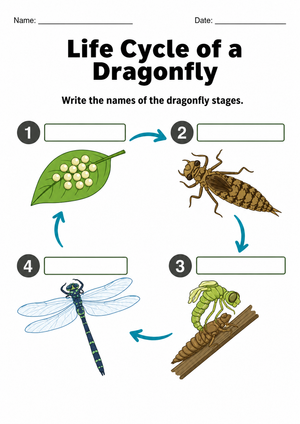
The worksheets cover the three life stages — egg, nymph, and adult — through task formats matched to what each stage demands from students:
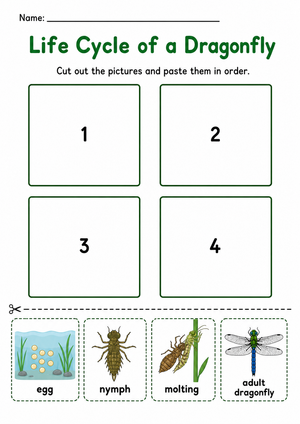
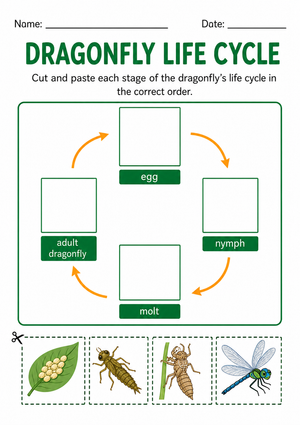
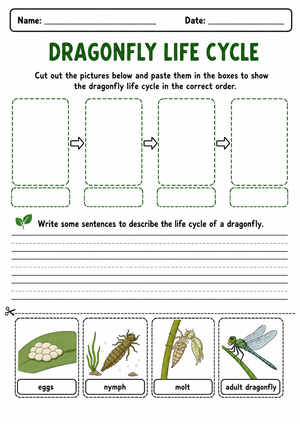
- Cut-and-paste sequencing: Students arrange illustrated stage cards in chronological order. This tactile format works well in grades 2–3 because physically manipulating pieces reduces the reading demands during initial instruction.
- Anatomy labeling: Separate diagrams for the aquatic nymph and the winged adult ask students to identify structures including the extensible lower jaw (labium), abdominal gills, and wing venation.
- Venn diagram comparison: Students sort characteristics — habitat, breathing method, diet, locomotion — between the nymph and adult stages on a single graphic organizer.
- Reading comprehension passages: Short informational texts on the nymph stage and the egg-to-adult transition, each followed by text-dependent questions that serve double duty as literacy practice.
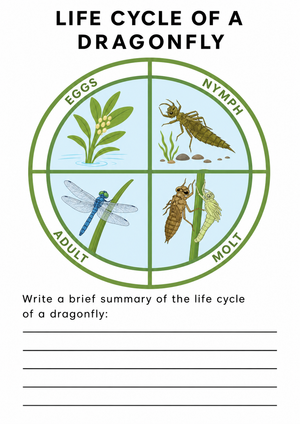
- Life cycle wheel: A circular organizer students complete to reinforce that the cycle repeats rather than ends at the adult stage.
Why the Three-Stage Model Deserves Its Own Unit
Dragonflies undergo hemimetabolous development — no pupal stage, no chrysalis, no wholesale reorganization of body structures inside a protective casing. The nymph that hatches from the egg is anatomically recognizable as a juvenile insect, not a larva with a radically different body plan. That distinction is exactly why dragonflies belong in a life cycles unit: they force students to revise prior knowledge rather than simply add to it. Cognitive revision is harder than addition, and the work of unlearning "all insects have four stages" builds more durable understanding of biological diversity than a second butterfly example would.
The nymph stage carries most of the instructional weight. Students are consistently surprised that the longest phase of the dragonfly's life — anywhere from several months to five years depending on species and water temperature — happens entirely underwater. A dragonfly nymph molts 8 to 17 times as it grows, each molt driven by the exoskeleton becoming too tight to accommodate further growth. That model of incremental, gradual change gives students a developmental framework that extends far beyond dragonflies.
Predictable Student Errors and the Misconceptions Behind Them
The most predictable error: students insert a pupal stage between the nymph and adult. The butterfly life cycle is almost always taught before the dragonfly, and the four-stage sequence gets encoded as the rule for all insects. When asked to sketch the dragonfly cycle from memory before seeing any labeled diagram, a notable share of students draw a chrysalis-like structure between the nymph and adult — even when the prompt explicitly states three stages. A sticky-note pre-sketch at the start of the lesson surfaces this misconception before it hardens, and the sequencing worksheet gives teachers a written record of exactly who needed the correction.
A subtler error shows up in the Venn diagram work. Students frequently place "active predator" only in the adult column, overlooking that dragonfly nymphs are aggressive aquatic hunters that catch mosquito larvae, tadpoles, and small fish using a hinged jaw that extends faster than prey can respond. This conflation of predatory behavior with flight leads students to underestimate the nymph stage's ecological significance. The anatomy labeling worksheet for the nymph — which isolates the labium and asks students to explain its function — directly addresses that gap.
Fitting These Worksheets Into Your Instructional Week
A strong entry point is using the cut-and-paste sequencing worksheet as a pre-assessment on day one, before any direct instruction. Students who correctly order egg, nymph, and adult have likely encountered the content before; those who insert a pupal stage or reverse the final two stages show exactly where the unit needs to slow down. The data costs only the first eight minutes of class. From there, the reading passage on the nymph stage pairs naturally with the anatomy labeling worksheet in the same block — students read first, then label, so the text provides context that makes the diagram readable rather than abstract.
The dragonfly life cycle pdf worksheets also integrate smoothly into science notebooks. Students glue the completed sequencing wheel and labeled diagrams onto facing pages, creating a reference they can return to when the class later compares hemimetabolous and holometabolous insects. The comparative Venn diagram works well as an exit ticket at the end of the lesson introducing the butterfly-versus-dragonfly distinction — it yields immediate formative data before the next session without requiring separate graded work.
Using These Worksheets With Students at Different Readiness Levels
For students in grades 2–3 who are still building reading stamina, the cut-and-paste sequencing and life cycle wheel worksheets stand on their own without the reading passages. Pairing those visual-first activities with a teacher read-aloud of the informational text keeps the science content accessible while preserving the conceptual challenge — students demonstrate understanding of stage sequence without being blocked by text complexity.
Students who move through the core worksheets quickly can extend their work by annotating the nymph diagram with molt-count labels and writing a hypothesis for why that number varies between species. A further extension — researching a second hemimetabolous insect such as a grasshopper or praying mantis and sketching its life cycle alongside the dragonfly's — builds genuine comparative biology skills. The dragonfly life cycle pdf worksheets serve as the anchor for that comparison, giving advanced students detailed reference material rather than requiring them to start from scratch.
Standard Alignment
These worksheets align most directly with NGSS 3-LS1-1, which asks students to develop models describing that organisms have unique and diverse life cycles sharing common features: birth, growth, reproduction, and death. In classroom terms, the life cycle wheel and sequencing activities are the model-building that standard calls for — students construct a representation of a biological process rather than merely reading about one. The comparative Venn diagram supports the "diverse life cycles" component by placing the dragonfly's three-stage development alongside the butterfly's four-stage cycle in a single visual field. Teachers in earlier grades may find additional alignment with NGSS 2-LS4-1, which covers observing and comparing the diversity of life in different habitats — the contrast between the nymph's fully aquatic environment and the adult's aerial range makes that standard concrete and measurable.
Frequently Asked Questions
Do these worksheets work for both second and fourth grade, or are they written for one specific level?
The set spans a range. The cut-and-paste sequencing and life cycle wheel worksheets are appropriate for grades 2–3, while the anatomy labeling sheets and reading comprehension passages are written at a grade 3–4 reading level. Teachers in mixed-readiness classrooms typically assign the sequencing and wheel to the full group, then direct students to the labeling and reading tasks based on readiness. The dragonfly life cycle pdf worksheets are built for selective use — assigning every worksheet in every lesson is neither necessary nor intended.
Do the worksheets use the term "naiad" or just "nymph"?
Both terms appear. Naiad is the more precise biological term for an aquatic insect nymph, and the first time it appears in any reading passage it is introduced alongside nymph in context. Students meet the technical vocabulary without needing a separate word-study lesson, and teachers who want to deepen science vocabulary have the term already embedded in the materials.
How long does each worksheet take to complete during class?
The cut-and-paste sequencing worksheet runs about 10–12 minutes with a brief introduction. Anatomy labeling sheets typically take 15–20 minutes, longer when students annotate independently without a word bank. The reading comprehension passage with questions runs 20–25 minutes for most third graders. These estimates assume at least one prior introductory lesson on the topic; using any worksheet cold, without earlier instruction, adds roughly 5–8 minutes for orientation.
Clear All