Mealworms are the larval stage of the darkling beetle, Tenebrio molitor, and they move through four distinct stages that students can observe directly rather than only reading about in a textbook. That combination of accurate content and a living organism makes this topic a natural fit for grades 2-5 classrooms that are building toward standards-aligned understanding of animal life cycles.
Worksheets built around this topic let you pair a hands-on rearing station with structured recording tasks, so students are not just watching mealworms wriggle around a bin. They are labeling diagrams, sequencing stages, and logging observations tied to specific vocabulary. That structure turns a fun classroom pet situation into a documented science practice.
The Four Stages Every Worksheet Should Cover
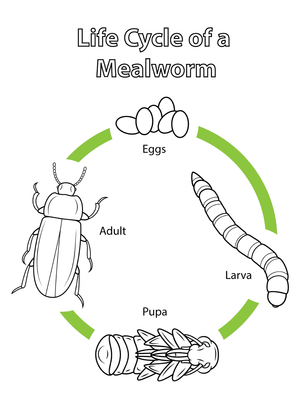
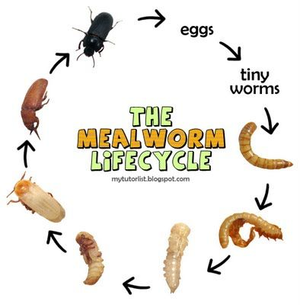
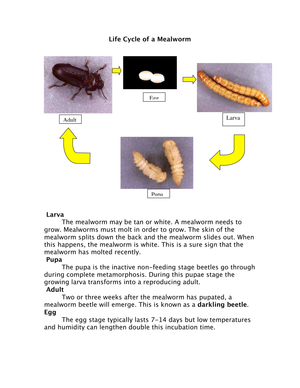
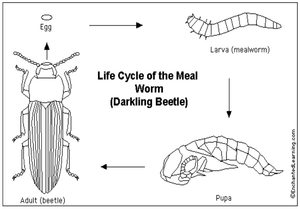
Complete metamorphosis in mealworms includes egg, larva, pupa, and adult beetle stages, and each one has distinct visual and behavioral markers worth building into your worksheet sequence.
- Egg: dust-speck sized and easy to miss without magnification, hatching in about 1-4 weeks.
- Larva (the mealworm itself): the longest stage, lasting roughly 8-10 weeks, during which the larva molts 10-20 times and grows to about 2-3.5 cm long.
- Pupa: a white, non-feeding, alien-looking stage lasting about 1-3 weeks while internal organs reorganize into adult form.
- Adult darkling beetle: lives about 1-3 months, with an exoskeleton that hardens and darkens from white to brown to black; it has wings but does not fly.
One detail that surprises many students and teachers alike is how much stage timing can shift based on environment. According to mealwormcare.org, the pace of development through all four stages depends heavily on temperature, humidity, and food and water availability, which means two mealworm bins started on the same day can reach the pupa or adult stage at noticeably different times. This variability is worth naming explicitly on a worksheet or observation log so students do not assume their timeline should match a printed textbook figure exactly.
Matching Worksheet Complexity to Grade Band
Not every classroom needs the same worksheet. Younger students benefit from simpler formats, while older students can handle more data-driven tasks.
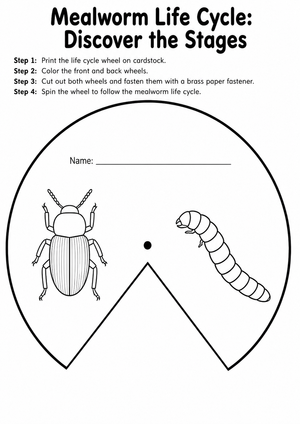
For grades K-2, favor sequencing cards, coloring pages of each stage, and simple matching activities that reinforce the order egg to larva to pupa to adult. Keep vocabulary limited to a handful of core terms and rely on visuals more than text.
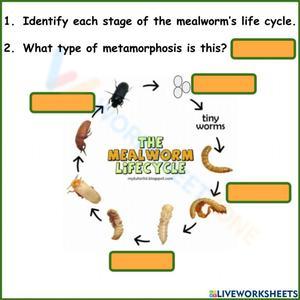
For grades 3-5, worksheets can shift toward labeled diagrams, short written observations, and basic data recording, such as noting molt counts or measuring approximate larva length over several weeks. This age group can also handle comparison tasks, like contrasting the mealworm cycle with another classroom insect.
Building a Multi-Week Mealworm Observation Journal
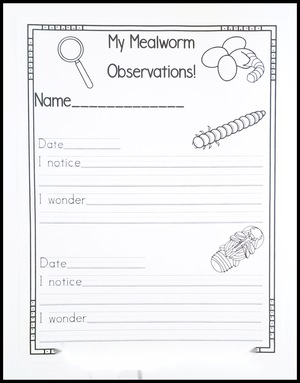
Because the larva stage alone runs 8-10 weeks, mealworms are well suited to a longer observation journal rather than a single-day activity. A simple weekly worksheet template can ask students to record what they see, sketch the current stage, and note any changes in size or color. Over a full cycle, egg to adult can span roughly 3-6 months depending on conditions, so setting that expectation with students up front helps avoid frustration if a mealworm bin seems to progress slowly some weeks.
This kind of ongoing log also supports formative assessment. You can check journals periodically for accurate use of vocabulary like larva, pupa, molt, and exoskeleton, and get a read on which students are confusing stage order or terminology well before a summative test.
Frequently Asked Questions
1. How long does the full mealworm life cycle take from egg to adult beetle?
The full cycle typically spans roughly 3-6 months, though exact timing depends on temperature, humidity, and food and water availability in the rearing container.
2. What is the difference between a mealworm larva and the adult darkling beetle?
The mealworm is the larval stage, a segmented, worm-like form that feeds and molts repeatedly over about 8-10 weeks. The adult darkling beetle emerges after pupation, has a hardened exoskeleton that darkens over time, and possesses wings, though it does not fly.
3. How can teachers safely set up a classroom mealworm observation station?
A basic bin with wheat bran or oat flakes for food and bedding, a small piece of potato or carrot for moisture, and a stable room-temperature spot away from direct sun is generally enough to support a mealworm colony through all four stages.
4. What grade levels are mealworm life cycle worksheets best suited for?
These worksheets work well across grades K-5, with simpler sequencing and coloring tasks for K-2 and more detailed labeling, vocabulary, and data recording tasks for grades 3-5.
5. How does mealworm metamorphosis compare to other classroom insect life cycles like butterflies?
Mealworms and butterflies both undergo complete metamorphosis with egg, larva, pupa, and adult stages, but the specific durations, appearance, and adult abilities, such as flight, differ, making them a useful side-by-side comparison for reinforcing the broader concept of complete metamorphosis.












 Interactive Worksheet Maker
 Quiz Maker
 Word Search Maker
 Crossword Puzzle Maker
 Word Scramble Generator
 Sentence Scramble Generator
 Handwriting Worksheet Generator
 Name Tracing Generator
 Fill In The Blank Generator