




























Views
Downloads

Butterfly Life Cycle Worksheet | Grade 2 Essential

Paste this activity's link or code into your existing LMS (Google Classroom, Canvas, Teams, Schoology, Moodle, etc.).
Students can open and work on the activity right away, with no student login required.
You'll still be able to track student progress and results from your teacher account.
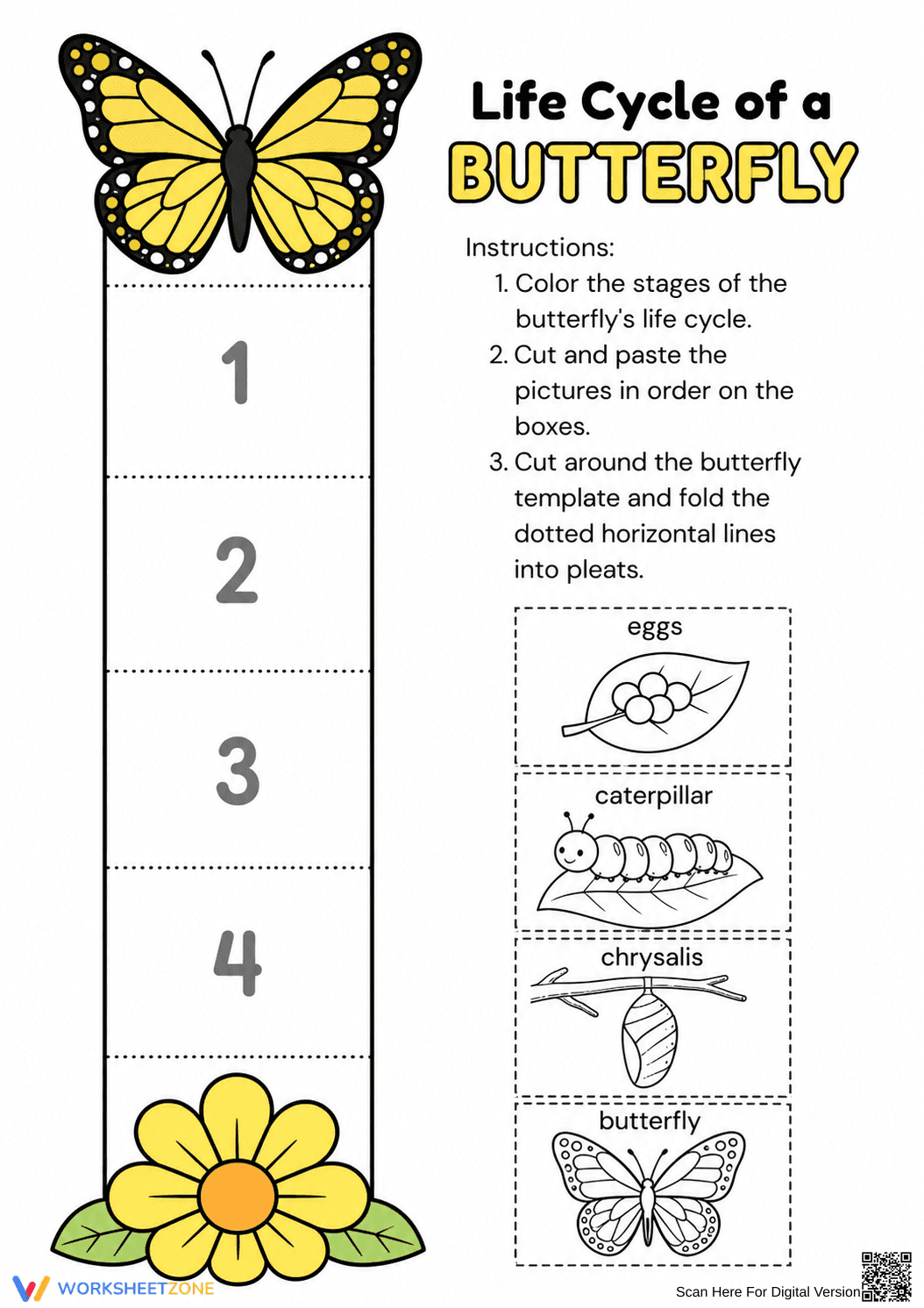
This interactive butterfly life cycle worksheet helps students master the four stages of metamorphosis through a tactile cut-and-paste activity. By arranging the egg, caterpillar, chrysalis, and adult butterfly stages, learners develop a concrete understanding of biological growth and development. This resource transforms abstract science concepts into a memorable, hands-on learning experience.
At a Glance
- Grade: 2 · Subject: Science
- Standard:
3-LS1-1— Develop models to describe that organisms have unique and diverse life cycles- Skill Focus: Metamorphosis sequencing
- Format: 1 page · 4 stages · Activity-based · PDF
- Best For: Science centers and independent practice
- Time: 20–30 minutes
What's Inside
This single-page PDF features a vertical sequencing strip and four distinct illustrated stages: eggs on a leaf, a caterpillar, a chrysalis, and a monarch butterfly. The worksheet includes clear, numbered instructions for coloring, cutting, and pasting. A unique folding component allows students to create a pleated accordion effect, adding a 3D element to their science notebooks or classroom displays.
Zero-Prep Workflow
- Print: Generate the required number of copies for your class in under 30 seconds.
- Distribute: Hand out the sheets along with basic supplies like scissors, glue, and crayons.
- Review: Provide a brief overview of the four stages before allowing students to work independently.
Total teacher preparation time is under 3 minutes, making it an ideal choice for busy mornings or emergency sub plans.
Standards Alignment
The primary alignment is `3-LS1-1`, which requires students to develop models to describe that organisms have unique and diverse life cycles but all have in common birth, growth, reproduction, and death. This worksheet serves as a physical model of the growth and development phase of an insect. Both standard codes can be copied directly into lesson plans, IEP goals, or district curriculum mapping tools.
How to Use It
Use this activity as a formative assessment after a read-aloud about butterflies to check for sequencing accuracy. Alternatively, place it in a science center during a unit on insects. Teachers should observe whether students correctly identify the chrysalis as the stage following the caterpillar. Expect students to spend approximately 25 minutes completing the coloring and assembly.
Who It's For
This activity is tailored for first through third-grade students, particularly those who benefit from kinesthetic learning. It provides excellent support for English Language Learners (ELLs) by using visual cues for scientific vocabulary. It pairs naturally with a classroom butterfly kit or an anchor chart detailing the stages of metamorphosis.
According to the RAND AIRS 2024 report on elementary science instruction, tactile modeling of biological processes significantly increases long-term retention of life science concepts in early childhood education. This worksheet aligns with the 3-LS1-1 standard by providing a structured framework for students to visualize the four stages of a butterfly's life cycle: egg, larva (caterpillar), pupa (chrysalis), and adult. By engaging in the physical act of sequencing and folding, students move beyond rote memorization toward a conceptual understanding of metamorphosis. Research from Fisher & Frey (2014) emphasizes that doing science through models bridges the gap between observation and explanation. This resource offers a high-utility, low-barrier entry point for Grade 1-3 learners to explore the complexities of nature through a simplified, accurate biological model that meets rigorous state and national science frameworks.


