




























Views
Downloads
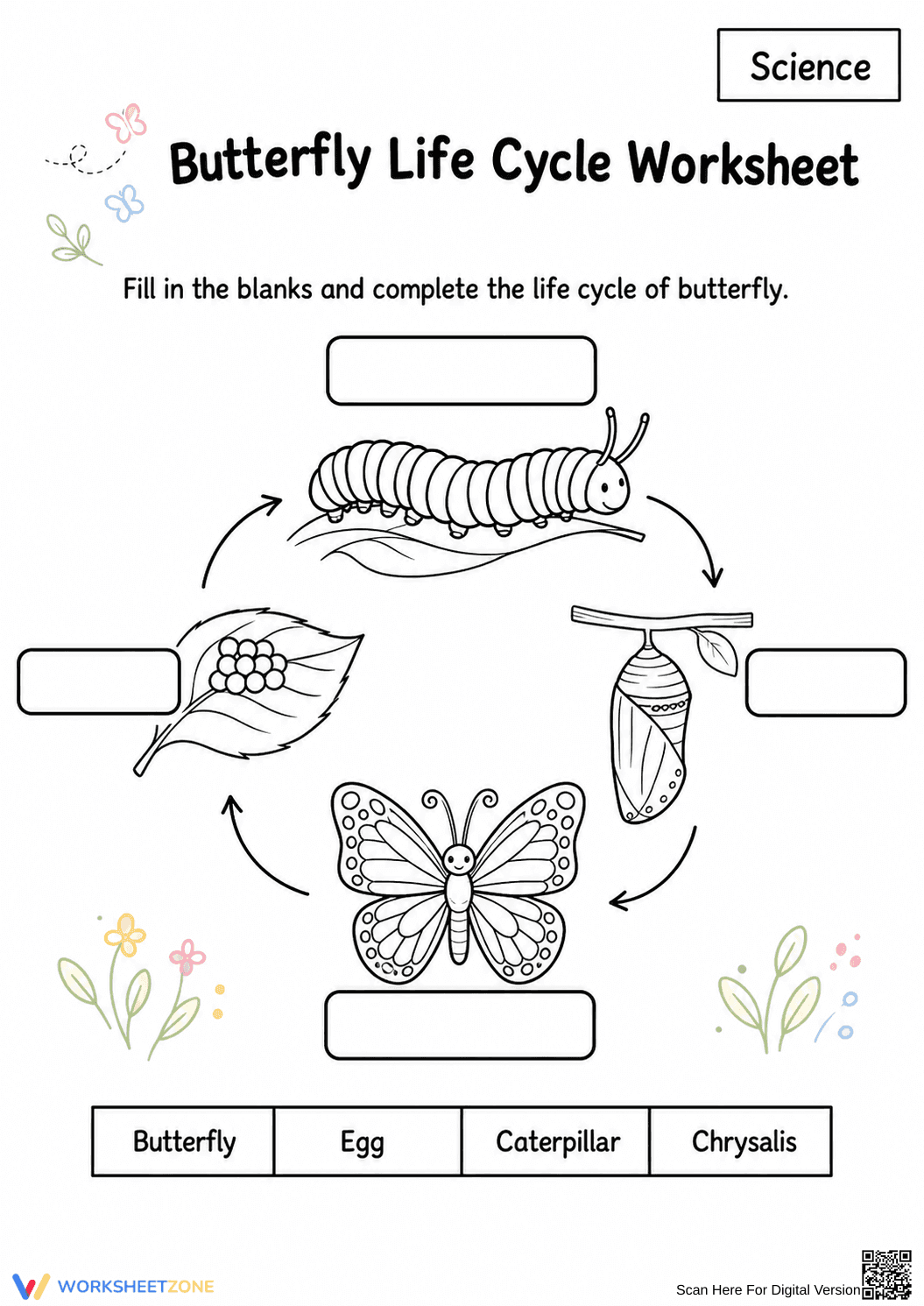

Butterfly Life Cycle Worksheet | Grade 6 Essential

Paste this activity's link or code into your existing LMS (Google Classroom, Canvas, Teams, Schoology, Moodle, etc.).
Students can open and work on the activity right away, with no student login required.
You'll still be able to track student progress and results from your teacher account.
This Grade 6 butterfly life cycle worksheet provides a visual framework for students to identify the stages of insect metamorphosis. By labeling the egg, caterpillar, chrysalis, and adult stages, learners demonstrate understanding of how organisms develop. This resource is designed for immediate classroom application to reinforce foundational life science concepts and vocabulary.
At a Glance
- Grade: 6 · Subject: Science
- Standard:
MS-LS1-4— Use evidence to support how animal behaviors and structures affect reproduction- Skill Focus: Insect Metamorphosis
- Format: 1 page · 4 problems · Answer key included · PDF
- Best For: Quick formative assessment or review
- Time: 10–15 minutes
The worksheet features a cyclical diagram illustrating the four stages of a butterfly's life. It includes four fill-in-the-blank spaces and a word bank containing "Butterfly," "Egg," "Caterpillar," and "Chrysalis." This one-page PDF is self-explanatory, making it an ideal tool for independent practice or a quick check for understanding during a biology unit.
Zero-Prep Workflow
- Step 1: Print the single-page PDF (30 seconds).
- Step 2: Distribute to students as a warm-up or exit ticket (1 minute).
- Step 3: Review the four stages using the provided answer key to check for understanding (5 minutes).
Total teacher prep time is under 2 minutes, making this an excellent option for sub plans or transition periods.
Standards Alignment
Primary Standard: MS-LS1-4 — Use evidence to support the explanation of how characteristic animal behaviors and specialized plant structures affect the probability of successful reproduction. This worksheet provides the prerequisite knowledge for understanding how developmental phases contribute to reproductive success. Both standard codes can be copied directly into lesson plans, IEP goals, or district curriculum mapping tools.
How to Use It
Use this as a formative assessment after a lesson on metamorphosis to gauge retention. It also functions as a "Do Now" activity to activate prior knowledge. Teachers should observe if students correctly sequence the transition from larva to pupa, which usually requires 10 to 15 minutes of focused work. This allows for immediate feedback on biological sequencing skills.
Who It's For
This resource is for Grade 6 students requiring a visual review of life cycles. It is helpful for English Language Learners and students with IEPs who benefit from the word bank and pictorial representations. Pair this with a time-lapse video for a comprehensive instructional experience that connects visual diagrams to real-world biological processes.
According to the RAND AIRS 2024 report on science literacy, visual models are critical for middle school students to internalize the stages of biological development. This worksheet aligns with MS-LS1-4 by requiring students to identify the specific growth phases of a butterfly, moving from egg to adult. By utilizing a word bank and a cyclical diagram, the resource reduces cognitive load while reinforcing the vocabulary of metamorphosis. Research indicates that structured diagrams help bridge the gap between abstract biological concepts and observable natural phenomena. This Grade 6 resource provides a clear, evidence-based approach to life science instruction, ensuring that students can accurately describe how organisms change throughout their life span. The inclusion of the chrysalis and caterpillar stages allows for a discussion on specialized structures for survival, a key component of the NGSS framework for middle school life science.


