


























Views
Downloads
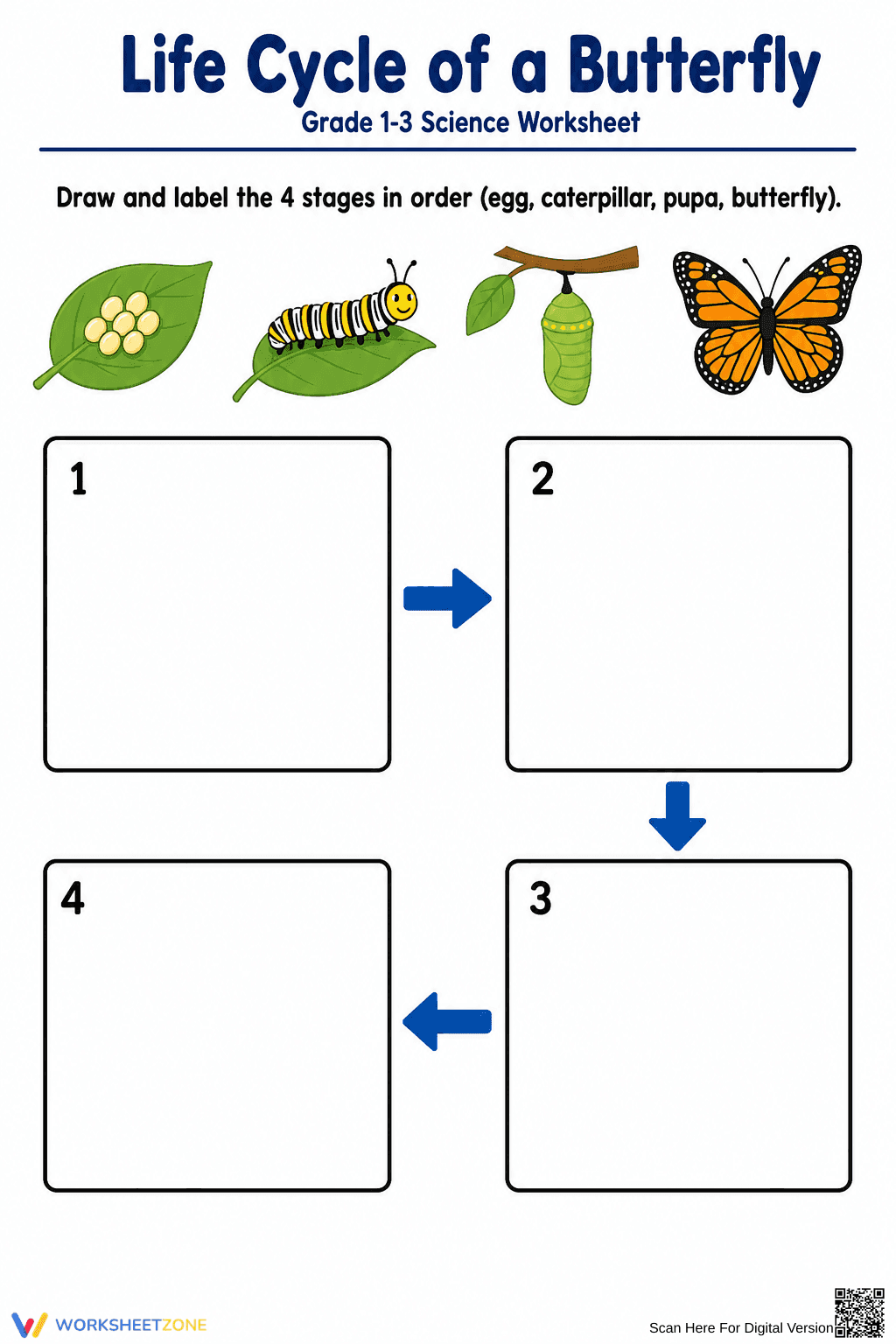

Grade 1-3 Butterfly Life Cycle — Printable No-Prep Worksheet
Paste this activity's link or code into your existing LMS (Google Classroom, Canvas, Teams, Schoology, Moodle, etc.).
Students can open and work on the activity right away, with no student login required.
You'll still be able to track student progress and results from your teacher account.
Mastering the butterfly life cycle is a foundational concept in early biology. This printable worksheet helps students visualize and internalize the four distinct stages of metamorphosis. By drawing and labeling the egg, caterpillar, pupa, and adult butterfly, learners build a concrete mental model of animal growth and development.
At a Glance
- Grade: 1-3 · Subject: Science
- Standard:
3-LS1-1— Develop models to describe unique and diverse life cycles- Skill Focus: Butterfly Life Cycle Sequencing
- Format: 1 page · 4 tasks · Answer key included · PDF
- Best For: Introduction to metamorphosis or formative assessment
- Time: 15–20 minutes
What's Inside
This single-page resource provides four numbered, blank boxes connected by sequential arrows, encouraging students to draw the physical transformations from egg to adult. The worksheet includes visual references of the four stages at the top to support accurate illustrations and correct spelling during the labeling process. A complete answer key is included for quick grading.
Zero-Prep Workflow
Teachers can implement this resource in under two minutes with a simple three-step process. First, print the desired number of copies for your science center or whole-class instruction (1 minute). Second, distribute the sheets along with crayons or colored pencils to encourage detailed observational drawings (1 minute). Finally, review the completed cycles as a class to clear up common misconceptions about the chrysalis phase (5 minutes). Its straightforward design makes it an ideal, self-explanatory activity for substitute teacher plans.
Standards Alignment
This activity is directly aligned to 3-LS1-1, which requires students to develop models to describe that organisms have unique and diverse life cycles but all have in common birth, growth, reproduction, and death. By creating their own visual model of the butterfly's transformation, students satisfy the core requirements of this Next Generation Science Standard. Both standard codes can be copied directly into lesson plans, IEP goals, or district curriculum mapping tools.
How to Use It
Use this worksheet as a concluding activity after observing real caterpillars in the classroom or watching a time-lapse video of metamorphosis. It serves as an excellent formative assessment during independent practice to check if students understand the correct sequence of growth. During the 15 to 20-minute activity, walk around and observe if students can accurately differentiate between the larva and pupa stages, providing immediate feedback on their biological models.
Who It's For
This resource is designed for first through third-grade students who are exploring living things and life cycles. It is particularly effective for visual learners and can be easily differentiated by providing pre-written sentence frames or vocabulary cards for students who need additional writing support. It pairs naturally with a classroom anchor chart showing the stages of an insect's life.
The 3-LS1-1 standard emphasizes that students must move beyond rote memorization of terms to develop functional models of biological processes, specifically focusing on the ability to sequence life cycles. Research from the ScienceDirect TpT Analysis indicates that student-generated drawings significantly enhance long-term retention of scientific cycles compared to passive reading alone. This worksheet facilitates that active construction of knowledge by requiring students to translate their mental images of an egg, caterpillar, pupa, and butterfly into a structured, sequential diagram. By engaging in this modeling task, learners participate in a key scientific practice identified in modern frameworks as essential for deep conceptual understanding. The inclusion of labeling ensures that technical vocabulary is integrated with visual evidence, creating a comprehensive assessment tool that mirrors the demands of state and national science assessments. This resource provides a reliable, evidence-based approach to teaching the complex concept of metamorphosis in elementary classrooms.


