Earthworms are a natural fit for a life cycle unit because their stages are visually distinct and their habitat, soil, is something every student has access to. Unlike butterflies or frogs, earthworms do not undergo metamorphosis in the dramatic sense, so the lesson becomes a good contrast point once students have already studied a metamorphosing organism. Worksheets that ask students to compare gradual growth versus metamorphic change build stronger conceptual understanding than either topic taught alone.
The Four Stages of the Earthworm Life Cycle
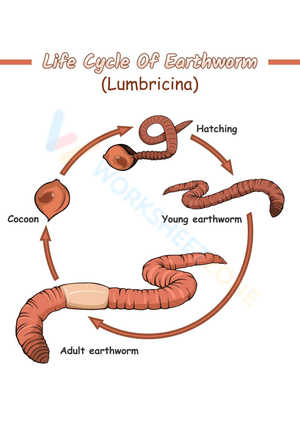
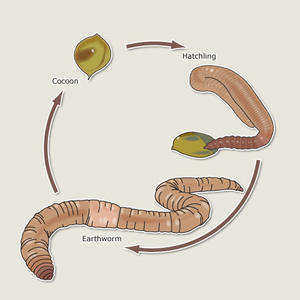
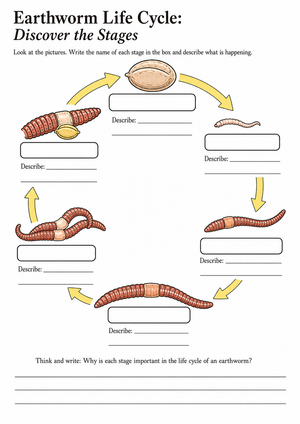
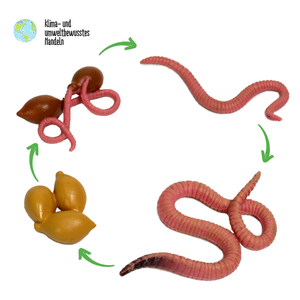
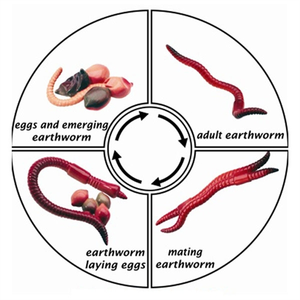
Earthworm life cycle worksheets should walk students through four main stages: cocoon, hatchling, juvenile, and mature adult. Each stage has clear physical markers that make for strong labeling or sequencing prompts.
- Cocoon: a lemon-shaped case secreted by the clitellum, containing developing eggs.
- Hatchling: newly emerged, unpigmented, and only a few millimeters long.
- Juvenile: rapidly growing, with thickening skin as it approaches adult form.
- Mature adult: sexually mature with a visible clitellum, ready to reproduce.
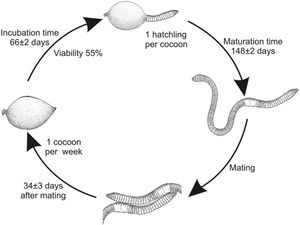
The cocoon stage is where most classroom worksheets lose precision. A single cocoon typically hatches in about two to three weeks and releases one to five young worms, not a single worm as many diagrams imply. Building this detail into a sequencing worksheet, such as asking students to write how many worms might emerge from one cocoon, pushes students past simple memorization and toward reading comprehension of the actual biology.
From Hatchling to Juvenile: What Changes
When a hatchling first emerges from the cocoon, it lacks pigment and is easy to overlook next to soil particles. Within a few days it gains full color, and from there it enters a rapid growth phase as a juvenile. Worksheets that ask students to describe or sketch size and color changes at each stage reinforce that growth is gradual rather than instantaneous, which is a common misconception carried over from insect metamorphosis lessons.
Reaching Maturity: The Role of the Clitellum
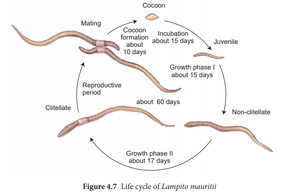
Around six weeks of age, an earthworm reaches sexual maturity and develops a visible clitellum, the thickened band near the front third of its body. This is one of the most useful landmarks for a labeling worksheet, since students can identify maturity by sight rather than by guessing an age. Worksheets that include a labeled diagram question, such as identifying the clitellum on an adult earthworm, give teachers an easy formative check of whether students distinguished juvenile and adult stages correctly.
Using Sequencing and Labeling Worksheets for Assessment
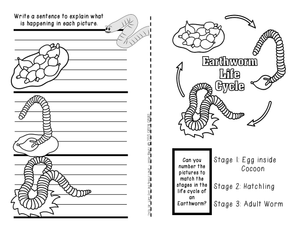
Sequencing and labeling worksheets are effective formative assessment tools because they make ordered thinking visible. A cut-and-paste sequencing activity, where students arrange cocoon, hatchling, juvenile, and adult images in order, quickly reveals whether a student understands the stage order versus simply naming the stages. A diagram-labeling worksheet, where students identify the clitellum, segments, and cocoon on an earthworm illustration, checks vocabulary alongside sequence. Short-answer stage description prompts push students to explain what changes at each stage rather than just recall labels, which is useful for students who are ready for more writing practice.
Classroom Implementation
Earthworm life cycle worksheets work best when paired with a real observation opportunity rather than used in isolation. A classroom compost bin or a simple soil sample in a clear container lets students watch worm movement and segment structure firsthand before completing a labeling worksheet, which improves both engagement and accuracy. For small-group science stations, rotate students through an observation station and a worksheet station so every group gets hands-on time. If live worms are not available, a short video clip showing cocoon formation and hatching gives students a visual anchor before they attempt the sequencing worksheet independently. Save five minutes at the end of the lesson for students to correct their own labeling using a answer key, since self-correction reinforces the vocabulary better than teacher-only grading.
Frequently Asked Questions
1. How long does it take for an earthworm cocoon to hatch?
An earthworm cocoon typically hatches in about two to three weeks, releasing one to five young worms.
2. What grade level is best suited for earthworm life cycle worksheets?
These worksheets work well for grades 2 through 4, particularly during life science or Earth Day themed units where students are building sequencing and labeling skills.
3. How can teachers pair worksheets with hands-on observation activities?
Set up a classroom compost bin or a simple soil sample container so students can observe segment structure and movement before completing a labeling or sequencing worksheet.
4. What are the four stages of the earthworm life cycle?
The four stages are cocoon, hatchling, juvenile, and mature adult, each marked by distinct physical changes such as pigment development and clitellum formation.
5. How do earthworms reproduce if they are hermaphrodites?
Earthworms carry both male and female reproductive organs but still require a mate. Two worms exchange sperm during mating, and each worm then forms its own cocoon.












 Interactive Worksheet Maker
 Quiz Maker
 Word Search Maker
 Crossword Puzzle Maker
 Word Scramble Generator
 Sentence Scramble Generator
 Handwriting Worksheet Generator
 Name Tracing Generator
 Fill In The Blank Generator