


























Views
Downloads

Butterfly Life Cycle Worksheet | Essential Grade K-2 Science
Paste this activity's link or code into your existing LMS (Google Classroom, Canvas, Teams, Schoology, Moodle, etc.).
Students can open and work on the activity right away, with no student login required.
You'll still be able to track student progress and results from your teacher account.
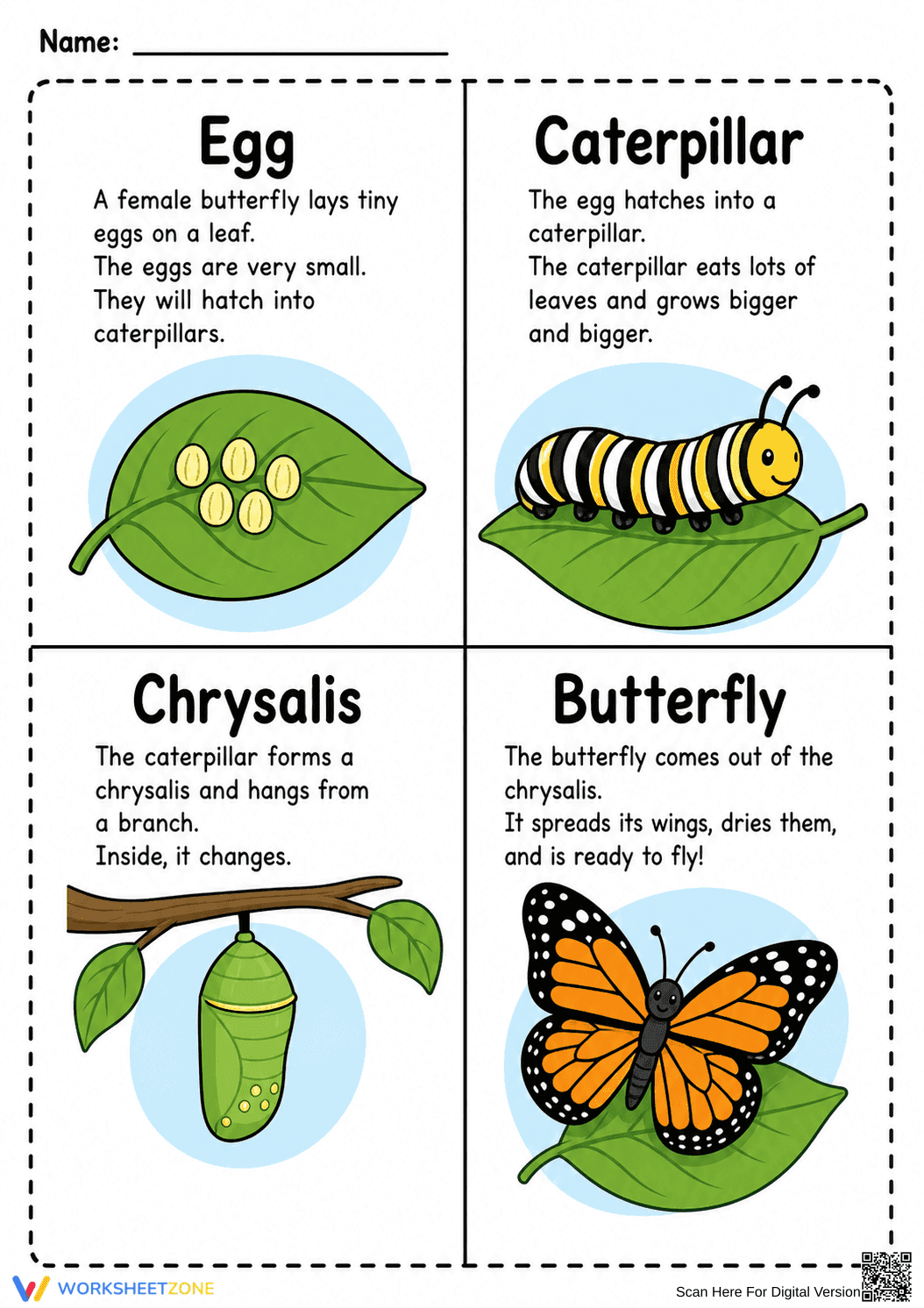
This Butterfly Life Cycle worksheet provides a clear, visual introduction to metamorphosis for early elementary students. By breaking down the complex biological process into four distinct, manageable stages, students develop a foundational understanding of how organisms grow and change over time. It serves as both an informational text and a visual reference for young scientists.
At a Glance
- Grade: K-2 · Subject: Science
- Standard:
3-LS1-1— Develop models to describe that organisms have unique and diverse life cycles- Skill Focus: Metamorphosis stages
- Format: 1 page · 4 informational blocks · Visual aids · PDF
- Best For: Introduction to life cycles and insects
- Time: 15–20 minutes
Inside this resource, you will find a single-page layout featuring the four primary stages of a butterfly's life: Egg, Caterpillar, Chrysalis, and Butterfly. Each section includes a high-quality illustration paired with a concise, age-appropriate description of the biological changes occurring. The text is designed for early readers, using simple vocabulary to explain the transition from egg to adult.
The zero-prep workflow for this worksheet is designed for maximum efficiency in the classroom. First, print the single-page PDF (30 seconds). Second, distribute the sheets to students as a primary reading source or visual anchor (1 minute). Finally, review the four stages as a whole-group discussion to check for comprehension (5 minutes). This resource is an ideal choice for emergency sub plans or quick science rotations.
This resource aligns with `3-LS1-1`, which requires students to develop models to describe that organisms have unique and diverse life cycles but all have in common birth, growth, reproduction, and death. It also supports CCSS.ELA-LITERACY.RI.K.7 by using illustrations to describe key ideas. These standards ensure students are building scientific literacy alongside reading skills.
Use this worksheet during the "Explain" phase of a 5E lesson cycle to provide formal definitions for observed phenomena. It works exceptionally well as a formative assessment tool; ask students to point to the stage where the insect "changes inside" to gauge their understanding of the chrysalis phase. Expected completion time for reading and discussion is 15 to 20 minutes.
This worksheet is specifically tailored for Kindergarten through 2nd-grade students who are beginning their exploration of life sciences and nature. It is particularly effective for English Language Learners (ELLs) due to the strong visual-to-text correlation. Pair this resource with a live butterfly kit or a non-fiction picture book about insects for a comprehensive learning experience.
The study of life cycles through visual models like this 3-LS1-1 aligned worksheet is a cornerstone of early childhood science education. By identifying the four stages of metamorphosis—egg, caterpillar, chrysalis, and butterfly—students engage in the foundational practice of modeling biological processes. According to Fisher & Frey (2014), the use of visual scaffolds combined with concise informational text significantly enhances the acquisition of domain-specific vocabulary in young learners. This worksheet facilitates the gradual release of responsibility by providing clear, observable facts that students can later apply to other organisms. Research from the NAEP suggests that early exposure to life science concepts through structured visual aids improves long-term retention of scientific cycles. This resource ensures that the plain-English skill of describing how an animal grows and changes is met through high-quality, accessible instructional design, making it a reliable tool for meeting state and national science frameworks.


