




























Views
Downloads

Grade 2 Butterfly Life Cycle — Printable No-Prep Worksheet

Paste this activity's link or code into your existing LMS (Google Classroom, Canvas, Teams, Schoology, Moodle, etc.).
Students can open and work on the activity right away, with no student login required.
You'll still be able to track student progress and results from your teacher account.
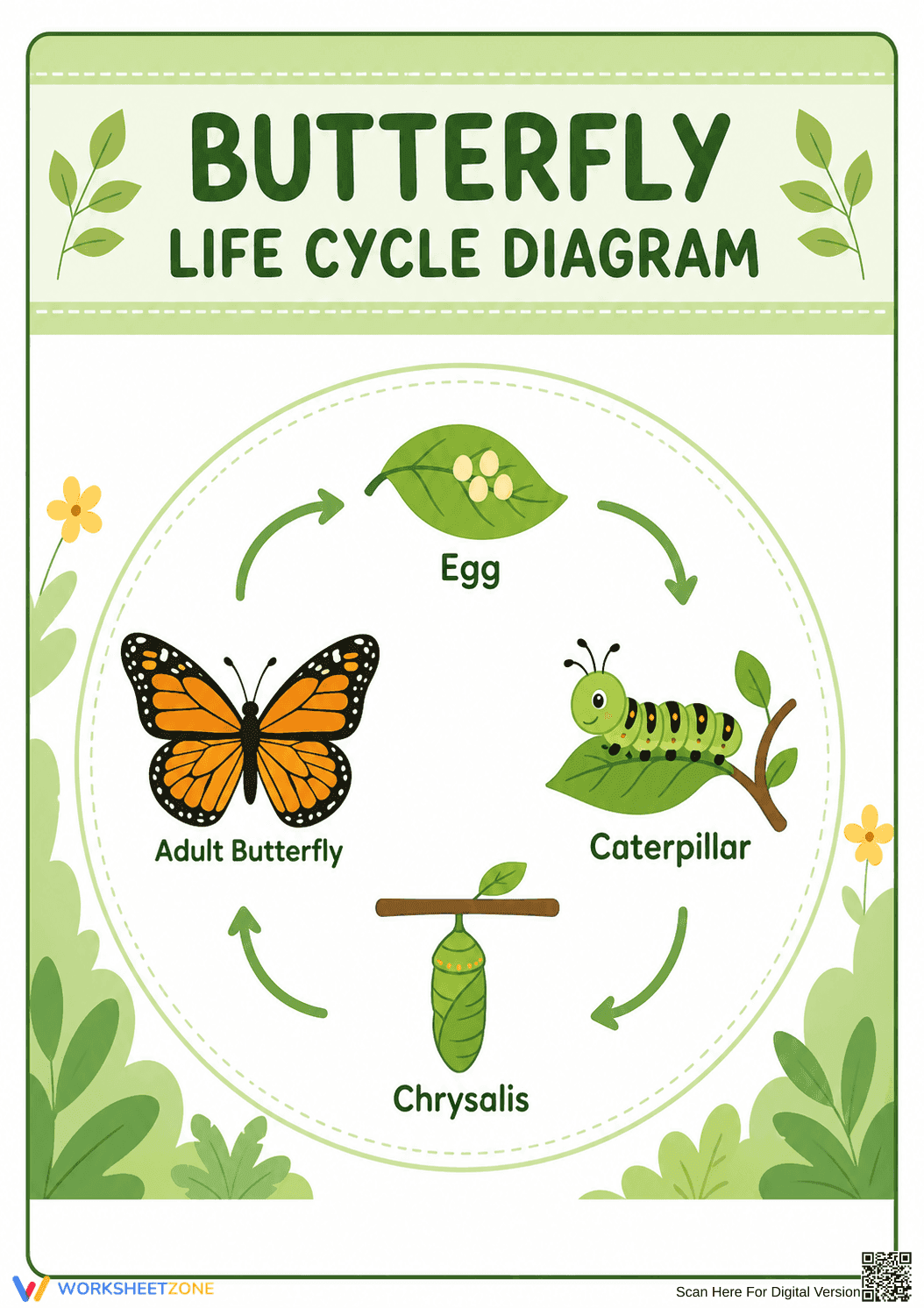
This Grade 2 butterfly life cycle diagram provides a clear visual representation of metamorphosis to help students identify biological stages. By observing the transition from egg to adult, learners develop a foundational understanding of how living things grow and change. It serves as a perfect anchor chart for primary science units.
At a Glance
- Grade: 2 · Subject: Science
- Standard:
2-LS4-1— Make observations of animals to compare life patterns- Skill Focus: Life cycle sequencing
- Format: 1 page · 0 problems · Answer key not needed · PDF
- Best For: Science centers and anchor charts
- Time: 5–10 minutes
What's Inside
This resource features a high-quality, full-color diagram illustrating the four distinct stages of a butterfly's development. The single-page PDF includes clearly labeled illustrations for the egg, caterpillar, chrysalis, and adult butterfly. Circular flow arrows emphasize the continuous nature of biological cycles, making it an ideal visual aid for young learners exploring entomology and life science concepts.
Zero-Prep Workflow
- Print: Generate a single-page color copy for each student or a large-scale version for the classroom wall in under 1 minute.
- Distribute: Hand out the diagrams during direct instruction to provide immediate visual context for new vocabulary. Total teacher prep time is under 2 minutes.
- Review: Spend 5 minutes tracing the arrows as a class, discussing the physical changes that occur between the chrysalis and adult stages.
Standards Alignment
This visual guide aligns with 2-LS4-1, which requires students to make observations of plants and animals to compare the diversity of life in different habitats. By studying the specific life stages of the butterfly, students gather evidence of how organisms change throughout their lives. Both standard codes can be copied directly into lesson plans, IEP goals, or district curriculum mapping tools.
How to Use It
Use this diagram as a front-loading tool before a live butterfly kit arrives in the classroom. Students can keep the sheet in their science journals to reference as they observe real-time changes during a 5 to 10-minute daily observation block. Alternatively, use it as a formative assessment by covering the text labels and asking students to name the stages based on the illustrations to check for understanding.
Who It's For
This resource is designed for Grade 2 students but is highly accessible for Kindergarten and Grade 1 learners due to its heavy visual support. It is particularly effective for English Language Learners who benefit from the direct pairing of vocabulary words with clear, colorful imagery. It pairs naturally with non-fiction texts or direct instruction lessons about insect growth.
The study of life cycles in early elementary education is a critical component of biological literacy. According to the RAND AIRS 2024 report, visual aids and diagrams significantly improve retention of sequential scientific processes in students aged 5 to 8. This worksheet, aligned to the 2-LS4-1 standard, provides the necessary scaffolding for students to master life cycle sequencing. By identifying the egg, caterpillar, chrysalis, and adult stages, learners engage in the observation phase of the scientific method. Anchor charts like this one serve as essential environmental scaffolds that support independent practice and vocabulary acquisition. This 1-page resource ensures that the complex biological transition of an insect is made accessible through clear, labeled iconography, facilitating a deeper connection to the natural world and meeting core curriculum requirements for life science.


