































Ready Butterfly Life Cycle Word Search | Grades 7–8 Science

Paste this activity's link or code into your existing LMS (Google Classroom, Canvas, Teams, Schoology, Moodle, etc.).
Students can open and work on the activity right away, with no student login required.
You'll still be able to track student progress and results from your teacher account.
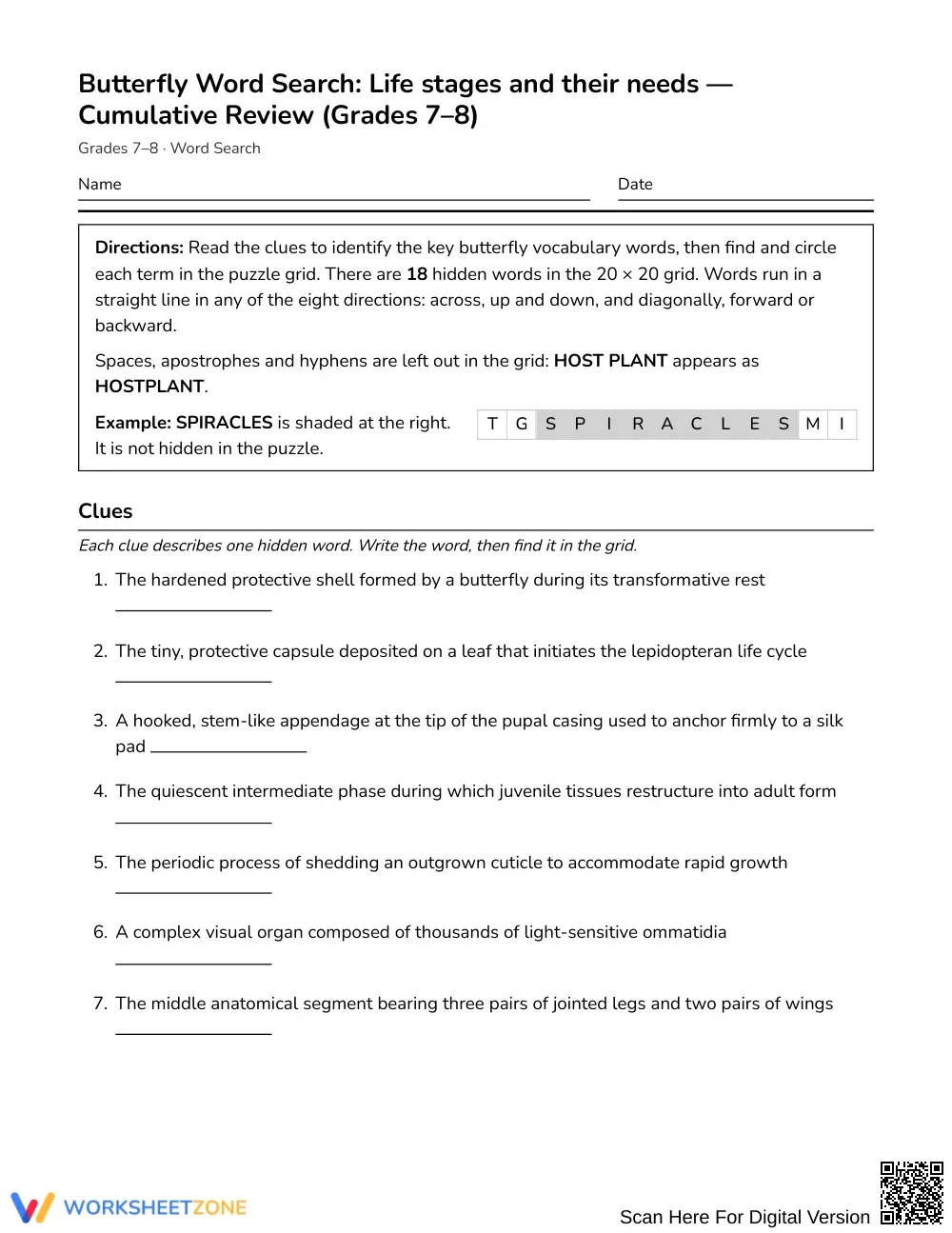
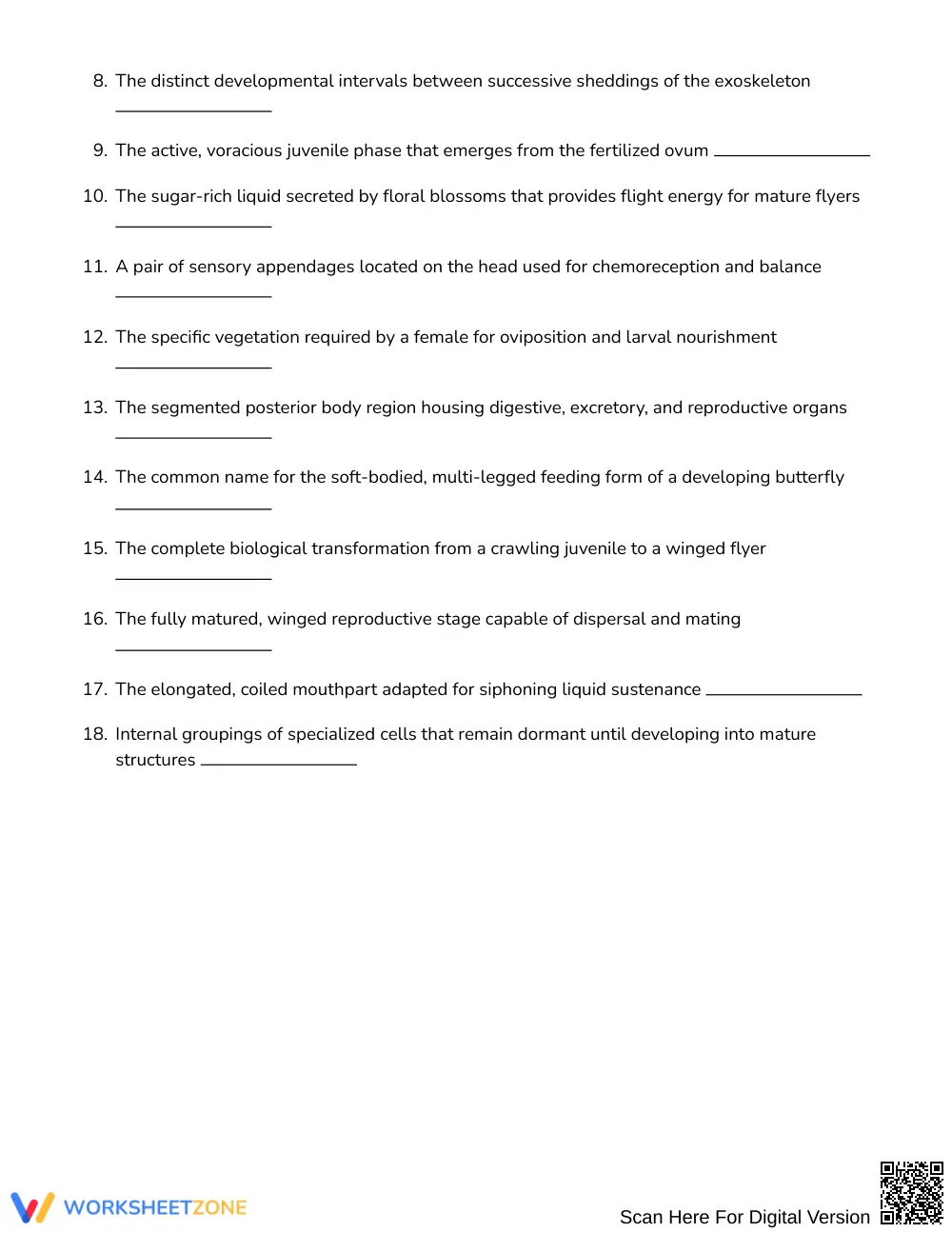
Reinforce middle school biology concepts with this cumulative review word search focusing on butterfly life stages and their needs. Students define and locate eighteen technical terms covering anatomical structures, physiological processes, and developmental phases from egg to adult. This focused activity strengthens scientific vocabulary retention, morphological awareness, and reading precision across multiple life science units.
At a Glance
- Grade: Grades 7–8 · Subject: Science
- Standard: Not standards-assessed — vocabulary enrichment
- Skill Focus: Life stages and their needs
- Format: 3 pages · 18 words · Answer key included · PDF
- Best For: Cumulative vocabulary review and sub plans
- Time: 20–30 minutes
This printable PDF includes an 18-word puzzle grid paired with detailed clue definitions rather than a simple word bank. Students must read challenging morphological and ecological definitions—such as identifying the chrysalis, cremaster, and imaginal discs—before finding each term. The resource contains complete 4-page answer key layouts that highlight letter coordinates clearly for swift checking.
The word search is constructed on a 20 by 20 letter grid containing 18 hidden vocabulary terms. Words run in all eight possible directions: horizontal, vertical, and diagonal paths running forward and backward (North, Northeast, East, Southeast, South, Southwest, West, and Northwest). Rather than merely copying terms from a list, students decipher rigorous biological definitions to determine the target vocabulary before searching the grid.
This activity is designed purely for vocabulary enrichment and cumulative review, so it is not aligned to a specific state or national standard. It supports general middle school life science units on growth, development, and organism structures by providing rigorous exposure to precise biological terminology.
Deploy this word search as an engaging post-instruction review following a complete unit on metamorphosis and insect adaptations. Teachers can observe whether students recognize anatomical terms like proboscis or thorax directly from the definitions without consulting their science notebooks. Alternatively, use this resource as an independent station task or emergency sub plan that requires 20 to 30 minutes of focused academic engagement.
This puzzle is tailored for general education and advanced Grades 7–8 life science classrooms. It provides rich orthographic and conceptual reinforcement for students developing academic vocabulary. Pair this activity directly with an insect anatomy diagram, a metamorphosis reading passage, or a hands-on live caterpillar observation lab to consolidate conceptual understanding.
Vocabulary acquisition in secondary science demands deliberate exposure to domain-specific terminology within authentic contexts. According to Fisher & Frey (2014), content-area literacy expands when adolescent learners engage with specialized morphological structures, such as metamorphosis, cremaster, and imaginal discs, through varied retrieval routines. Integrating definitional clue-matching with orthographic search patterns reinforces semantic memory pathways, allowing middle school students to bridge basic life cycle concepts with advanced cellular and anatomical terminology. This word search activity provides structured reinforcement of 18 essential terms across developmental biology and insect physiology, systematically supporting vocabulary retention without lowering academic rigor. By requiring students to interpret complex biological descriptions before locating words across eight spatial orientations, the resource promotes cognitive engagement and persistent text analysis, strengthening foundational literacy across Grades 7–8 life science curricula.


