




























Views
Downloads
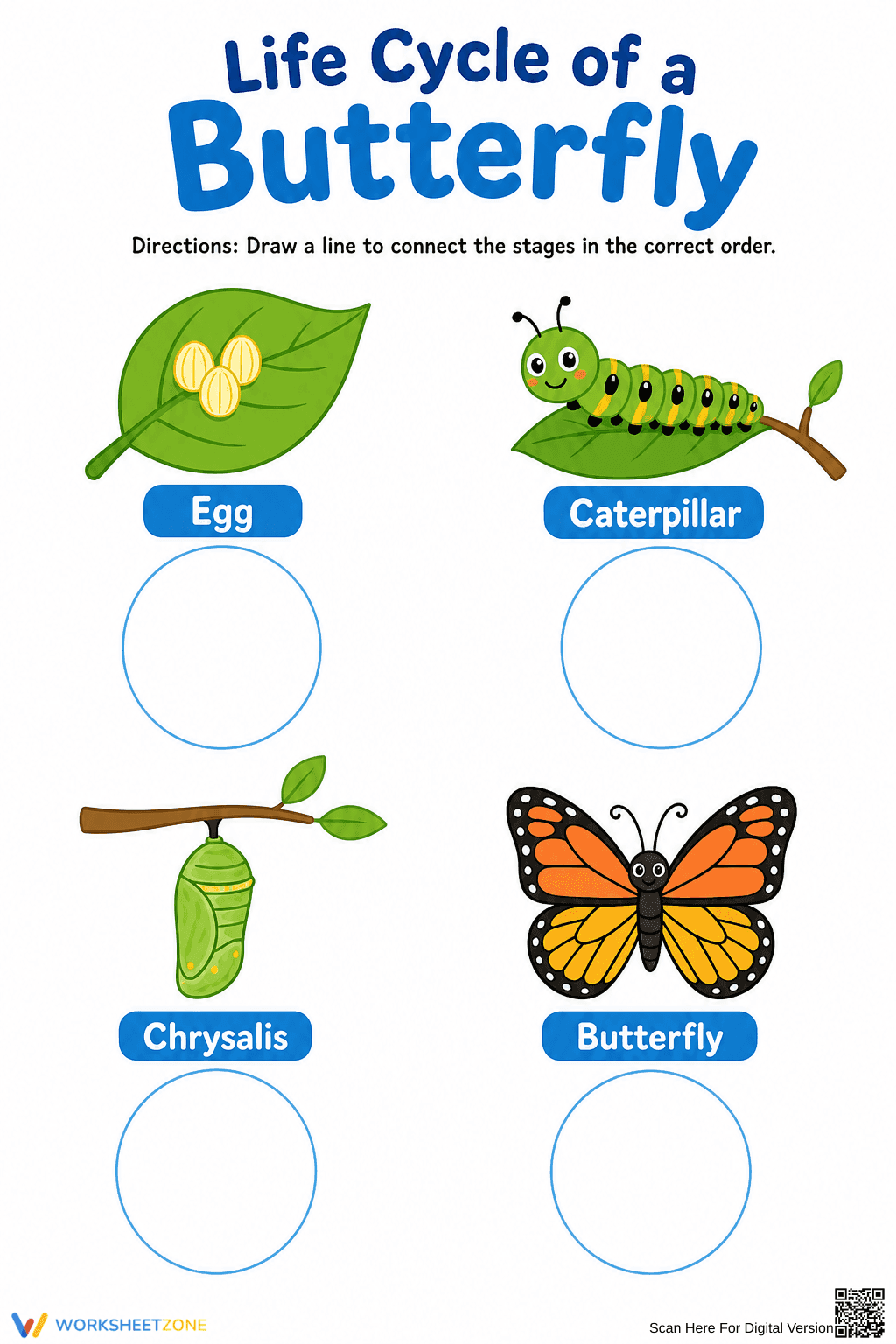

Printable Butterfly Life Cycle Worksheet | Grade 1

Paste this activity's link or code into your existing LMS (Google Classroom, Canvas, Teams, Schoology, Moodle, etc.).
Students can open and work on the activity right away, with no student login required.
You'll still be able to track student progress and results from your teacher account.
This foundational science worksheet helps early learners master the biological sequencing of a butterfly's development. By connecting the four distinct stages of metamorphosis, students visually reinforce their understanding of growth and change in living organisms. The clear illustrations provide immediate context for young scientists building core life science vocabulary.
At a Glance
- Grade: 1 · Subject: Science
- Standard:
3-LS1-1— Describe that organisms have unique and diverse life cycles- Skill Focus: Sequencing life cycle stages
- Format: 1 page · 4 problems · Answer key included · PDF
- Best For: Independent practice and science centers
- Time: 10–15 minutes
This single-page resource features four vibrant, easy-to-recognize illustrations representing the egg, caterpillar, chrysalis, and adult butterfly stages. Students are tasked with drawing lines to connect the corresponding circles in the correct chronological order. The straightforward layout minimizes distractions, while the included answer key ensures quick and accurate grading for educators. Large text and clear visual cues make the activity highly accessible for early readers.
Designed for immediate classroom implementation, this resource requires absolutely no teacher setup:
- Print (1 minute): The high-contrast PDF prints beautifully in both color and grayscale.
- Distribute (1 minute): Hand out the single page alongside pencils or crayons.
- Review (3 minutes): Use the provided answer key to quickly check student sequences.
With a total prep time of under two minutes, this worksheet is an excellent addition to emergency sub plans or spontaneous science centers.
This activity aligns with 3-LS1-1: Develop models to describe that organisms have unique and diverse life cycles but all have in common birth, growth, reproduction, and death. It also supports early observational skills by having students identify specific physical traits of each developmental phase. Both standard codes can be copied directly into lesson plans, IEP goals, or district curriculum mapping tools.
Deploy this worksheet immediately after a read-aloud session about caterpillars or during a dedicated spring science unit. It serves perfectly as an independent desk activity while the teacher circulates the room. As a formative assessment tip, watch how students draw their lines; hesitation between the chrysalis and adult stages might indicate a need to review the concept of metamorphosis. Most students will complete the sequencing task within a 10 to 15-minute timeframe.
This resource is primarily designed for first-grade students and kindergarteners who are just beginning to explore biological concepts. The visual nature of the matching task provides excellent differentiation for English Language Learners (ELLs) and visual learners who benefit from picture-based instruction. Pair this worksheet with a physical butterfly habitat or an anchor chart detailing insect anatomy for a comprehensive learning experience.
Integrating visual sequencing tasks into early science education significantly strengthens foundational comprehension of biological processes. According to a 2024 report by EdReports, students who engage with clear, step-by-step visual models of natural phenomena demonstrate higher retention rates when learning complex vocabulary. This worksheet directly supports 3-LS1-1 by requiring learners to describe that organisms have unique and diverse life cycles through a structured matching activity. By physically drawing connections between the egg, caterpillar, chrysalis, and butterfly stages, young learners transition from passive observation to active cognitive mapping. This hands-on approach not only solidifies their grasp of metamorphosis but also builds essential fine motor skills required for early writing. Utilizing targeted, standards-aligned visual aids ensures that foundational life science concepts are introduced accurately and effectively, setting the stage for more advanced biological studies in later elementary grades.


