Comprehensive Moth worksheets for Elementary Science
These moth worksheets give 3rd through 5th grade science teachers a targeted, standards-grounded way to teach complete metamorphosis through an organism that genuinely surprises students who assume butterflies own the lepidopteran spotlight. Each worksheet in the set addresses one distinct skill — life cycle sequencing, anatomical labeling, comparative analysis between moths and butterflies, or reading comprehension tied to moth adaptations — so teachers pull exactly what a given lesson needs rather than working through an entire packet. The set earns its place alongside any elementary life science unit on animal growth and development.
Concepts in Each Worksheet
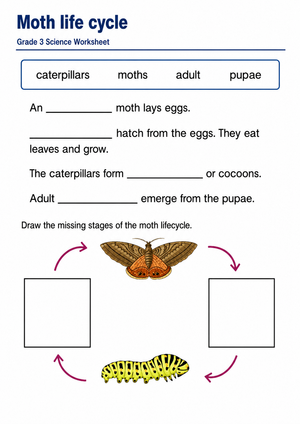
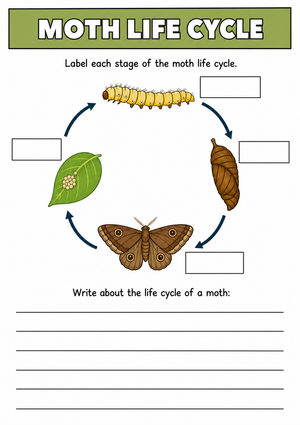
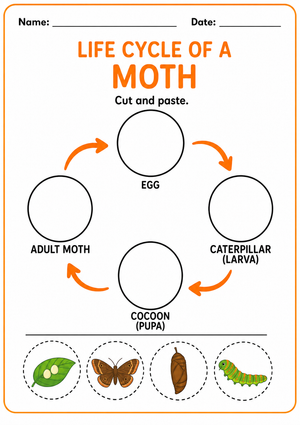
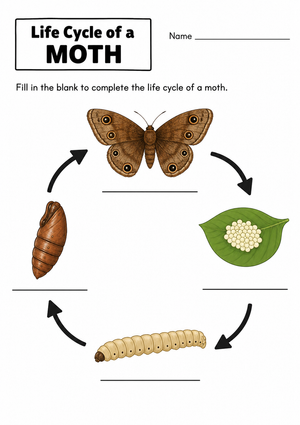
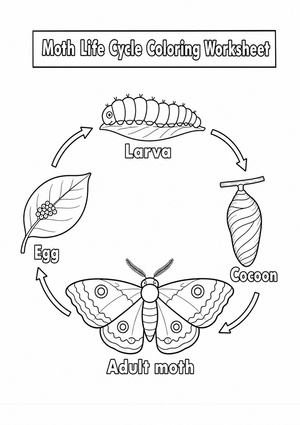
The life cycle worksheets ask students to sequence four stages — egg, larva, pupa, adult — using cut-and-paste cards, then label each stage with its scientific term. That format matters: committing to a physical order exposes confusion in a way that circling answers never does. A labeling worksheet focuses on moth anatomy, guiding students to identify the head, thorax, and abdomen, then locate compound eyes, feathery antennae, and the six legs attached exclusively to the thorax. A comparison graphic organizer in Venn diagram format has students sort distinguishing traits: antennae structure, resting wing posture, and active hours. One reading comprehension worksheet covers the peppered moth — specifically how industrial melanism altered which coloration survived predation — and includes text-dependent questions that connect life science directly to environmental science. Vocabulary-matching rounds out the set, targeting terms like metamorphosis, cocoon, chrysalis, nocturnal, and proboscis.
The distinction between cocoon and chrysalis deserves more than a footnote. Most students arrive having studied butterflies first, which means "chrysalis" is already their default word for the pupal stage. These activities force the structural difference into the open: a chrysalis is a shed larval skin that hardens into a shell with no silk involved, while a moth caterpillar spins a separate silk casing around its body. That is a genuine biological difference, not a vocabulary nicety, and the worksheets are built to make students articulate it rather than sidestep it.
Errors Students Make That These Worksheets Help Surface
Leg placement is the most persistent anatomical error. Students who have memorized "insects have six legs" will still label those legs distributed across all three body segments. The labeling worksheet — which requires placing all six legs on the thorax specifically — catches this before it hardens into a misconception that follows students into middle school.
Sequence errors cluster at the pupa stage. Students routinely place the cocoon after the adult moth, reasoning that "the moth comes out of the cocoon, so the cocoon must be the last step." The correction is worth teaching explicitly: the adult moth is inside the cocoon, and the cocoon is the structure that enables the transformation. Cut-and-paste cards make this argument concrete — students have to physically place the cocoon before the adult or the sequence simply does not work.
A subtler transfer error appears in the comparison work. After extended butterfly study, some students assume all lepidopterans follow identical four-stage patterns with identical structures. When they encounter moths, they map "chrysalis" directly onto the moth pupa stage without examining whether the label fits. The Venn diagram activity slows that transfer down and forces students to interrogate the analogy rather than accept it.
Fitting These Worksheets Into Your Week
The life cycle sequencing worksheet works well as a Tuesday warm-up — a 7-minute independent task while attendance is taken — if Monday's lesson introduced the four stages through direct instruction or a read-aloud. Students arrive with enough background to attempt the sequence on their own, and their card placements tell you exactly who needs a follow-up conversation before the unit moves forward. The peppered moth reading comprehension worksheet is a natural Friday task: it pushes the unit's ideas into environmental science without requiring new setup, and students who finish early can respond to an extension prompt about what might happen to the peppered moth population if air pollution were significantly reduced.
For whole-group instruction, project the blank anatomy diagram and work through the labels as a class before students complete their own copies. The public labeling exercise surfaces the leg-placement error in real time — someone will suggest the abdomen, which opens a short discussion worth having in front of everyone. Science notebooks benefit from the Venn diagram: folded and glued in, it becomes a reference students actually return to during later comparative work on other organisms. One classroom move worth trying: bring a spool of real silk thread the day you teach the pupal stage. Most moth caterpillars spin their cocoons from silk, and letting students handle the material before they read about it gives the biology a tactile anchor that printed diagrams alone cannot replicate.
Standard Alignment
These worksheets align to NGSS 3-LS1-1, which asks students to develop models describing that organisms have unique and diverse life cycles while sharing the common elements of birth, growth, reproduction, and death. Moths are a deliberate fit here. Complete metamorphosis — four stages with a radical structural transformation during the pupa stage — directly challenges the simpler growth models students carry from observing mammals and birds. The standard also calls for comparison across organisms, and moths sit in productive tension with butterflies (same four-stage cycle, structurally different pupa) and frogs (also complete metamorphosis, but with aquatic larval stages). Teachers who use moths alongside a frog unit build exactly the kind of comparative reasoning 3-LS1-1 requires. The moth worksheets used in that comparative sequence give students annotatable models to revise and set side by side — which is what "develop models" actually demands, not passive observation of a single organism.
Adjusting the Set for a Range of Learners
Students who need additional support benefit from having the life cycle cards pre-cut so the cognitive work stays on sequencing and labeling rather than fine motor cutting. Providing a word bank on the anatomy worksheet removes the spelling barrier without reducing the conceptual demand — students still have to identify where each term belongs on the diagram. For the reading comprehension worksheet, asking students to underline textual evidence before answering questions keeps the task accessible without removing the analytical work.
Students ready to extend can push the comparison worksheet in two directions. First, ask them to add a third column for a frog or another organism with complete metamorphosis and sort traits across three cases simultaneously. Second, after completing the cocoon-versus-chrysalis vocabulary work, ask them to write a short explanation of why the two terms are not interchangeable — a task that reveals whether they understand the structural difference or have only memorized a definition. The moth worksheets in this set include enough biological detail that advanced students have the raw material to write that distinction accurately, not just approximate it.
Frequently Asked Questions
What is the difference between a moth cocoon and a butterfly chrysalis?
A butterfly caterpillar sheds its final layer of skin, and the hardened shell that forms underneath is the chrysalis — no silk is involved in building it. A moth caterpillar, by contrast, spins a separate protective casing from silk around its own body; that structure is the cocoon. Both house the pupa during transformation, but they form through entirely different biological processes. This distinction comes up repeatedly in the comparison activities because students who have studied butterflies first arrive with "chrysalis" as their default pupa word and need direct instruction before they apply the correct term to moths.
What four stages make up a moth's life cycle?
Moths undergo complete metamorphosis: egg, larva, pupa, and adult. The female lays eggs on a host plant selected specifically because the hatching larvae will feed on it. Those larvae — caterpillars — shed their exoskeleton several times as they grow, then spin a silk cocoon and enter the pupal stage, during which the body reorganizes entirely. The adult moth that emerges is reproductively capable and, depending on the species, may not eat at all — some adults lack functional mouthparts entirely and survive only on energy stored during the larval stage.
How do students distinguish a moth from a butterfly?
Three physical traits are reliable enough for elementary students to apply consistently: antennae shape (moths have feathery or thread-like antennae; butterflies have thin antennae with clubbed tips), resting wing posture (moths typically rest with wings spread flat; butterflies fold wings upright over their backs), and activity period (moths are predominantly nocturnal; butterflies are diurnal). The comparison graphic organizer in the moth worksheets uses exactly these three traits so students practice sorting them in relationship to each other rather than reciting a memorized list.
What do moth caterpillars eat, and does that change when they become adults?
Caterpillars are leaf-eaters with chewing mouthparts, and most species feed on one specific host plant — eggs are laid on that plant so larvae hatch near their food source. Adult moths that do feed drink liquid nectar through a coiled tube called a proboscis. A number of moth species have no functional mouthparts as adults and do not feed at all, surviving entirely on energy stored during the larval stage. That contrast is worth teaching explicitly: the larva and adult are not simply different sizes of the same body — they are built for entirely different biological roles, which is precisely what metamorphosis means.
Clear All