Exploring Insect Life Cycles with Shield Bug Printable Worksheets
These shield bug printable worksheets give elementary and middle school science teachers a direct path into incomplete metamorphosis — a developmental pattern students routinely conflate with the butterfly's four-stage sequence — through an organism many of them have already encountered clustered on a sunny wall in late October or crawling across a tomato plant. The set covers anatomy labeling, life cycle sequencing, invasive species reading comprehension, and vocabulary work, all built around Halyomorpha halys and its relatives in the family Pentatomidae.
The Specific Skills Each Worksheet Targets
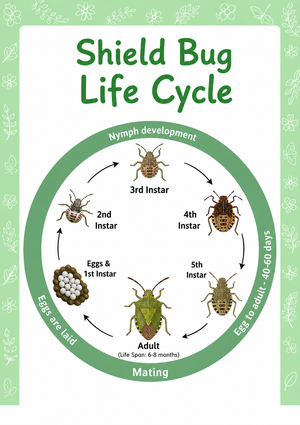
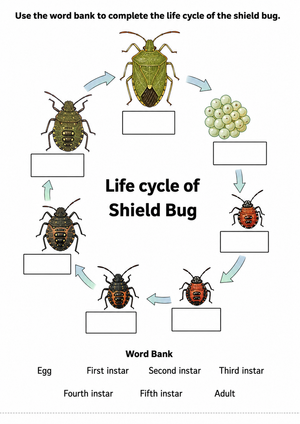
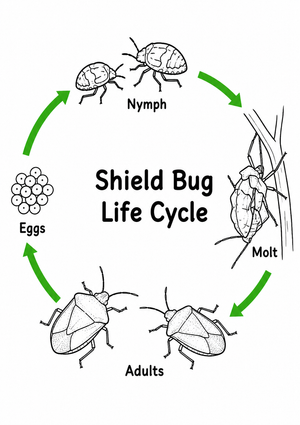
The life cycle worksheets ask students to sequence the three primary stages — egg, nymph, and adult — and then correctly place all five nymphal instars within that framework. That distinction matters: a student who understands that the single "nymph stage" contains five discrete growth phases carries a far more accurate mental model of hemimetabolous development than one who treats nymph as a monolithic category equivalent to larva in the butterfly cycle.
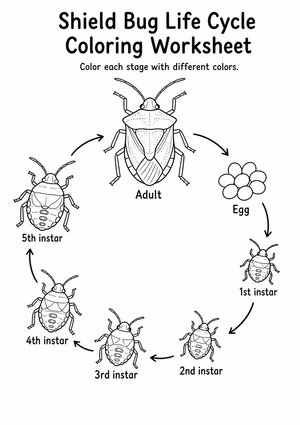
Anatomy worksheets focus on eight structures: the scutellum (the large triangular plate that names the insect), the compound eyes, the five-segmented antennae, the proboscis, the six jointed legs, the scent glands located on the thorax in adults and on the dorsal abdomen in nymphs, visible wing pads in late-instar nymphs, and the fully developed wings in adults. Students label, color by structure type, and in one worksheet rewrite each term alongside a brief functional definition — which requires them to process vocabulary rather than simply match arrows to blanks.
The reading comprehension worksheets center on the brown marmorated stink bug as an invasive species case study. After reading a short passage, students answer inference and recall questions about agricultural damage, overwintering behavior, and the ecological distinction between native and introduced species. A vocabulary-matching section targets seven terms: hemimetabolous, instar, molting, scutellum, proboscis, exoskeleton, and integrated pest management.
Why Incomplete Metamorphosis Is Harder to Teach Than It Looks
Incomplete metamorphosis is developmentally harder for students to grasp than complete metamorphosis, and the difficulty is specific: the absence of a pupal stage removes the single most memorable visual anchor in the butterfly narrative. Students who have spent years coloring chrysalises expect every insect life cycle to include a dormant transformation phase. The shield bug provides a concrete counter-example precisely because the nymph is visibly, actively alive at every instar — it just looks like a smaller, wingless version of the adult. That gradual change is what makes this organism useful for instruction: students have to observe carefully rather than wait for a dramatic reveal.
The five-instar structure also gives teachers a rare opportunity to address continuous biological change without a narrative hook. In a butterfly unit, the chrysalis carries the dramatic weight. Here, the pedagogical work is training students to notice incremental differences — a habit of mind that transfers later to embryology, plant development, and ecological succession. These worksheets build that capacity through structured, repeated labeling rather than through reading alone.
Mistakes Students Make That These Worksheets Surface
The most persistent error is the phantom pupa. Students who complete a butterfly unit before encountering the shield bug will frequently draw or label a cocooned stage between the fifth instar and the adult — an insertion that makes intuitive sense to them because they have internalized "metamorphosis equals cocoon." The sequencing worksheet makes this error immediately visible: a student who adds a fourth stage to a three-stage diagram is showing you exactly what their mental model contains. That is a productive mistake to have on paper, because it gives you a specific misconception to address rather than a vague misunderstanding to diagnose through questioning.
A second common error involves instar count. When asked how many nymph stages the shield bug has, students frequently answer three or four — partly because the word "stage" gets tangled with the three primary stages of the life cycle. The worksheets maintain a deliberate terminological distinction, using "stage" for the three main divisions and "instar" consistently for the five growth phases within the nymph stage. That vocabulary discipline is worth naming explicitly during the brief direct instruction before students begin independent work.
On anatomy worksheets, students regularly mislabel the scutellum as the abdomen. The two structures overlap visually in a dorsal diagram, and students who have never closely observed a live or photographed specimen often default to the anatomical term they already know. Projecting a high-resolution dorsal photograph alongside the worksheet diagram resolves most of that confusion before it becomes an error pattern across the class.
Building These Worksheets Into Your Lesson Sequence
These shield bug printable worksheets land most effectively when placed after students have completed a butterfly or mealworm life cycle unit — not before. Positioning them second uses prior knowledge as a foil: students arrive with "egg, larva, pupa, adult" and immediately have to reconcile that template with a three-stage, five-instar cycle that skips pupal transformation entirely. That cognitive friction is the lesson. The compare-and-contrast worksheet, which asks students to fill a two-column chart distinguishing complete from incomplete metamorphosis across six characteristics, hits with considerably more force when students have a concrete prior experience to set against it.
For the anatomy labeling activity, a five-minute whole-class projection of the diagram before independent work reduces the number of students who stall on the scutellum. Pull up the diagram on the smartboard, ask two students cold to read two unlabeled structures aloud, then release students to work independently. That brief preview keeps cognitive attention on the biology rather than on decoding an unfamiliar diagram format — a meaningful difference when students only have 15 minutes of independent work time in the period.
Station rotation works particularly well with this set. One station runs the life cycle wheel assembly; a second station holds the anatomy labeling and coloring sheet; a third holds the invasive species reading passage and vocabulary matching. Three stations of roughly twelve minutes each fill a 40-minute period cleanly, with time at the end for a whole-class debrief on the instar count question — which almost always surfaces the three-versus-five disagreement worth having in front of the room.
Standard Alignment
The life cycle and anatomy worksheets align with NGSS LS1.B: Growth and Development of Organisms, which expects students to construct explanations for how organisms grow and develop through predictable stages. In classroom terms, LS1.B is most commonly addressed first in 3rd grade through the butterfly or frog life cycle, then revisited in 5th and 6th grade when students are expected to compare multiple developmental patterns and explain the adaptive advantages of each. These worksheets belong at that second instructional moment — not the introductory butterfly lesson, but the comparative analysis that follows it.
The invasive species reading comprehension component also addresses NGSS LS2.C: Ecosystem Dynamics, Functioning, and Resilience, which at the middle school level asks students to analyze how introduced species affect ecosystem stability. The brown marmorated stink bug's documented spread across 47 U.S. states since its first confirmed detection in Allentown, Pennsylvania in 2001 gives that standard a current, domestically traceable example with real agricultural data behind it.
Adjusting the Worksheets for Different Learners
Teachers who have used these shield bug printable worksheets in mixed-ability classrooms most often differentiate by task format rather than by topic — everyone encounters the same biology, but the cognitive demand of each task varies. The anatomy labeling worksheet has a word-bank version that supplies all eight structure names and asks students to place them correctly rather than generate them from memory. That version maintains the spatial reasoning challenge of the labeling task while removing the retrieval demand that causes some students to disengage from the diagram before they have started. The life cycle sequencing activity also comes in a pre-cut version, where stage cards are already separated and students sort and glue rather than cut — appropriate for early elementary students or students with fine motor challenges.
For students ready for extension, the invasive species worksheet closes with an open-ended prompt: identify one integrated pest management strategy used to control the brown marmorated stink bug and evaluate its effectiveness based on a specific piece of evidence. That task moves students from comprehension into analysis and requires engaging with a source beyond the worksheet itself — a useful bridge toward the reading-to-argue work expected in middle school science.
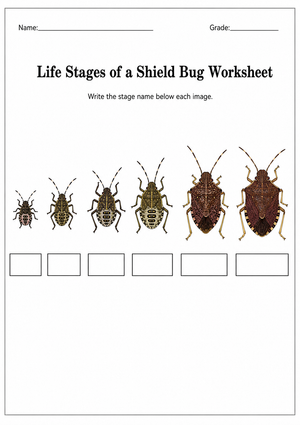
One honest limitation worth flagging: the five-instar sequencing activity assumes students can detect subtle visual differences between early instars in a diagram. Students who rely heavily on color differentiation may find the first through third instars difficult to distinguish when worksheets are printed in black and white. Printing the life cycle worksheet in color, or projecting the color version while students work from grayscale copies, addresses this before it becomes a frustration point mid-lesson.
Frequently Asked Questions
Do these worksheets require students to have seen a live shield bug?
No, but a two-minute projection of a high-resolution dorsal photograph before the anatomy labeling activity helps considerably. Students with a visual reference — particularly one that shows the scutellum clearly against the thorax — label the diagram with more confidence and fewer errors in the upper body region. If live specimens are accessible, even a brief five-minute observation session before students sit down to complete these shield bug printable worksheets makes the anatomy vocabulary stick noticeably faster than diagram work alone.
What grade levels are these worksheets written for?
The life cycle sequencing wheel and cut-and-paste activities work well in grades 2–4. The anatomy labeling and coloring sheets are pitched at grades 3–6. The invasive species reading comprehension and vocabulary matching worksheets are written at a grade 5–7 reading level and work well as paired reading assignments or independent practice in a middle school science block. In multi-level settings, most teachers use the life cycle wheel with younger students and the anatomy and reading worksheets with older ones.
How does the shield bug life cycle compare to the frog life cycle for teaching this concept?
Both are categorized as incomplete metamorphosis, but the frog's tadpole stage involves a distinct body plan — limbs appear incrementally, the tail reabsorbs — which actually shares more visual logic with complete metamorphosis than with the shield bug nymph's consistent body form. For teaching the specific claim that incomplete metamorphosis means the juvenile resembles the adult from the moment of hatching, the shield bug is the cleaner example. Frogs are excellent for teaching gradual developmental change; shield bugs are better for establishing, concretely, what "no pupal stage" actually means in practice.
Clear All