




























Views
Downloads
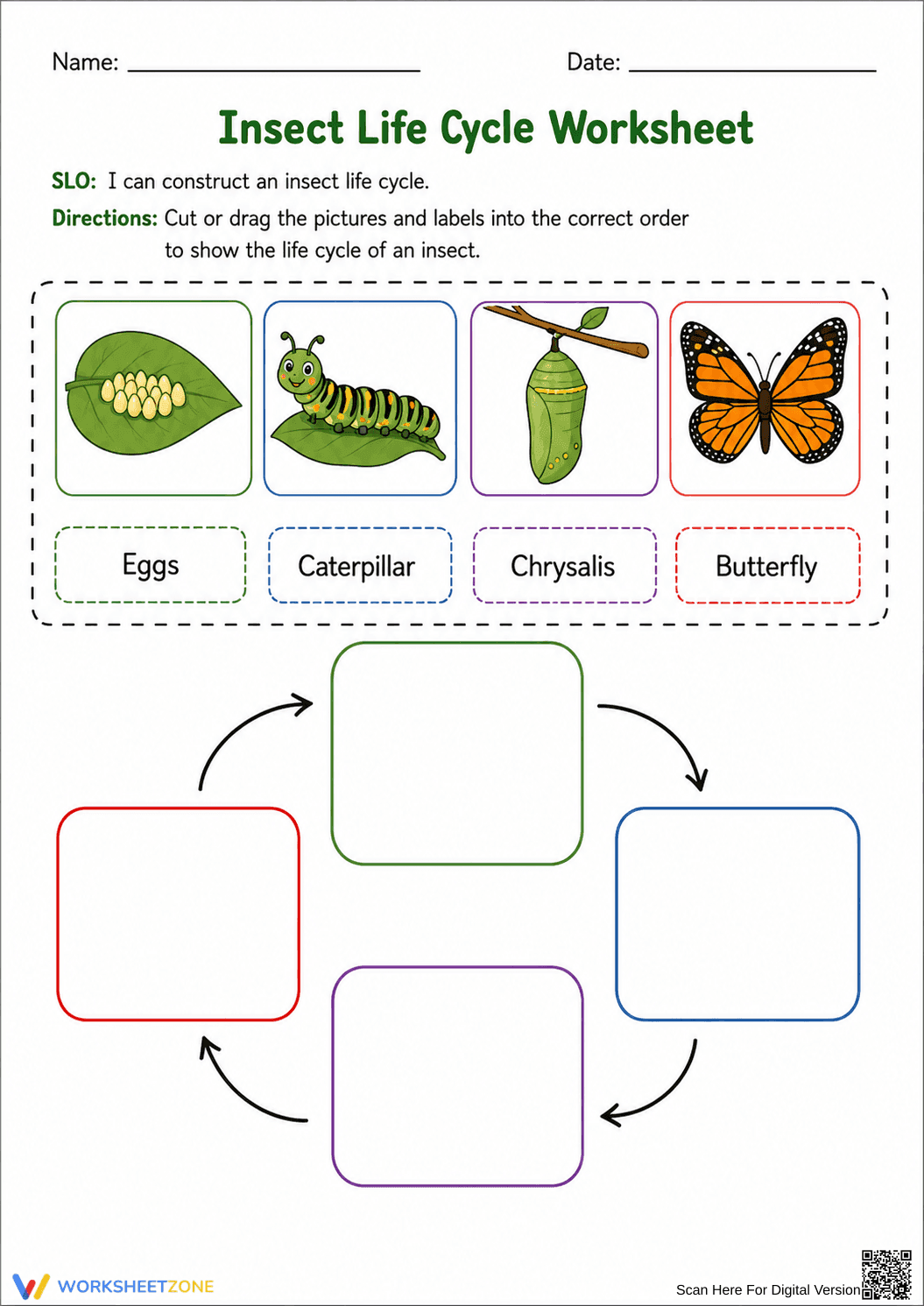

Essential Insect Life Cycle Worksheet | Grade 3 Science

Paste this activity's link or code into your existing LMS (Google Classroom, Canvas, Teams, Schoology, Moodle, etc.).
Students can open and work on the activity right away, with no student login required.
You'll still be able to track student progress and results from your teacher account.
This Grade 3 insect life cycle worksheet provides a hands-on modeling activity for students to master the stages of metamorphosis. By correctly sequencing visual representations and scientific labels, learners demonstrate their understanding of biological growth patterns. This resource ensures students can identify the specific transitions from eggs to adult butterflies within a circular system.
At a Glance
- Grade: 3 · Subject: Science
- Standard:
3-LS1-1— Develop models to describe that organisms have unique and diverse life cycles- Skill Focus: Metamorphosis Sequencing
- Format: 1 page · 8 tasks · Answer key included · PDF
- Best For: Independent practice or science centers
- Time: 15–20 minutes
What's Inside
This single-page PDF features a clear, circular diagram designed for visual learners. It includes four high-quality illustrations representing the egg, larva (caterpillar), pupa (chrysalis), and adult (butterfly) stages. Below the diagram, students find four corresponding text labels. The layout is optimized for either digital drag-and-drop interaction or traditional cut-and-paste physical manipulation, providing flexibility for different classroom environments.
Zero-Prep Workflow
This resource is designed for immediate classroom implementation with a total teacher prep time of under 2 minutes. First, print the required number of copies for your cohort. Second, distribute the sheets along with scissors and glue sticks for a tactile experience. Finally, review the completed cycles using the included answer key for instant formative feedback during the lesson. This streamlined process makes it an ideal choice for emergency sub plans or quick morning work.
Standards Alignment
This worksheet is specifically aligned to `3-LS1-1`, which requires students to develop models to describe that organisms have unique and diverse life cycles but all have in common birth, growth, reproduction, and death. It also supports CCSS.ELA-LITERACY.RI.3.7 by using information gained from illustrations to demonstrate understanding of the text. Both standard codes can be copied directly into lesson plans, IEP goals, or district curriculum mapping tools.
How to Use It
Use this worksheet as a summative assessment after a unit on entomology or as a guided practice activity during direct instruction. It is particularly effective when paired with a live classroom observation of a butterfly kit. Teachers can use the completed diagrams as a formative assessment to check for misconceptions regarding the order of the pupa and larva stages. Expected completion time is approximately 15 to 20 minutes depending on the student's fine motor speed.
Who It's For
This resource is ideal for third-grade students, though it remains accessible for second-grade enrichment or fourth-grade review. It serves English Language Learners (ELLs) well through its heavy reliance on visual cues and vocabulary matching. Pair this with a non-fiction text about monarch butterflies or an anchor chart detailing the characteristics of insects to provide a comprehensive learning experience.
According to the RAND AIRS 2024 report on elementary science instruction, the use of visual modeling tools significantly improves the retention of complex biological sequences in early learners. This worksheet addresses the 3-LS1-1 standard by requiring students to construct a physical model of an insect's life cycle, moving beyond rote memorization to active conceptual mapping. Research by Fisher & Frey (2014) emphasizes that scaffolds like the circular diagram provided here support the gradual release of responsibility, allowing students to transition from teacher-led observation to independent mastery of scientific terminology. By integrating both pictorial evidence and technical labels (Eggs, Caterpillar, Chrysalis, Butterfly), the resource aligns with modern pedagogical shifts toward multi-modal literacy. This 1-page tool provides the 8 specific tasks necessary to verify student competency in identifying the commonalities of growth and reproduction across different species.


