Exploring the Rhino Beetle Life Cycle: Printable Science Worksheets
These rhino beetle worksheets resources give 4th–6th grade science teachers a concrete entry point into complete metamorphosis, insect adaptation, and decomposer ecology — three concepts that appear consistently in life science units but rarely carry this much natural student interest. Each worksheet pairs visual labeling tasks with reading passages and written response prompts, so students move between analytical modes without leaving the topic. The rhinoceros beetle works unusually well as an anchor organism because every feature of its biology — the two-year larval stage, the male horn used in combat, the pupal reorganization — illustrates a concept the curriculum already requires.
The Biology Each Worksheet Addresses
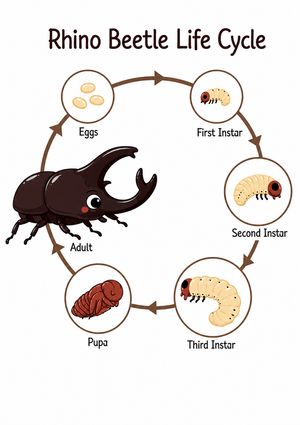
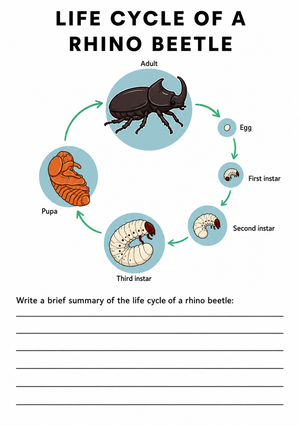
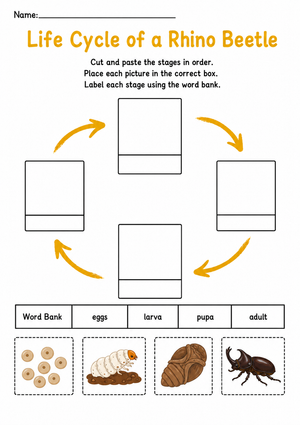
The core content across the set is the four-stage complete metamorphosis cycle: egg, larva, pupa, adult. Students learn that the female deposits eggs in rotting wood or leaf litter — not randomly, but in material that immediately serves as the hatching larva's first food source. The larval stage, the longest in the cycle at up to two years, is where students most often underestimate the biology. Grubs spend this entire period feeding continuously on decaying organic matter, accumulating the energy reserves needed for the cellular reorganization that happens inside the pupal case. The adult that emerges from pupation is fully formed — wings, legs, horn — but not built for long-term survival. Most adults live only three to six months before the cycle begins again.
Physical adaptation tasks ask students to compare male and female beetles directly. Males carry a pronounced horn used in combat with rival males over territory and food access; females lack the horn entirely. This is a direct example of sexual dimorphism that students can see clearly in the provided diagrams. One worksheet also includes a proportional strength calculation: rhinoceros beetles can lift objects up to 850 times their own body weight, and students calculate what that figure would mean for a person of a given weight. This cross-curricular problem is the task students reference weeks later when explaining the unit to someone else.
The comparative metamorphosis chart in this rhino beetle worksheets set asks students to distinguish complete metamorphosis (egg → larva → pupa → adult) from incomplete metamorphosis (egg → nymph → adult), using grasshoppers and dragonflies as contrasting organisms. Students identify which stage is absent from the incomplete sequence and write an explanation of why that distinction matters for classifying insects.
Building These Worksheets Into Your Lesson Plans
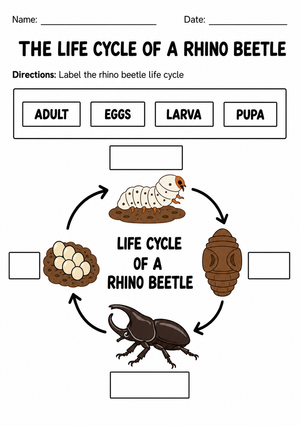
The life cycle diagram worksheet works best as a whole-class launch. Project the blank version while students follow along with their printed copies — this guided first pass through vocabulary (larva, pupa, pupal case, exoskeleton, sexual dimorphism) reduces the cognitive load students carry into independent work later in the week. Once the class has labeled the diagram together, the reading passage worksheet functions well at a station or as Monday warm-up practice, because the terminology is already anchored from the diagram session.
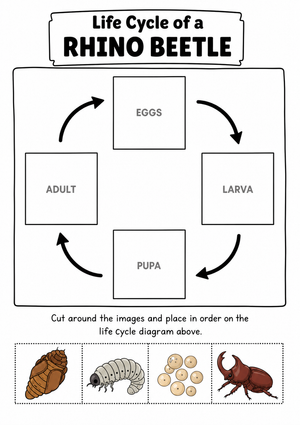
When covering the two-year grub phase, placing a small sealed container of clean compost or decaying wood on student desks while they work through the labeling task makes a measurable difference in retention. Students are reading about an organism that lives inside rotting material — the sensory element makes the diagram concrete rather than abstract. The Venn diagram comparing male and female beetle traits works well at a second station, and the cut-and-paste sequencing activity is worth saving for pairs or small groups rather than assigning as solo work, because the conversation students have while sequencing reveals whether they understand stage order or are guessing from the illustrations. The rhino beetle worksheets sequencing task, in particular, surfaces stage-order confusion that written assessments alone tend to miss.
Errors to Watch For in Student Work
The most consistent error is assuming the adult stage is the longest phase of the life cycle. Students anchor on what they see — the visible beetle — and assign it the most time. When they read that grubs spend up to two years underground, many rewrite this as a few weeks in their response paragraphs, unconsciously normalizing the timeline to match butterflies or other insects they have studied before. Asking students to compare the rhinoceros beetle's larval timeline against a monarch butterfly's larval stage (a few weeks) before they complete the written response sharpens the contrast and improves accuracy considerably.
A second error surfaces in the comparative chart: students frequently label the nymph stage as a larva when working with incomplete metamorphosis insects. They recognize that both involve young insects that look different from the adult, and use the terms interchangeably. The distinction worth pressing is that nymphs already resemble the adult body plan in shape, while larvae — like the C-shaped rhinoceros beetle grub — bear no resemblance to the adult whatsoever. A third error appears in writing tasks: students write that the beetle "turns into" a pupa, framing pupation as something that happens to the insect from outside. The more precise framing is that the larva forms the pupal case around itself, which helps students understand that the process is internally driven.
Adjusting the Worksheets for Different Learners
For students who struggle with dense text, the diagram tasks are the right entry point. A student who has not yet worked through the reading passage can label a diagram with teacher modeling, then use those labeled terms as a reference map when returning to the text. This visual-first, text-second sequence works particularly well for English language learners, who benefit from having the conceptual framework in place before they encounter unfamiliar vocabulary in paragraph form.
Advanced students get the most from the proportional strength calculation. Asking a student to determine what a 120-pound person could lift at 850 times body weight (approximately 102,000 pounds) turns the passage into a math problem requiring reading comprehension, unit reasoning, and multiplication. The follow-up question — "What are the limits of this comparison? Why can't organisms simply scale up this way?" — introduces inverse scaling principles that will not appear formally in the curriculum for years, but students can reason about them qualitatively right now.
Standard Alignment
These worksheets address NGSS LS1.B: Growth and Development of Organisms, which requires students to understand that animals pass through distinct stages of growth and development and that adult animals can reproduce. The rhinoceros beetle's four-stage life cycle is a direct exemplar of this standard at the organism level. The physical adaptation tasks also connect to LS1.A: Structure and Function — specifically the relationship between structural features (horn, exoskeleton, streamlined female body) and survival behaviors (combat, protection, burrowing). In most 4th–6th grade scope-and-sequence plans, these standards appear in the second or third life science unit, after cells and before ecosystems. Placing the rhino beetle worksheets set at that point in the sequence gives teachers a high-interest organism that carries both standards at once, reducing the need for separate exemplar activities.
Frequently Asked Questions
What are the four stages of a rhinoceros beetle's life cycle?
The rhinoceros beetle undergoes complete metamorphosis: egg, larva (grub), pupa, and adult. Each stage serves a distinct biological function — the egg stage establishes the organism, the larval stage builds mass and energy stores, the pupal stage reorganizes the body plan entirely, and the adult stage focuses on reproduction.
How long does each stage last?
The larval stage is by far the longest, lasting up to two years as the grub feeds on decaying organic material underground. Eggs hatch within a few weeks. The pupal stage spans several weeks to a few months depending on temperature and species. Adults live roughly three to six months — long enough to mate and, for females, to deposit eggs in suitable decaying wood before the cycle begins again.
Are rhinoceros beetles harmful to people or crops?
Rhinoceros beetles do not bite or sting humans. Adults feed on fruit nectar, tree sap, and decaying fruit; larvae feed on rotting wood and leaf litter. They are not significant agricultural pests. In their native ecosystems, they function as decomposers, breaking down dead plant material and returning nutrients to the soil.
Why do males have horns and females do not?
The horn difference is a clear example of sexual dimorphism. Males use their horns in physical contests with rival males — attempting to lever opponents off branches or logs to secure access to food sources and mating opportunities. Females do not compete this way, and their smooth, rounded bodies are better suited for burrowing into decaying wood to lay eggs safely away from predators.
Clear All