Beetles are one of the most classroom-friendly organisms for teaching complete metamorphosis because the four stages are visually distinct, the transformation happens on a manageable timeline, and low-cost specimens like mealworms make live observation realistic even in schools without a lab budget.
This guide breaks down each stage of the beetle life cycle, explains how it compares to incomplete metamorphosis insects, and offers practical ways to pair the content with worksheets, vocabulary practice, and formative checks.
The Four Stages of Complete Metamorphosis
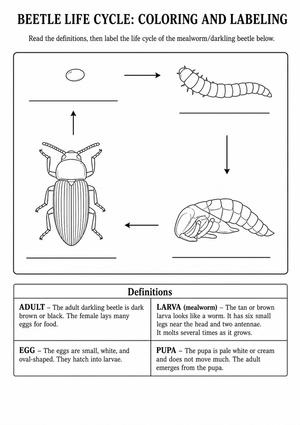
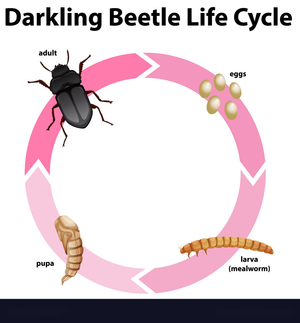
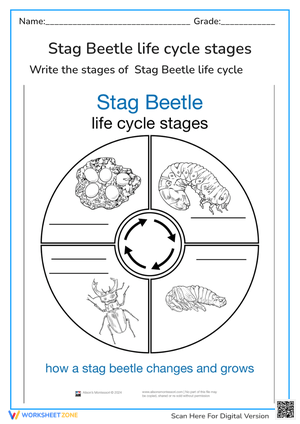
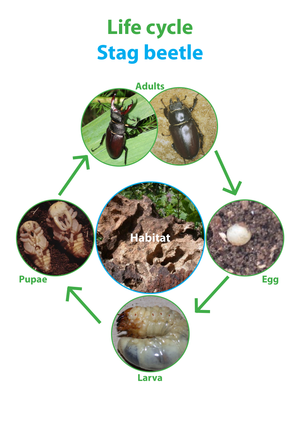
Beetles undergo complete metamorphosis, meaning they pass through four distinct and visually different stages: egg, larva, pupa, and adult. Unlike incomplete metamorphosis insects, a beetle at each stage looks nothing like the stage before it, which is exactly what makes sequencing worksheets so effective for this unit. Students can sort images by physical features alone rather than relying on labels.
- Egg: the beginning stage, often laid in soil, wood, or decaying matter depending on species
- Larva: the main growth and feeding stage
- Pupa: an inactive transformation stage
- Adult: the reproductive, mobile, winged stage most students recognize as a beetle
Each stage plays a specific biological role, and helping students name that role, not just the stage, builds toward deeper standards-aligned understanding of growth and change in organisms.
Stage 1 and 2: Egg and Larva (the Grub Stage)
The beetle larva stage is commonly called a grub, and it is the primary feeding and growth stage of the entire life cycle. During this stage, the young beetle eats continuously and grows rapidly, molting its exoskeleton multiple times as its soft body expands. Grubs look nothing like adult beetles: they are typically soft-bodied, cream or white colored, and segmented, which surprises many students who expect a smaller version of the adult insect.
This is a strong point to pause for a labeling worksheet, since students often mislabel the larva as a caterpillar or a worm. Reinforcing the vocabulary word grub, alongside larva, helps students connect the general science term to the specific beetle example.
Stage 3: The Pupa, an Inactive but Essential Stage
During the pupa stage the insect is inactive and does not eat, dedicating this period entirely to internal transformation. This is a detail worksheets alone rarely capture: students often assume the pupa is dormant or resting, when in fact the beetle's body is undergoing dramatic internal restructuring, breaking down larval tissue and rebuilding adult structures like wings and legs. Naming this stage as active transformation rather than rest is a useful correction to build into class discussion before students complete a stage-matching activity.
Mealworms, a common classroom beetle species known as the darkling beetle, spend one to three weeks in the pupa stage before emerging as adults. This timeline is short enough that a mealworm observation unit can realistically fit inside a two- to four-week science block, making it one of the more practical hands-on options for elementary classrooms.
Stage 4: The Adult Beetle
When a beetle emerges from the pupa stage, it does not immediately look like the beetle most students picture. Newly emerged adult beetles are pale or whitish and harden and darken in color over time as their exoskeleton cures. This color-change detail is a great formative check: ask students to explain, in one or two sentences, why a freshly emerged beetle looks different from one that has been an adult for several days.
Once the exoskeleton hardens, the adult beetle is capable of flight (in most species), feeding, and reproduction, which restarts the cycle with new eggs.
Worksheet Pairing Ideas for the Beetle Unit
Once students understand the four stages and the biological purpose of each, worksheets become a tool for retention rather than a first introduction. Consider pairing this content with:
- A four-box sequencing worksheet using egg, larva, pupa, and adult images in the correct order
- A labeling diagram identifying key features at each stage, including the exoskeleton and developing wings
- A vocabulary matching page covering larva, pupa, exoskeleton, and metamorphosis
- A life cycle wheel craft that students can reference throughout the unit
- A short written response asking students to explain why the pupa stage is inactive but essential
For classes running a live mealworm observation, add a simple science journal page where students record color, size, and stage changes over the one- to three-week pupa window, then connect their notes back to the worksheet sequence.
Frequently Asked Questions
1. How many stages are in a beetle life cycle and what happens in each?
There are four stages: egg, larva (grub), pupa, and adult. The larva stage is the main feeding and growth period, the pupa stage is an inactive but essential transformation period, and the adult stage is when the beetle reproduces and the cycle begins again.
2. What grade level is best suited to teach beetle metamorphosis?
This topic fits well in grades 2 through 4 elementary science, where students are building foundational understanding of organism growth and change and can handle the vocabulary shift from general terms like insect to specific terms like larva and pupa.
3. How long does it take a beetle to go from egg to adult?
Timelines vary by species, but mealworms, or darkling beetles, spend roughly one to three weeks in the pupa stage alone, making the full egg-to-adult cycle realistic to track within a classroom unit of several weeks.
4. How is a beetle life cycle different from a grasshopper life cycle?
Beetles undergo complete metamorphosis with four visually distinct stages, while grasshoppers undergo incomplete metamorphosis, where the young nymph already resembles a smaller adult and simply grows larger without a pupa stage.
5. What classroom materials or live specimens work best for teaching this unit?
Mealworms are a common, low-cost, low-maintenance option for a live classroom life cycle unit, requiring only bran or oats, a slice of potato or apple for moisture, and periodic observation rather than daily handling.












 Interactive Worksheet Maker
 Quiz Maker
 Word Search Maker
 Crossword Puzzle Maker
 Word Scramble Generator
 Sentence Scramble Generator
 Handwriting Worksheet Generator
 Name Tracing Generator
 Fill In The Blank Generator