


























Views
Downloads

Printable Butterfly Life Cycle Worksheet | Grade 3 Science
Paste this activity's link or code into your existing LMS (Google Classroom, Canvas, Teams, Schoology, Moodle, etc.).
Students can open and work on the activity right away, with no student login required.
You'll still be able to track student progress and results from your teacher account.
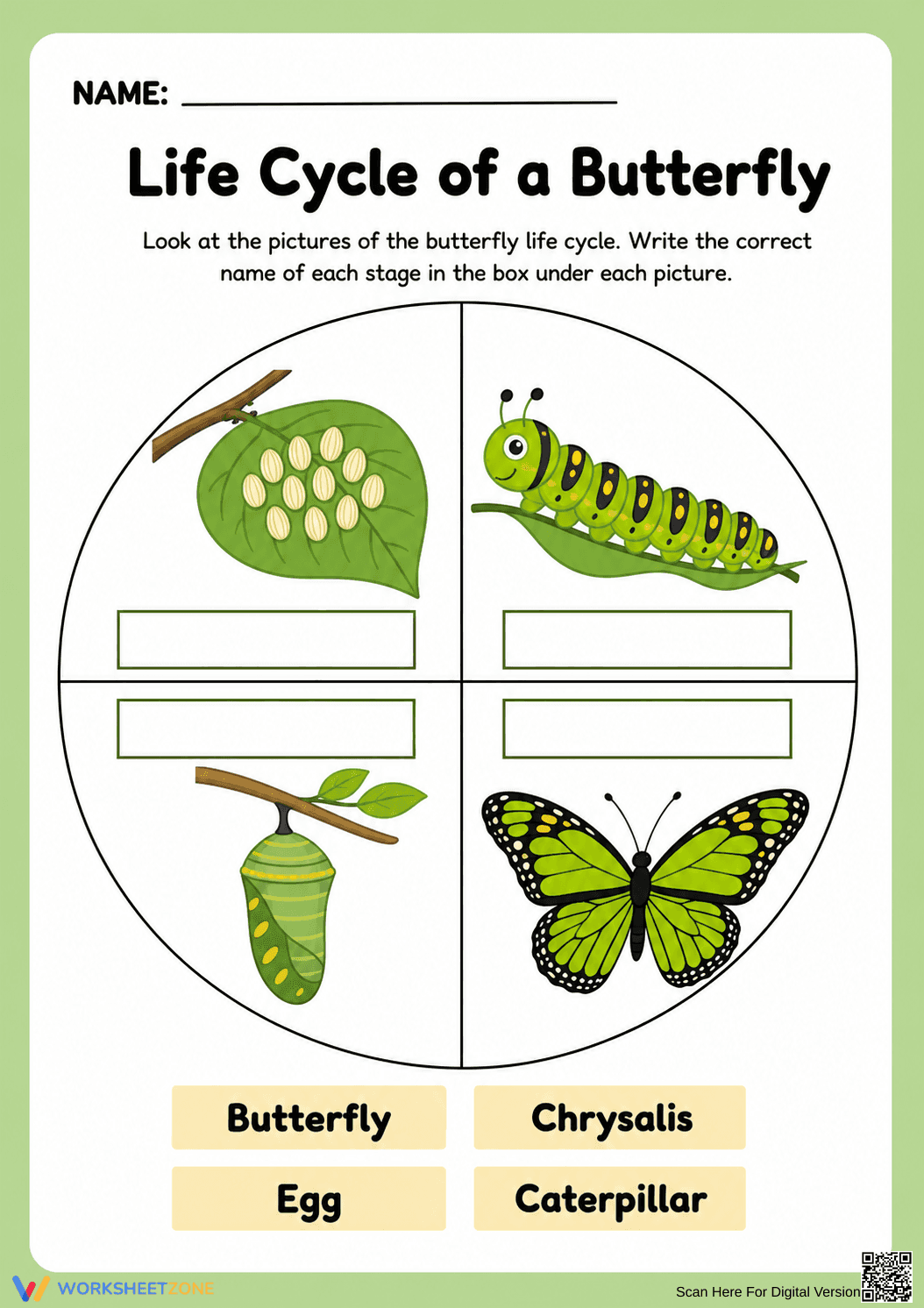
This printable science worksheet helps students master the stages of metamorphosis by labeling the butterfly life cycle. By matching key vocabulary terms to clear visual models, young learners build foundational biology skills and reinforce their understanding of how living organisms grow and change over time.
At a Glance
- Grade: 3 · Subject: Science
- Standard:
3-LS1-1— Describe that organisms have unique and diverse life cycles.- Skill Focus: Labeling butterfly life cycle stages
- Format: 1 page · 4 problems · Answer key included · PDF
- Best For: Independent practice
- Time: 10–15 minutes
This single-page resource features a clear, circular diagram illustrating the four main stages of a butterfly's development: egg, caterpillar, chrysalis, and adult butterfly. Students are provided with four empty text boxes corresponding to each illustration and a helpful word bank at the bottom of the page to guide their spelling and vocabulary selection. A complete answer key is included to ensure accurate grading and immediate feedback.
Designed for maximum efficiency, this worksheet requires absolutely no teacher setup.
- Print (1 minute): Simply download the PDF and print a class set. The clear design saves ink and prints beautifully in black and white.
- Distribute (1 minute): Hand out the worksheets along with pencils. The instructions are self-explanatory, allowing students to begin immediately.
- Review (3 minutes): Quickly check student responses using the provided answer key or review as a whole class.
With a total prep time of under two minutes, this activity is an excellent addition to any emergency sub plan or busy science block.
This activity is directly aligned with Next Generation Science Standard 3-LS1-1: Develop models to describe that organisms have unique and diverse life cycles but all have in common birth, growth, reproduction, and death. It also supports early elementary life science frameworks by emphasizing sequential biological processes. Both standard codes can be copied directly into lesson plans, IEP goals, or district curriculum mapping tools.
This labeling activity works exceptionally well as an independent practice assignment immediately following direct instruction on insect metamorphosis. Alternatively, teachers can place it in a science center for collaborative group work. As a formative assessment tip, observe whether students can correctly sequence the chrysalis and caterpillar stages without relying heavily on the word bank, which indicates a solid grasp of the developmental timeline. Expect students to complete this task within 10 to 15 minutes.
This resource is primarily designed for second and third-grade students developing their foundational life science vocabulary. The inclusion of a word bank provides built-in differentiation, making it accessible for English Language Learners and students who require spelling support. It pairs perfectly with a read-aloud book about caterpillars or a hands-on butterfly observation kit.
Understanding biological sequences is a critical component of early elementary science education. When students engage with standard 3-LS1-1 to describe that organisms have unique and diverse life cycles, they develop essential cognitive mapping skills. Research from ScienceDirect TpT Analysis highlights that integrating visual diagrams with targeted vocabulary practice significantly improves long-term retention of scientific concepts in young learners. By requiring students to actively connect terms like "chrysalis" and "caterpillar" to specific visual representations, this worksheet moves beyond rote memorization into meaningful conceptual application. The structured format reduces cognitive load, allowing students to focus entirely on the biological sequence rather than complex task instructions. This targeted approach ensures that foundational life science principles are firmly established before students progress to more complex ecological studies in upper elementary grades.


