


























Views
Downloads

Butterfly Life Cycle Matching Worksheet | Grade 2 Ready
Paste this activity's link or code into your existing LMS (Google Classroom, Canvas, Teams, Schoology, Moodle, etc.).
Students can open and work on the activity right away, with no student login required.
You'll still be able to track student progress and results from your teacher account.
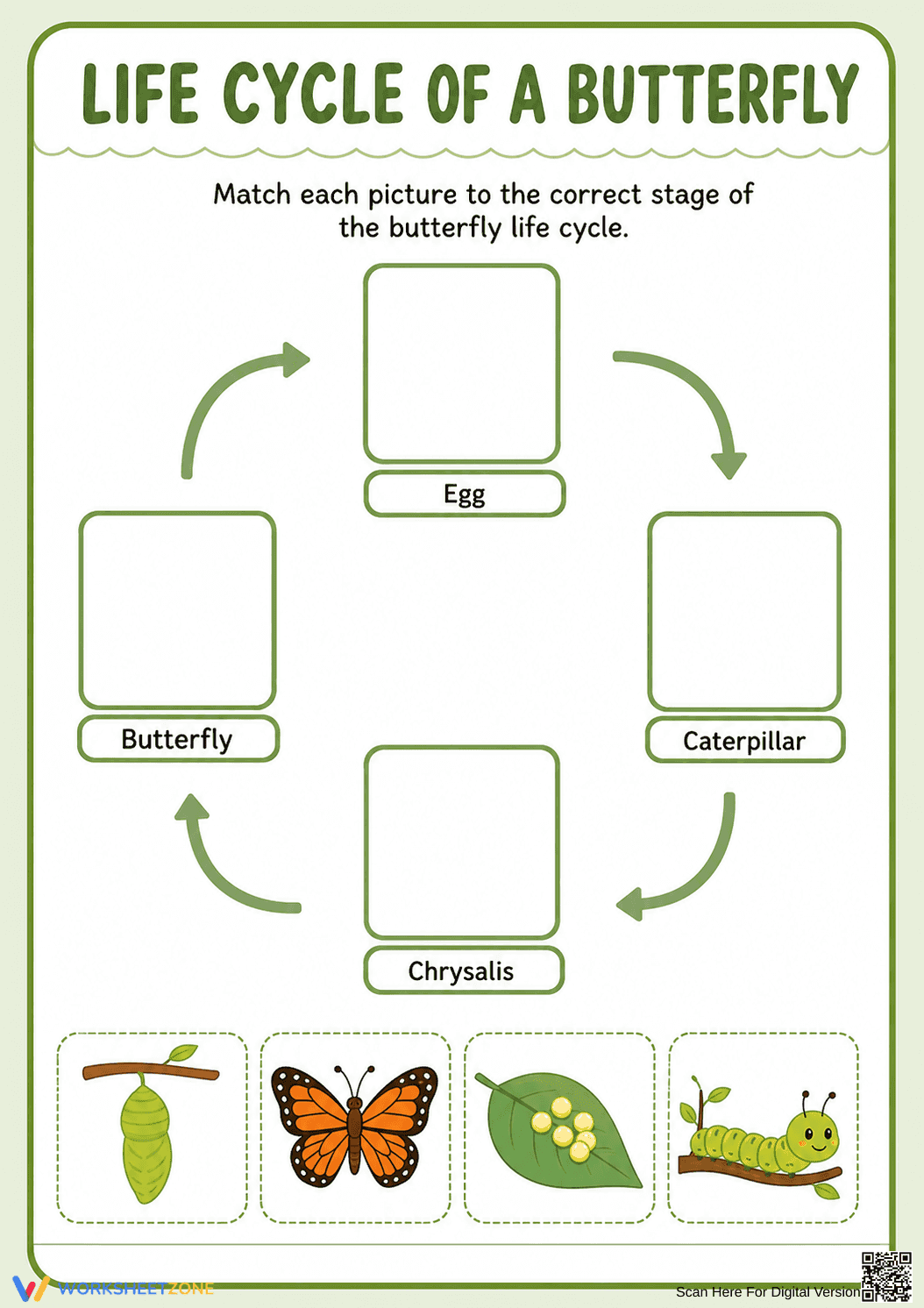
This butterfly life cycle matching activity helps students visualize the transformation from egg to adult. By physically arranging the stages of metamorphosis, learners develop a concrete understanding of biological growth and development. It provides a clear, interactive way to assess student comprehension of insect life cycles and sequencing skills while building foundational scientific vocabulary.
At a Glance
- Grade: 2 · Subject: Science
- Standard:
3-LS1-1— Develop models to describe that organisms have unique and diverse life cycles- Skill Focus: Metamorphosis Sequencing
- Format: 1 page · 4 problems · Answer key included · PDF
- Best For: Independent practice or science centers
- Time: 10–15 minutes
This single-page PDF features a circular life cycle diagram with four designated slots for the egg, caterpillar, chrysalis, and butterfly stages. At the bottom of the page, students find four high-quality illustrations ready for cutting and pasting. The layout is clean and intuitive, ensuring that young learners can focus on the scientific concepts without being overwhelmed by complex instructions or cluttered design.
The zero-prep workflow for this activity is designed for maximum efficiency in busy classrooms. First, print the required number of copies for your class in under 30 seconds. Next, distribute the sheets along with scissors and glue sticks, which takes about 1 minute. Finally, review the completed cycles as a whole group to reinforce the vocabulary in approximately 5 minutes. This makes it an ideal choice for emergency sub plans or quick morning work.
This resource is aligned with 3-LS1-1, which requires students to develop models to describe that organisms have unique and diverse life cycles but all have in common birth, growth, reproduction, and death. It also supports CCSS.ELA-LITERACY.RI.2.3 by asking students to describe the connection between a series of scientific ideas or steps in technical procedures. Both standard codes can be copied directly into lesson plans, IEP goals, or district curriculum mapping tools.
Use this worksheet as a formative assessment after a read-aloud about butterflies. It works best during the "elaborate" phase of a 5E lesson plan. Teachers should observe whether students correctly identify the chrysalis stage, as this is often the most confused part of the sequence. Expect students to complete the matching and coloring in a range of 10 to 15 minutes depending on their fine motor skills.
This activity is designed for elementary students in grades 2 through 4, particularly those who benefit from tactile and visual learning. It is highly effective for English Language Learners (ELLs) because it uses clear imagery to bridge the gap between vocabulary and biological concepts. Pair this with a live butterfly kit or a time-lapse video of metamorphosis for a complete instructional unit that engages multiple senses.
According to the RAND AIRS 2024 report on elementary science instruction, interactive modeling through sequencing activities significantly improves long-term retention of biological processes in early childhood education. This worksheet leverages that research by requiring students to actively manipulate the stages of the 3-LS1-1 standard. By matching the egg, caterpillar, chrysalis, and butterfly images to their corresponding labels, students move beyond rote memorization into conceptual modeling. The use of a circular diagram reinforces the cycle aspect of life, a fundamental concept in the NGSS framework. Research from Fisher & Frey (2014) suggests that such scaffolded, visual tasks are essential for developing the domain-specific vocabulary necessary for scientific literacy. This resource provides a structured environment where students can practice these skills independently, making it a reliable tool for both general education classrooms and specialized instructional settings focused on life science mastery.


