




























Views
Downloads

Printable Butterfly Life Cycle Worksheet | Grade 4-5

Paste this activity's link or code into your existing LMS (Google Classroom, Canvas, Teams, Schoology, Moodle, etc.).
Students can open and work on the activity right away, with no student login required.
You'll still be able to track student progress and results from your teacher account.
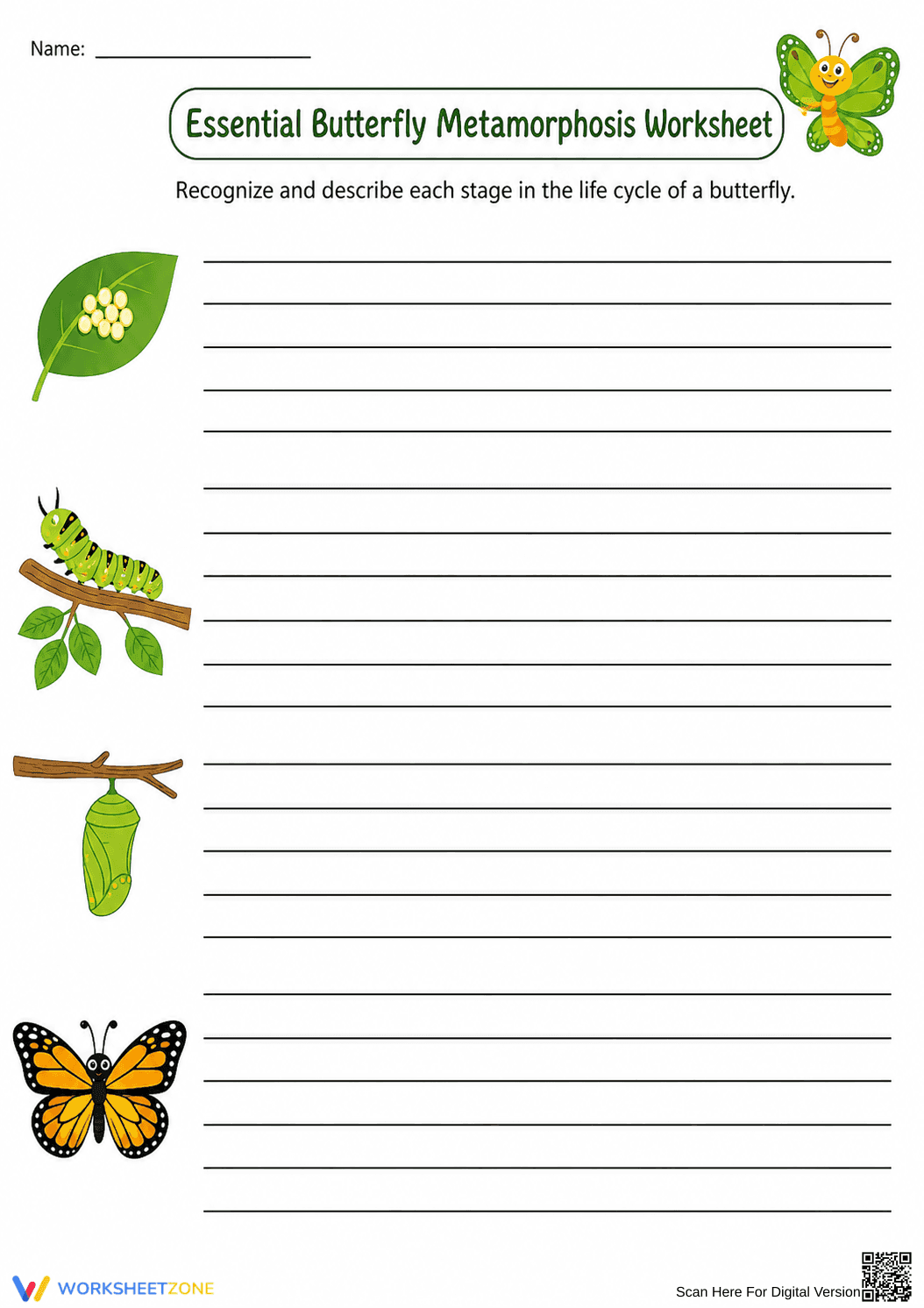
This Grade 4 and 5 science worksheet focuses on the biological process of butterfly metamorphosis, enabling students to recognize and describe each distinct stage of growth. By engaging with visual cues and descriptive writing prompts, learners develop a concrete understanding of life cycles and master essential scientific terminology.
At a Glance
- Grade: 4–5 · Subject: Science
- Standard:
3-LS1-1— Describe unique life cycles and common birth and growth patterns- Skill Focus: Butterfly Metamorphosis
- Format: 1 page · 4 problems · Answer key included · PDF
- Best For: Independent practice or sub plans
- Time: 15–20 minutes
What's Inside
This single-page PDF features four high-quality illustrations representing the egg, larva, pupa, and adult butterfly stages. Each image is paired with ample horizontal lines, providing a structured space for students to practice scientific observation and technical writing. A complete answer key is provided to facilitate quick grading or student self-correction.
Zero-Prep Workflow
To implement this resource, teachers follow a simple three-step process: Print (30 seconds), Distribute (1 minute), and Review (5 minutes). Because the worksheet is self-contained with clear visual prompts and instructional text, it requires zero prior setup or supplementary materials. Total teacher prep time is under two minutes, making it an ideal choice for emergency sub plans or as a transition activity between main science lessons.
Standards Alignment
This resource is aligned with 3-LS1-1, requiring students to develop models to describe that organisms have unique and diverse life cycles but all have in common birth, growth, reproduction, and death. By describing the specific metamorphosis of the butterfly, students provide evidence of these biological stages. Both standard codes can be copied directly into lesson plans, IEP goals, or district curriculum mapping tools.
How to Use It
Use this worksheet as a summative assessment after a unit on insect life cycles to check for individual student mastery. Alternatively, it serves as an excellent independent practice activity during science centers. As a formative assessment observation tip, watch for students who can name the stages but struggle to describe the physical changes, indicating a need for more visual support. Expect a completion time of 15 to 20 minutes.
Who It's For
The worksheet is designed for Grade 4 and 5 students studying living things and life cycles. It is particularly effective for visual learners and can be differentiated by providing word banks for students who require additional writing support. It pairs naturally with a time-lapse video of a butterfly hatching or a classroom observation of a live butterfly garden.
The butterfly metamorphosis worksheet provides a structured approach to the 3-LS1-1 standard, focusing on the ability to describe unique life cycles and common birth and growth patterns. According to Fisher & Frey (2014), the use of visual scaffolds combined with descriptive writing prompts significantly enhances the retention of technical vocabulary and complex biological concepts in upper elementary students. This resource targets four specific stages of metamorphosis, ensuring that students can identify the transition points and unique characteristics of each phase. Scientific literacy is bolstered as students translate visual observations into precise scientific language. By isolating the butterfly's transformation, teachers can effectively measure student understanding of growth and development patterns as outlined in national science frameworks. This worksheet is part of a comprehensive science curriculum designed to minimize teacher prep while maximizing student engagement with core disciplinary ideas in life science.


