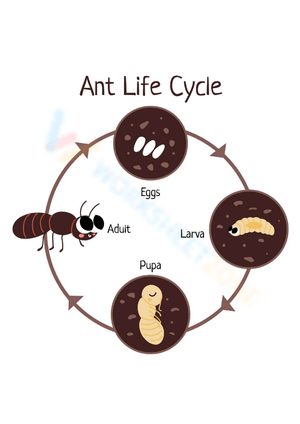
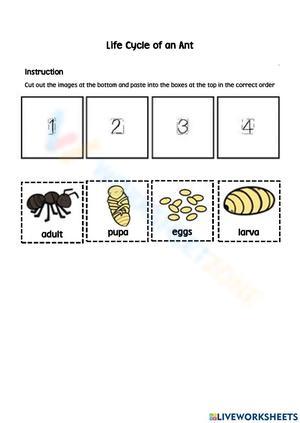
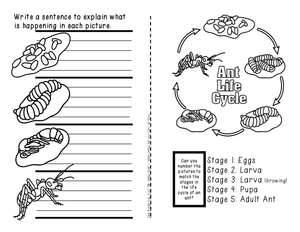
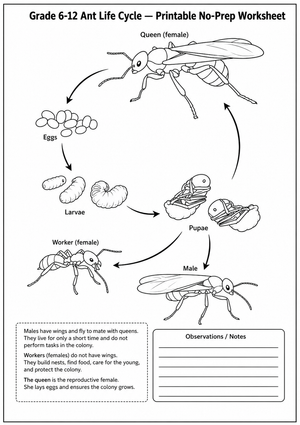
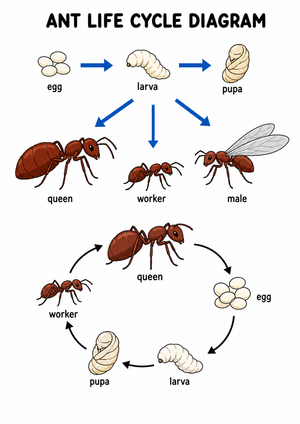
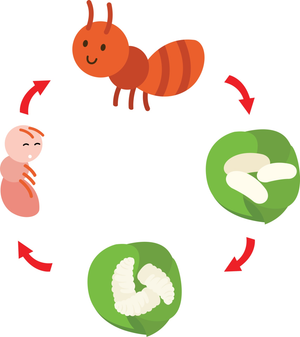
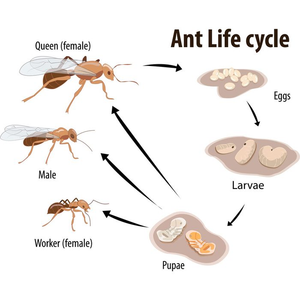
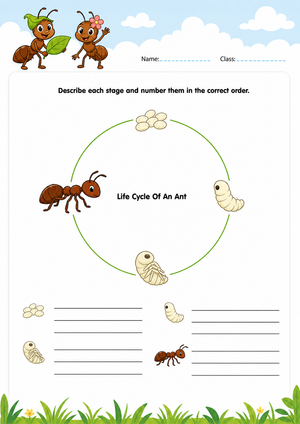
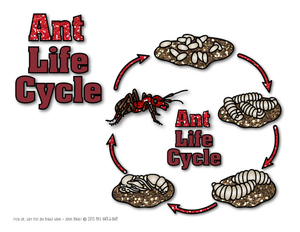
Helping your child explore the natural world at home should feel like a shared adventure rather than another chore at the kitchen table. Many parents tell us they want to support science learning but worry about finding materials that feel both gentle and meaningful. Our ant life cycle worksheets give you a calm, structured way to guide your child through one of the most fascinating insect societies on Earth, with no special background knowledge required on your part.
Each page is built to grow alongside your child, beginning with simple labeling tasks for the head, thorax, and abdomen and gradually moving into colony roles, tunnel mapping, and food-gathering routines. As your child completes each section, they build quiet confidence in observing patterns, following directions, and recording what they notice. Teachers value these same pages because they slot neatly into a lesson plan or independent science center.
The visual design invites curiosity rather than rushing through facts. Soft illustrations of worker ants, queens, and larvae give young students room to color, trace, and ask questions, turning practice into something that feels like play. Printable formats mean you can revisit a favorite activity whenever your child wants to look closer, and the included PDF answer keys take the guesswork out of checking work together at the end of the day.
Beyond simple identification, these ant life cycle worksheets open a window into the science your child is meeting in the classroom, including life cycles, habitats, and animal communities. Pair them with our guide to plant life cycle activities for a deeper unit on living systems, or branch into our butterfly life cycle pages when your young learner is ready for another insect adventure with familiar pacing.
Make ant life cycle worksheets part of a quiet weekend morning, a rainy afternoon, or a summer learning routine that keeps skills warm without pressure. Worksheetzone created this collection so families and classrooms could share clear, age-appropriate science resources side by side. Print a few pages, sit beside your child, and enjoy watching their understanding of these tiny, hardworking insects grow with every focused minute through ant worksheets.
Frequently Asked Questions
Question 1: What grade levels are ant life cycle worksheets best suited for?
Our worksheets are designed to support learners from kindergarten through upper elementary grades, with simpler labeling pages for younger children and more detailed colony-structure activities for older students. Teachers often use them across grades two through five, while parents can adapt them for preschoolers by focusing on coloring and basic vocabulary. The flexible format makes it easy to match the right page to your child's current reading level and science background.
Question 2: How do these worksheets support classroom science standards?
The ant life cycle worksheets align with common life science topics including animal life cycles, habitats, anatomy, and community behavior. Teachers can use them to introduce vocabulary, reinforce observation skills, and prompt discussion about insect roles in an ecosystem. The printable PDF format works well for stations, homework folders, or substitute lesson plans, and each page leaves room for students to record their own questions, drawings, and short written reflections.
Question 3: Can parents use ant life cycle worksheets without a science background?
Yes, the worksheets are written so any caring adult can guide a child through them confidently. Clear instructions, friendly illustrations, and included answer keys remove the pressure of needing to remember biology details. Parents can sit beside their child, read the prompts together, and treat each page as a shared discovery rather than a quiz, which builds both learning skills and a positive attitude toward science at home.
Question 4: How do these life cycle worksheets connect to broader insect studies?
Ants are an excellent gateway into the wider insect world because their colonies show clear roles, life stages, and habitats. After completing the ant pages, students naturally become curious about bees, butterflies, beetles, and other insects with similar structures. Teachers and parents can pair these worksheets with our other insect life cycle resources to build a longer thematic unit, helping students notice patterns across different species over several weeks.












 Interactive Worksheet Maker
 Quiz Maker
 Word Search Maker
 Crossword Puzzle Maker
 Word Scramble Generator
 Sentence Scramble Generator
 Handwriting Worksheet Generator
 Name Tracing Generator
 Fill In The Blank Generator