


























Views
Downloads

Printable Cell Organelles Worksheet | Grade 6 Science
Paste this activity's link or code into your existing LMS (Google Classroom, Canvas, Teams, Schoology, Moodle, etc.).
Students can open and work on the activity right away, with no student login required.
You'll still be able to track student progress and results from your teacher account.
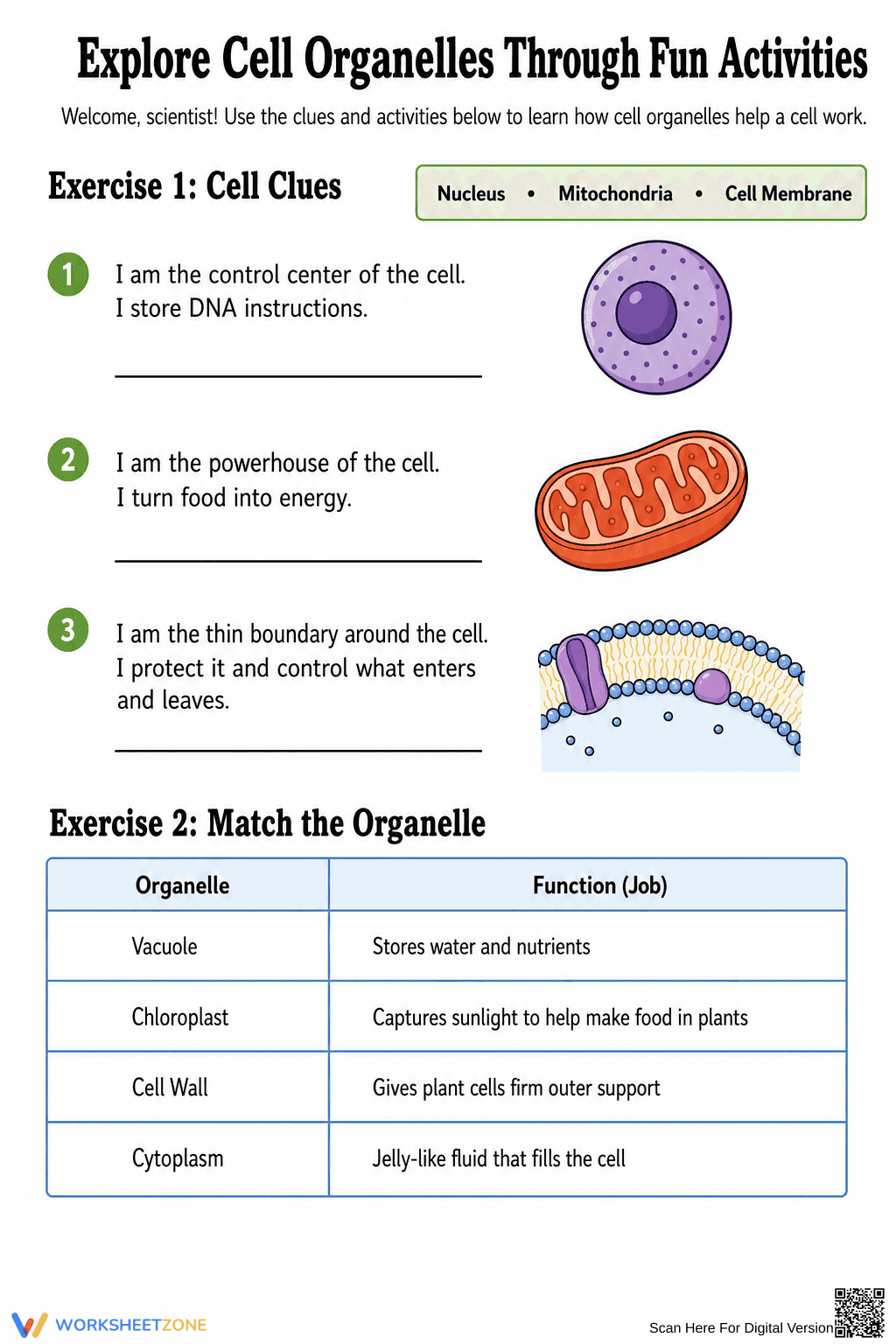
This middle school science worksheet helps students identify cell organelles and understand their specific functions within a cell. By completing visual identification tasks and creating real-world analogies, learners will develop a concrete understanding of microscopic biology concepts.
At a Glance
- Grade: 5–7 · Subject: Science
- Standard:
MS-LS1-2— Describe how cell parts contribute to overall cell function- Skill Focus: Identifying cell organelles and functions
- Format: 2 pages · 10 problems · PDF
- Best For: Independent practice or sub plans
- Time: 20–30 minutes
What's Inside
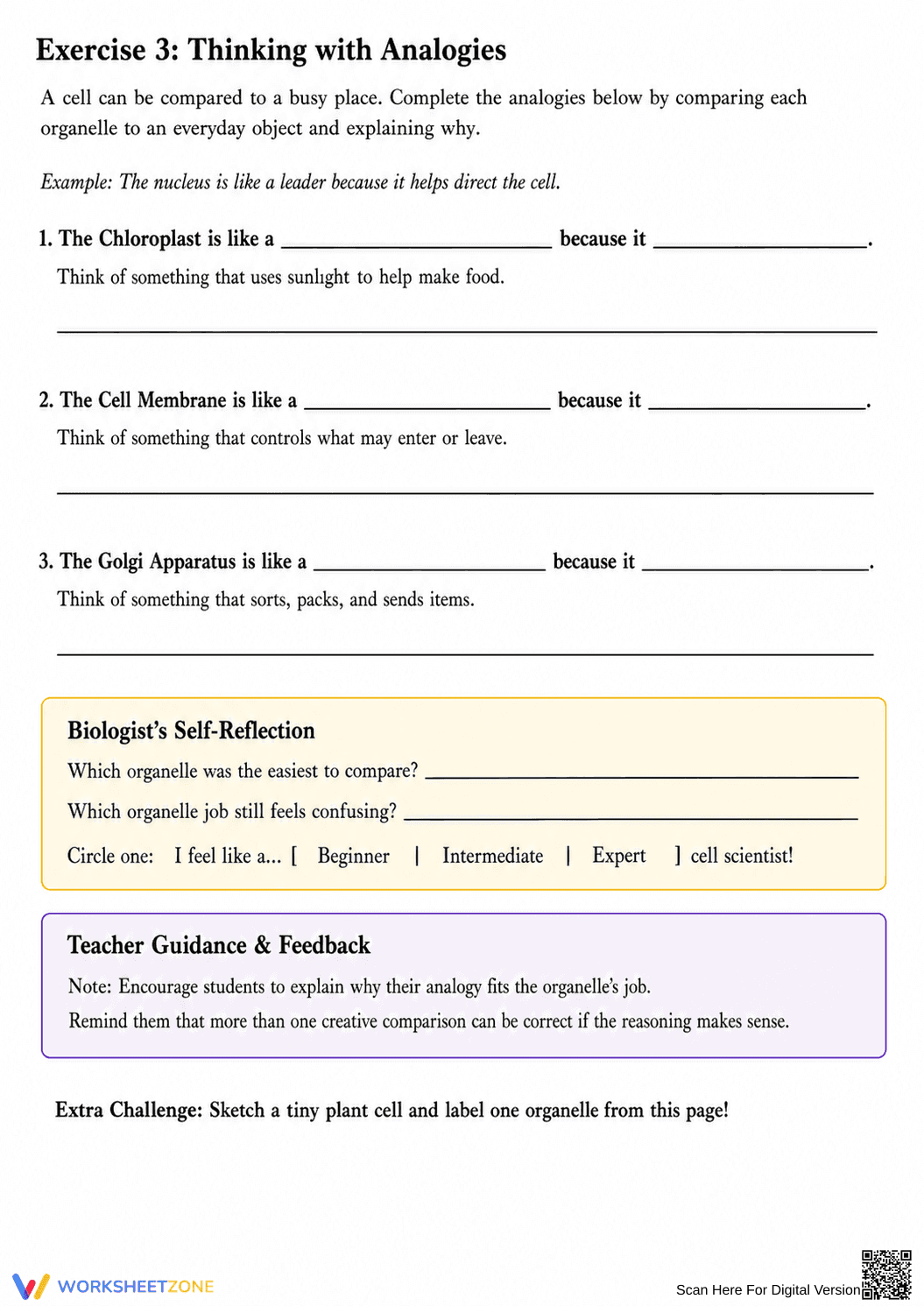
This two-page resource features a variety of engaging task types to reinforce cell biology. Students will find a "Cell Clues" section with visual diagrams, a function reference table, and a "Thinking with Analogies" exercise that prompts them to compare organelles to everyday objects. The worksheet also includes a built-in student self-reflection and an extra drawing challenge for early finishers.
Zero-Prep Workflow
- Print (1 minute): Simply print the two-page PDF double-sided. No special materials or complex teacher setup are required.
- Distribute (1 minute): Hand out the worksheet after a brief introductory lesson on cell structures. The instructions are written directly to the student.
- Review (5 minutes): Use the built-in teacher guidance notes to facilitate a quick class discussion about the creative analogies students developed.
Total teacher prep time is under two minutes, making this an excellent emergency sub plan.
Standards Alignment
Aligned to MS-LS1-2: Develop and use a model to describe the function of a cell as a whole and ways parts of cells contribute to the function. The analogy exercise specifically supports this by having students model organelle functions using familiar systems. Both standard codes can be copied directly into lesson plans, IEP goals, or district curriculum mapping tools.
How to Use It
- Independent Practice: Assign this worksheet immediately following direct instruction on plant and animal cells. The visual clues provide excellent scaffolding for independent work.
- Formative Assessment: Review the "Biologist's Self-Reflection" section at the bottom of page two. This provides immediate insight into which organelles students find confusing, allowing you to adjust tomorrow's warm-up accordingly.
Expected completion time is 20 to 30 minutes.
Who It's For
This resource is designed for Grade 5, 6, and 7 science students in general education or introductory biology settings. The visual supports and analogy frameworks make it highly accessible for diverse learners who might struggle with abstract scientific vocabulary. It pairs perfectly with a 3D cell model building activity or a digital interactive cell diagram.
Aligning instructional materials to MS-LS1-2 ensures students can describe how cell parts contribute to overall cell function. According to EdReports 2024, science curricula that incorporate analogies and visual modeling significantly improve middle school students' retention of abstract biological processes. When educators provide structured opportunities to compare cellular structures to familiar systems, students demonstrate a deeper, more resilient grasp of life science fundamentals. By connecting microscopic organelles to macroscopic, everyday objects, learners bridge the gap between rote memorization and conceptual understanding. This approach not only supports standard mastery but also fosters the critical thinking skills essential for advanced scientific inquiry. Furthermore, integrating self-reflection directly into the learning process encourages metacognition, allowing students to identify their own areas of confusion before moving on to complex cellular interactions. This evidence-based strategy ensures that foundational biology concepts are firmly established, paving the way for future success in high school science courses.


