


























Views
Downloads

Grade 9 Cell Organelles — Printable No-Prep Worksheet
Paste this activity's link or code into your existing LMS (Google Classroom, Canvas, Teams, Schoology, Moodle, etc.).
Students can open and work on the activity right away, with no student login required.
You'll still be able to track student progress and results from your teacher account.
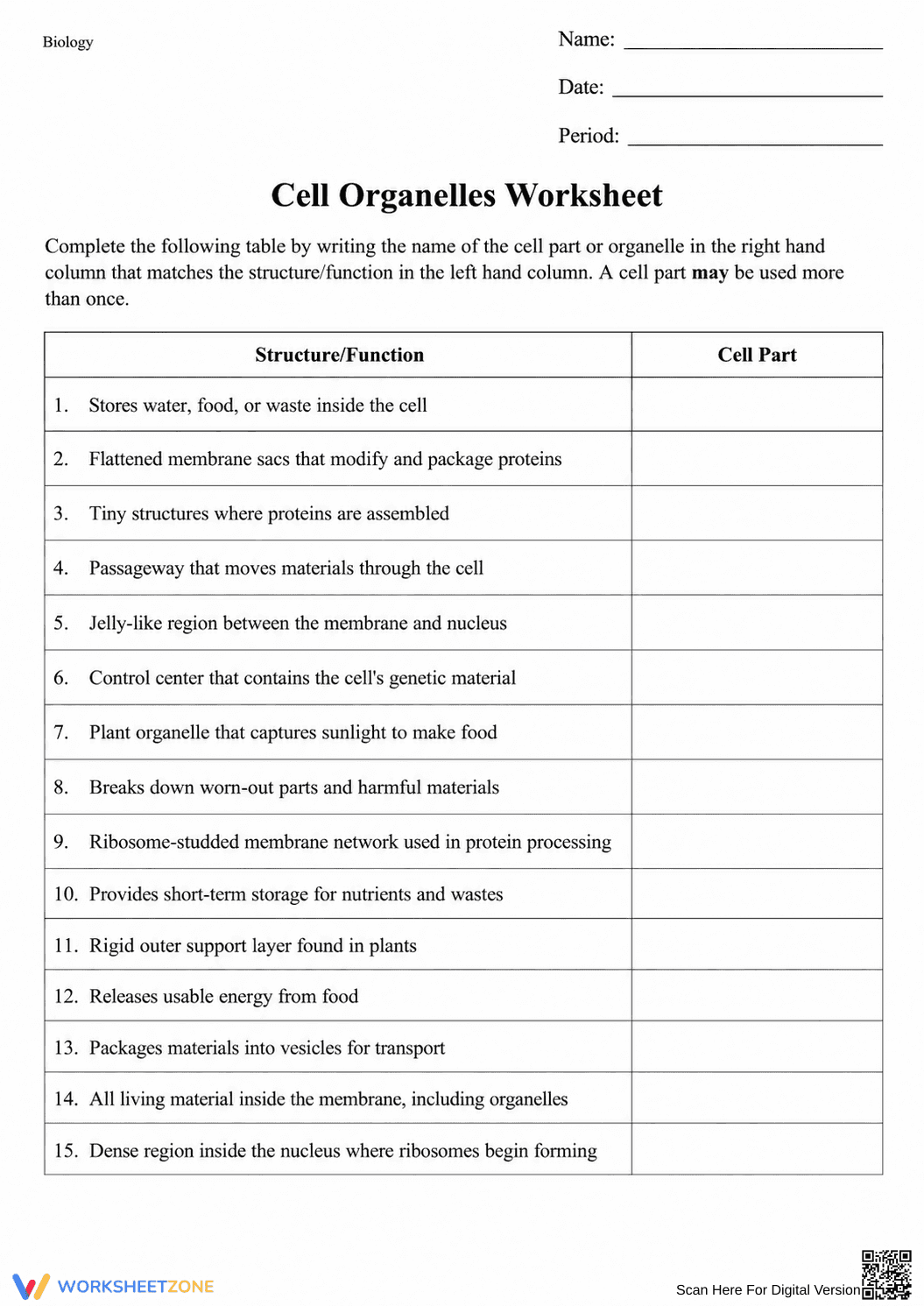
This high school biology worksheet helps students master cell organelles and their specific functions. By matching structural descriptions to the correct cell parts, students build a strong foundation in cellular biology. The clear, straightforward format ensures learners can confidently identify key differences between plant and animal cells.
At a Glance
- Grade: 9-11 · Subject: Biology
- Standard:
HS-LS1-2— Describe how cell parts contribute to overall function- Skill Focus: Cell organelles and functions
- Format: 2 pages · 42 problems · Answer key included · PDF
- Best For: Independent practice and review
- Time: 20–30 minutes
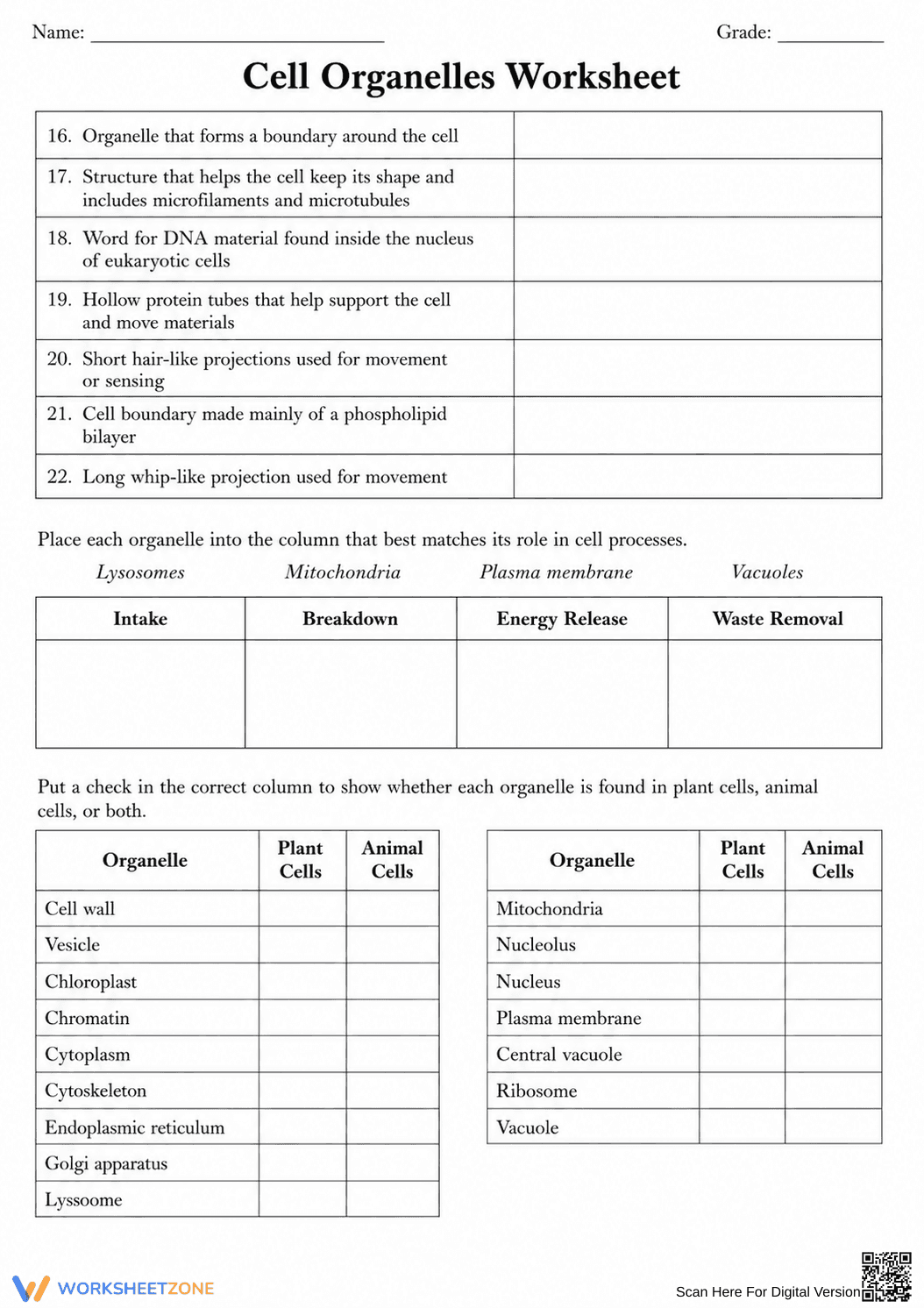
Inside this resource, educators will find a comprehensive two-page activity featuring 42 distinct tasks. The first section includes 22 fill-in-the-blank matching questions where students identify organelles based on their structure or function. The second page features a categorization table for cellular processes like energy release and waste removal, followed by a checklist to distinguish which organelles belong to plant cells, animal cells, or both. A complete answer key is provided for quick grading.
This resource is designed for a seamless, zero-prep workflow:
- Print (1 minute): Simply download the PDF and print double-sided copies for your class.
- Distribute (1 minute): Hand out the worksheets at the start of the lesson or as a structured review activity.
- Review (3 minutes): Use the included answer key to quickly check student understanding or facilitate a whole-class review.
With under two minutes of total teacher prep time, this worksheet is an excellent option for busy educators or as a reliable emergency sub plan.
This worksheet is aligned to HS-LS1-2, requiring students to develop and use a model to illustrate the hierarchical organization of interacting systems that provide specific functions within multicellular organisms. By identifying individual organelles and their roles, students build the necessary knowledge to understand broader cellular systems. Both standard codes can be copied directly into lesson plans, IEP goals, or district curriculum mapping tools.
This worksheet is highly versatile in the classroom. Use it as an independent practice assignment immediately following direct instruction on cell structures to reinforce new vocabulary. Alternatively, it serves as an effective formative assessment tool before a unit exam. As students complete the plant versus animal cell checklist, teachers can circulate and observe whether learners are correctly identifying exclusive structures like chloroplasts and cell walls. Expect students to complete the entire activity in 20 to 30 minutes.
This resource is primarily designed for Grade 9 through 11 biology students. The structured matching format provides built-in scaffolding that benefits visual learners and students needing clear, direct vocabulary practice. It pairs perfectly with a 3D cell model activity or a direct instruction lesson on eukaryotic cell structures, giving students a concrete way to apply what they have just learned.
Understanding cellular structures is a critical component of high school life sciences. This worksheet aligns with HS-LS1-2, helping students describe how cell parts contribute to overall function. According to a ScienceDirect TpT Analysis, structured vocabulary practice and categorization tasks significantly improve long-term retention of complex biological concepts. By requiring students to repeatedly interact with terms like mitochondria, ribosomes, and chloroplasts across different question formats, this resource moves learners beyond rote memorization into functional application. The inclusion of comparative tasks, such as distinguishing between plant and animal cells, further deepens conceptual understanding. Educators can rely on this evidence-based approach to ensure students are adequately prepared for advanced topics in genetics and cellular respiration, making it an essential addition to any biology curriculum.


