


























Views
Downloads

Essential Cell Organelle Worksheet | Grade 8-10 Science
Paste this activity's link or code into your existing LMS (Google Classroom, Canvas, Teams, Schoology, Moodle, etc.).
Students can open and work on the activity right away, with no student login required.
You'll still be able to track student progress and results from your teacher account.
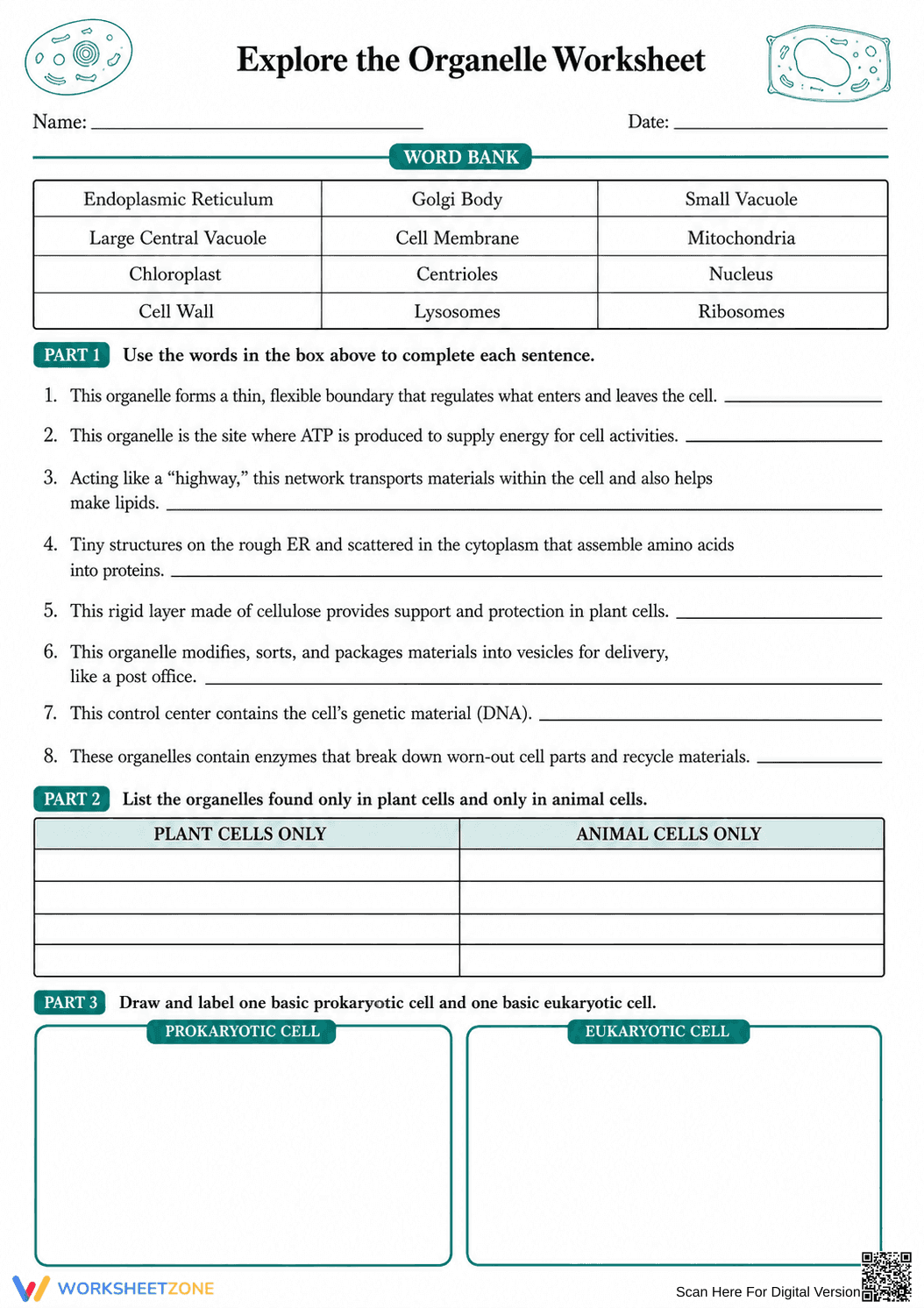
This comprehensive cell biology worksheet helps students master the identification and function of major organelles. By connecting structural features to biological roles, learners build a foundational understanding of how eukaryotic and prokaryotic cells operate. It provides a clear path from vocabulary acquisition to conceptual comparison and visual modeling.
At a Glance
- Grade: 8-10 · Subject: Science
- Standard:
MS-LS1-2— Develop and use a model to describe the function of a cell- Skill Focus: Organelle identification and cell comparison
- Format: 1 page · 11 tasks · Answer key included · PDF
- Best For: Mid-unit review or formative assessment
- Time: 25–35 minutes
The resource features three distinct sections designed to reinforce cellular anatomy. It begins with a 12-term word bank supporting eight descriptive fill-in-the-blank questions. Following this, a structured comparison table requires students to categorize organelles by cell type. The final section provides dedicated space for drawing and labeling prokaryotic and eukaryotic models, ensuring a multi-modal learning experience.
This worksheet is designed for an immediate, zero-prep classroom workflow. Teachers can print the single-page PDF in under 30 seconds. Distribution takes less than a minute, and the structured layout allows students to work independently with minimal guidance. Reviewing the completed work is streamlined by the included answer key, making it an ideal choice for emergency sub plans or quick check-ins.
This activity aligns directly with MS-LS1-2, focusing on the relationship between cell parts and the function of the cell as a whole. It also supports HS-LS1-2 by requiring students to illustrate the hierarchical organization of specialized cells. Both standard codes can be copied directly into lesson plans, IEP goals, or district curriculum mapping tools.
Use this worksheet as a formative assessment after a lecture on cell structure to gauge student retention. Alternatively, assign it as a collaborative lab station activity where students use microscopes to verify the structures they are labeling. Expect students to spend approximately 30 minutes completing all three parts, including the detailed drawing section.
This resource is tailored for middle and high school biology students, including those in inclusive classrooms who benefit from the provided word bank. It pairs naturally with a cell membrane anchor chart or a digital microscope lab. The clear formatting supports English Language Learners by providing specific vocabulary cues alongside functional descriptions.
According to the RAND AIRS 2024 report, high-quality science materials that integrate visual modeling with textual evidence significantly improve long-term retention of complex biological concepts. This worksheet addresses the MS-LS1-2 standard by requiring students to move beyond rote memorization of organelle names toward a functional understanding of cellular systems. By comparing plant and animal cells and illustrating the differences between prokaryotes and eukaryotes, students engage in the modeling practice central to modern science frameworks. Research from Fisher & Frey (2014) emphasizes that scaffolded vocabulary support, such as the word bank provided here, allows students to focus cognitive energy on higher-order analysis rather than simple recall. This 11-task resource provides the necessary structure for students to demonstrate mastery of cellular anatomy while building the visual literacy skills required for advanced biological studies in high school and beyond.


