


























Views
Downloads

Grade 7 Cell Organelles — Printable No-Prep Worksheet
Paste this activity's link or code into your existing LMS (Google Classroom, Canvas, Teams, Schoology, Moodle, etc.).
Students can open and work on the activity right away, with no student login required.
You'll still be able to track student progress and results from your teacher account.
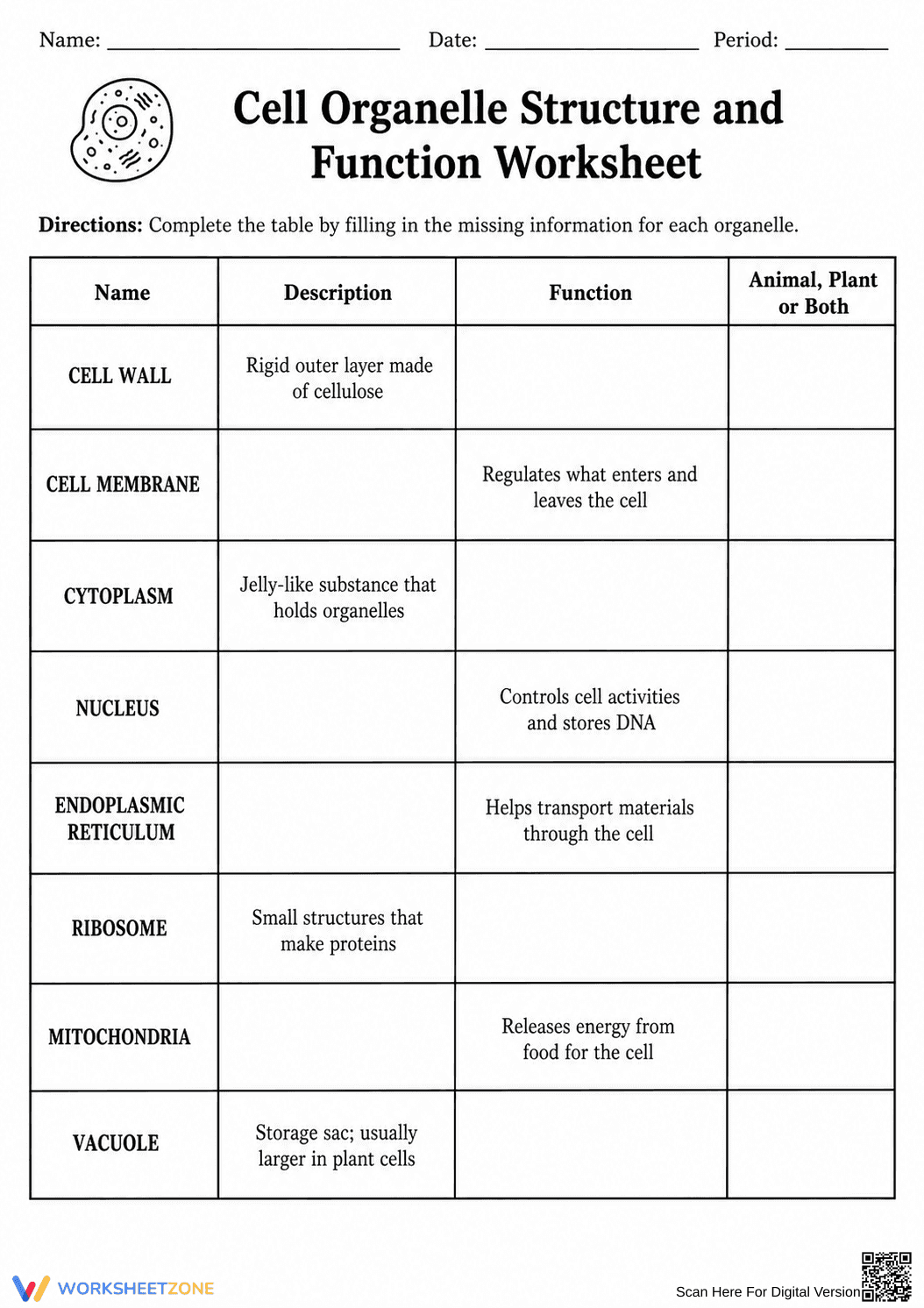
This Grade 7 biology worksheet gives students structured practice identifying cell organelles and their specific roles. By completing the comprehensive tables, learners will solidify their understanding of how cellular structures function and differentiate between plant and animal cells, ensuring they grasp foundational life science concepts.
At a Glance
- Grade: 7 · Subject: Biology
- Standard:
MS-LS1-2— Describe how parts of cells contribute to overall cellular function- Skill Focus: Cell Organelle Structure and Function
- Format: 2 pages · 35 problems · Answer key included · PDF
- Best For: Independent practice or review
- Time: 20–30 minutes
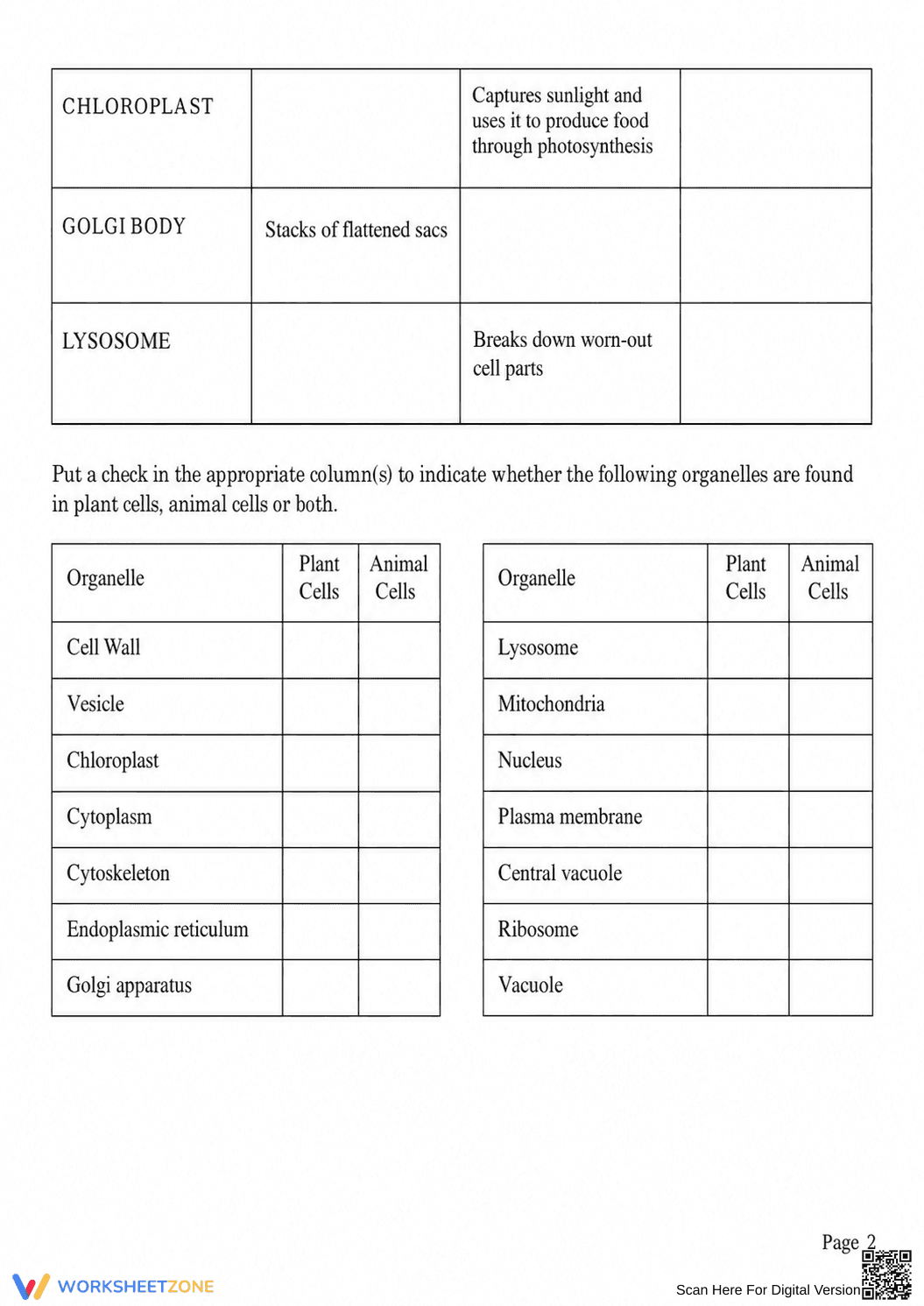
This two-page resource features a highly organized fill-in-the-blank format. The first section includes an extensive table where students supply missing descriptions, primary functions, and cell types (plant, animal, or both) for eleven key organelles, including the mitochondria, nucleus, and endoplasmic reticulum. The second section provides a quick-check grid for fourteen cellular structures, requiring students to categorize them by cell type. A complete answer key is included to streamline grading.
Zero-Prep Workflow
- Print (1 minute): Simply download the PDF and print double-sided for a complete student packet.
- Distribute (1 minute): Hand out the worksheets at the start of class or leave them in a designated sub folder.
- Review (3 minutes): Use the provided answer key to quickly check student progress or facilitate a whole-class review session.
With under two minutes of total teacher prep time, this resource is highly suitable for emergency sub plans or immediate classroom deployment.
Standards Alignment
This worksheet is directly aligned to MS-LS1-2: Develop and use a model to describe the function of a cell as a whole and ways parts of cells contribute to the function. It specifically targets the identification and functional description of individual organelles. Both standard codes can be copied directly into lesson plans, IEP goals, or district curriculum mapping tools.
How to Use It
Deploy this worksheet after direct instruction on cell biology to reinforce new vocabulary and concepts. It serves as an excellent independent practice activity while the teacher circulates the room. As a formative assessment tip, observe whether students struggle to differentiate between the cell wall and cell membrane, which often indicates a need for targeted reteaching. Expected completion time ranges from 20 to 30 minutes depending on student reading levels.
Who It's For
This resource is designed for middle school life science and introductory high school biology students. It provides clear, structured scaffolding for learners who benefit from graphic organizers and tabular data entry. For optimal results, pair this worksheet with a visual anchor chart of plant and animal cells or a 3D cell model demonstration to support visual and kinesthetic learners.
Mastering cellular biology requires repeated exposure to specialized vocabulary and structural relationships. Aligned with MS-LS1-2, this resource helps students describe how parts of cells contribute to overall cellular function through structured, tabular practice. According to Fisher & Frey (2014), utilizing graphic organizers and structured tables significantly improves student retention of complex scientific terminology by reducing cognitive load and visually mapping relationships. By categorizing organelles by their presence in plant or animal cells, students engage in the comparative analysis necessary for higher-order scientific reasoning. This targeted practice ensures learners move beyond rote memorization to a functional understanding of cellular systems, laying the groundwork for advanced biological studies. The clear format supports independent learning, making it a reliable tool for consistent academic growth in the science classroom.


