


























Views
Downloads

Amoeba Sisters Thanksgiving Cards | Grade 3-8 Essential
Paste this activity's link or code into your existing LMS (Google Classroom, Canvas, Teams, Schoology, Moodle, etc.).
Students can open and work on the activity right away, with no student login required.
You'll still be able to track student progress and results from your teacher account.
These Amoeba Sisters Thanksgiving cards provide a creative way for students to express gratitude while reinforcing core biological concepts. By blending humor with scientific accuracy, this resource helps students internalize vocabulary related to cell structures and ecological relationships. It is an ideal bridge between holiday celebrations and rigorous life science curriculum standards.
At a Glance
- Grade: 3-8 · Subject: Science
- Standard:
MS-LS1-1— Provide evidence that living things are made of cells and organelles- Skill Focus: Biological Vocabulary & Gratitude
- Format: 1 page · 4 cards · No answer key required · PDF
- Best For: Holiday science enrichment and sub plans
- Time: 10–15 minutes
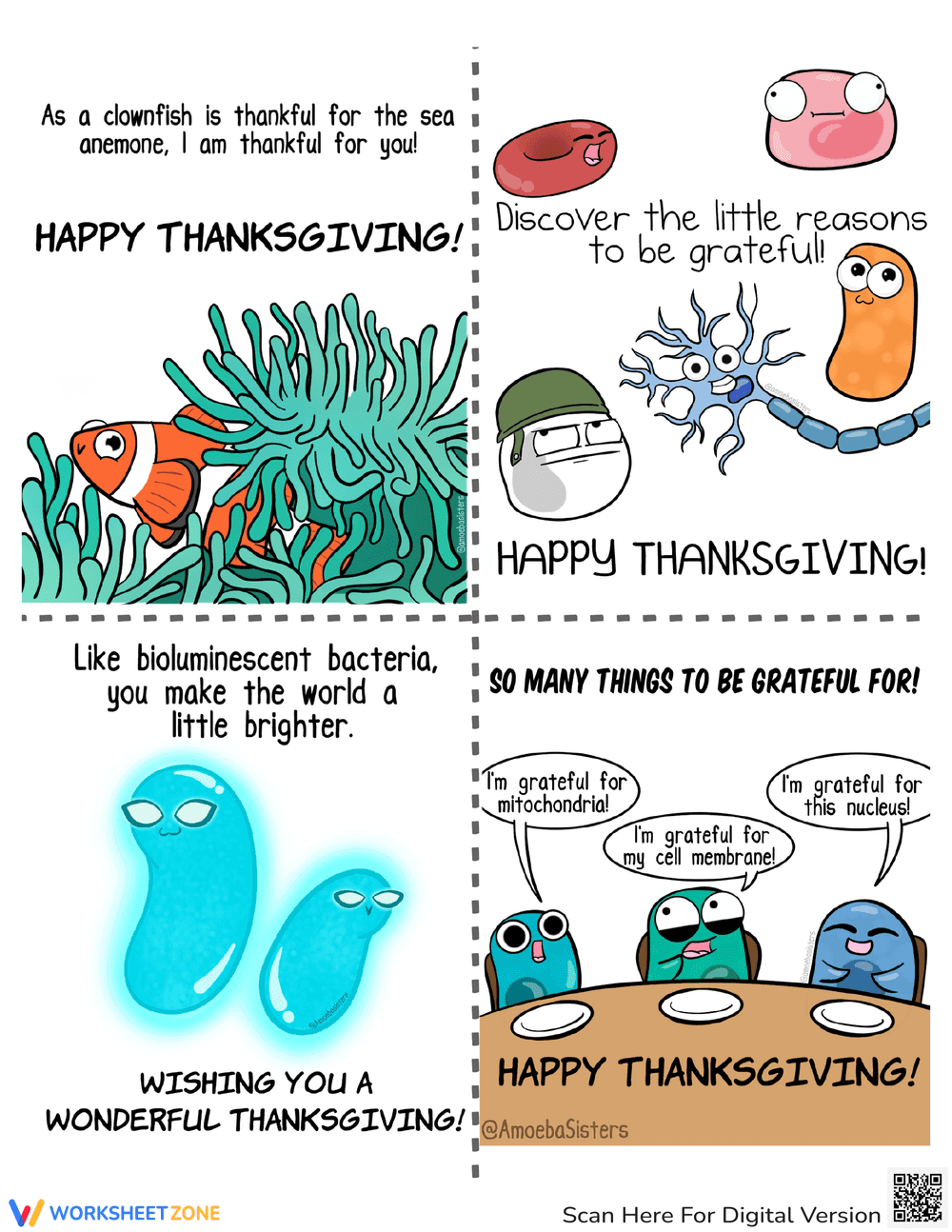
The PDF contains one page with four distinct card designs. Each card features a unique Amoeba Sisters illustration, including a clownfish and anemone (symbiosis), bioluminescent bacteria, and cell organelles like the mitochondria and nucleus. The layout is designed for easy printing and folding, allowing students to write personalized messages on the back or inside of each card.
Zero-Prep Workflow
- Print: Generate the single-page PDF for your entire class in under 30 seconds.
- Distribute: Hand out the sheets and have students cut along the dashed lines to create four individual cards.
- Review: Allow students to identify the science concept and write their messages in 10 to 15 minutes.
Total teacher preparation time is under two minutes, making it an excellent sub plan or transition activity during the short Thanksgiving week.
Standards Alignment
This resource aligns with MS-LS1-1: "Conduct an investigation to provide evidence that living things are made of cells; either one cell or many different numbers and types of cells." It also touches upon ecological interactions. Both standard codes can be copied directly into lesson plans, IEP goals, or district curriculum mapping tools.
How to Use It
Use these cards as a formative assessment exit ticket where students must explain the science pun before leaving for break. Alternatively, assign them as a "Science of Gratitude" station during a classroom rotation. Completion typically takes 15 minutes, providing a meaningful way to observe student understanding of cell parts and symbiotic relationships without the pressure of a formal test.
Who It's For
This activity is designed for students in Grades 3 through 8, particularly those in life science or general biology tracks. It serves as a natural pairing for an Amoeba Sisters video on cell structures or ecological levels of organization, offering a tactile extension to digital instruction for visual and kinesthetic learners.
According to the RAND AIRS 2024 report, integrating creative arts into STEM subjects significantly increases student retention of complex terminology. These cards utilize the humor-effect in cognitive psychology, where mnemonic-style puns regarding the mitochondria and nucleus help anchor abstract concepts in long-term memory. By applying MS-LS1-1 through a social-emotional lens, educators provide a multi-modal learning experience that meets the needs of diverse learners. Fisher & Frey (2014) emphasize that such low-stakes writing tasks are essential for building academic confidence before high-stakes assessments. This resource ensures that the holiday season does not result in instructional downtime but rather reinforces the essential understanding that all living things are composed of functional units called cells.


