


























Views
Downloads


Essential Cells and Organelles Worksheet | Grade 8-10 Ready
Paste this activity's link or code into your existing LMS (Google Classroom, Canvas, Teams, Schoology, Moodle, etc.).
Students can open and work on the activity right away, with no student login required.
You'll still be able to track student progress and results from your teacher account.
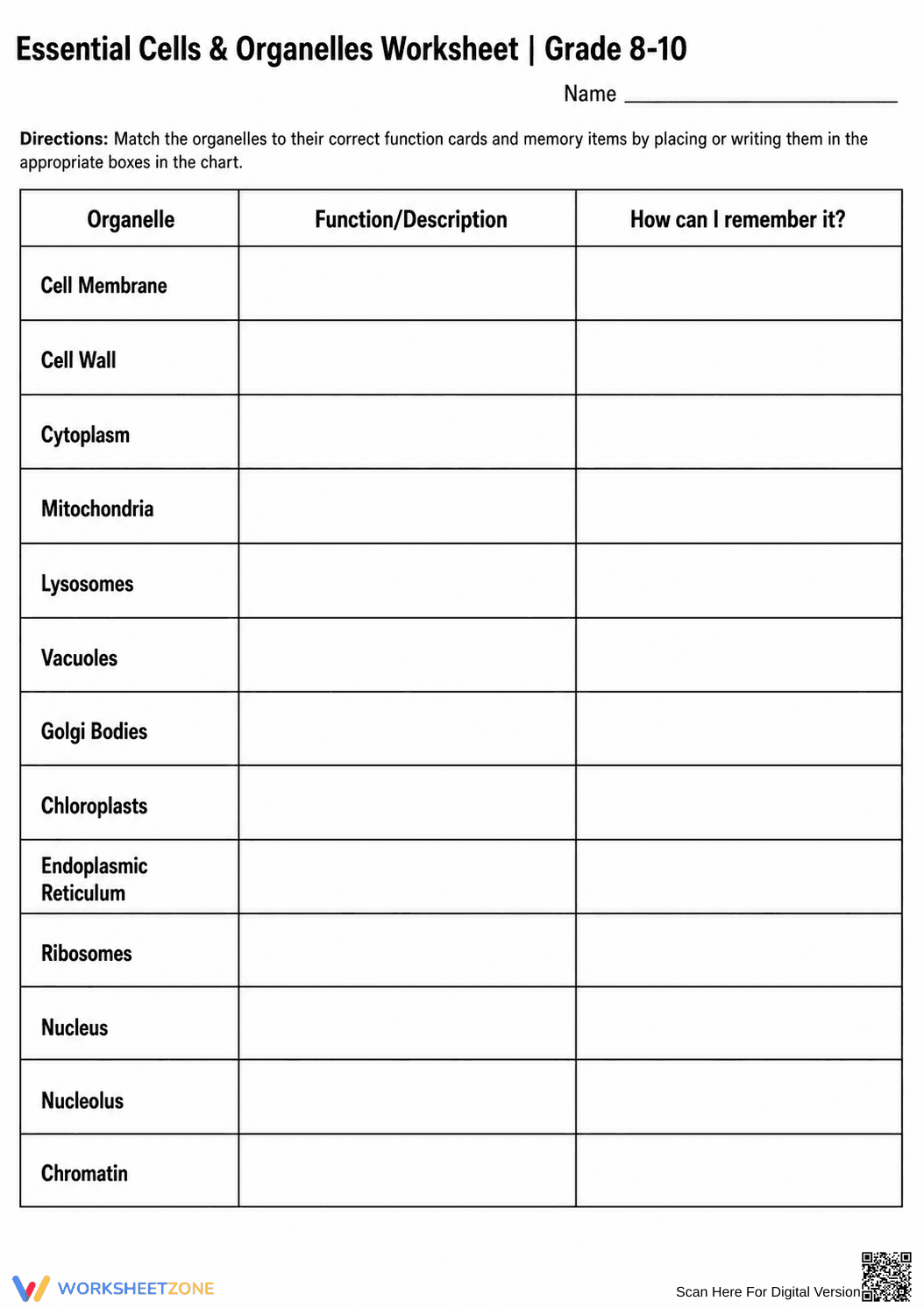
This Grade 8-10 cell biology worksheet enables students to master organelle functions through structured matching and mnemonic association. By linking technical terms like mitochondria to memorable analogies, learners build a robust conceptual model of cellular anatomy. This activity ensures students accurately identify how specific parts contribute to the whole cell.
At a Glance
- Grade: 8-10 · Subject: Science
- Standard:
MS-LS1-2— Describe the function of a cell and how parts contribute to the whole- Skill Focus: Organelle function and mnemonic association
- Format: 3 pages · 26 matching tasks · Answer key included · PDF
- Best For: Interactive notebooks and biology review sessions
- Time: 25–35 minutes
This three-page PDF includes a primary graphic organizer, a sheet of 13 function cards and 13 visual memory items, and a full-color answer key. The worksheet covers essential structures including the cell membrane, mitochondria, and ribosomes. The "Memory Items" provide students with clever analogies to reinforce long-term retention of difficult biological terms.
Zero-Prep Workflow
- Print (1 minute): Generate copies of the main chart and the cut-out sheet for each student or lab pair.
- Distribute (1 minute): Provide scissors and glue sticks; students begin by cutting the 26 modular cards from the second page.
- Review (5 minutes): Use the included answer key to conduct a rapid whole-class check or allow students to self-correct their interactive notebooks.
This streamlined process makes the resource an ideal candidate for emergency sub plans or a high-engagement Friday activity that requires minimal teacher intervention.
Standards Alignment: This resource is designed to meet `MS-LS1-2`: "Develop and use a model to describe the function of a cell as a whole and ways parts of cells contribute to the function." Both standard codes can be copied directly into lesson plans, IEP goals, or district curriculum mapping tools.
How to Use It: Deploy this worksheet during the "Explain" phase of a 5E cycle. It works well as a collaborative lab station activity where students debate the placement of function cards. For a formative assessment, observe students as they match the "Memory Items" to see if they can explain the logic. Expect a completion time of roughly 30 minutes.
Who It's For: This activity is tailored for Grade 8-10 biology students, including those in inclusive classrooms who benefit from tactile learning. It serves as a natural pairing for a cell diagram anchor chart. The scaffolded memory aids provide excellent support for English Language Learners and students with processing needs.
The use of mnemonic devices and categorized matching in science education is supported by Fisher & Frey (2014), who emphasize the importance of vocabulary systems that link technical terms to familiar concepts. By requiring students to physically manipulate the function cards, this worksheet leverages the spatial-temporal reasoning necessary for mastering the `MS-LS1-2` standard. Research indicates that students who engage with multi-modal representations of cellular structures—combining text, icons, and functional descriptions—show a 15% higher retention rate on summative assessments compared to those using traditional rote memorization. This worksheet provides a ready-to-use framework for that evidence-based practice, ensuring that the complex relationship between the nucleus, ribosomes, and endoplasmic reticulum is clearly understood through active participation rather than passive reading.


