


























Views
Downloads

Essential Cell Organelles Worksheet | Grade 5-6 Science
Paste this activity's link or code into your existing LMS (Google Classroom, Canvas, Teams, Schoology, Moodle, etc.).
Students can open and work on the activity right away, with no student login required.
You'll still be able to track student progress and results from your teacher account.
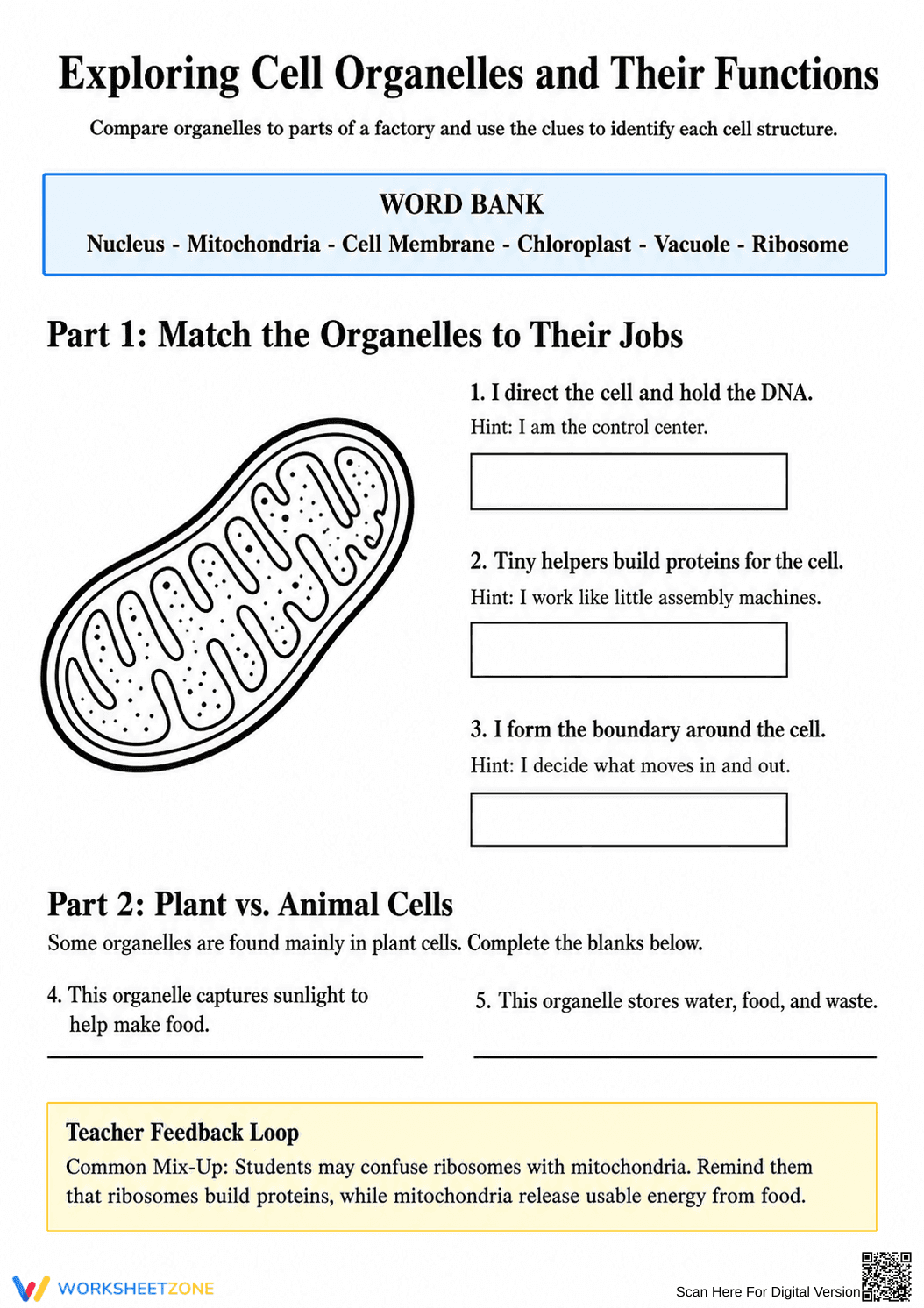
This Grade 5 and 6 science worksheet provides a comprehensive look at cell organelles and their vital functions. Students will identify key structures like the nucleus and mitochondria while using factory analogies to understand biological processes. It is designed to bridge the gap between abstract cellular concepts and concrete real-world models.
At a Glance
- Grade: 5-6 · Subject: Science
- Standard:
MS-LS1-2— Develop and use a model to describe the function of a cell- Skill Focus: Organelle identification and functional analogies
- Format: 2 pages · 11 problems · Answer key included · PDF
- Best For: Middle school biology introductory lessons
- Time: 25–35 minutes
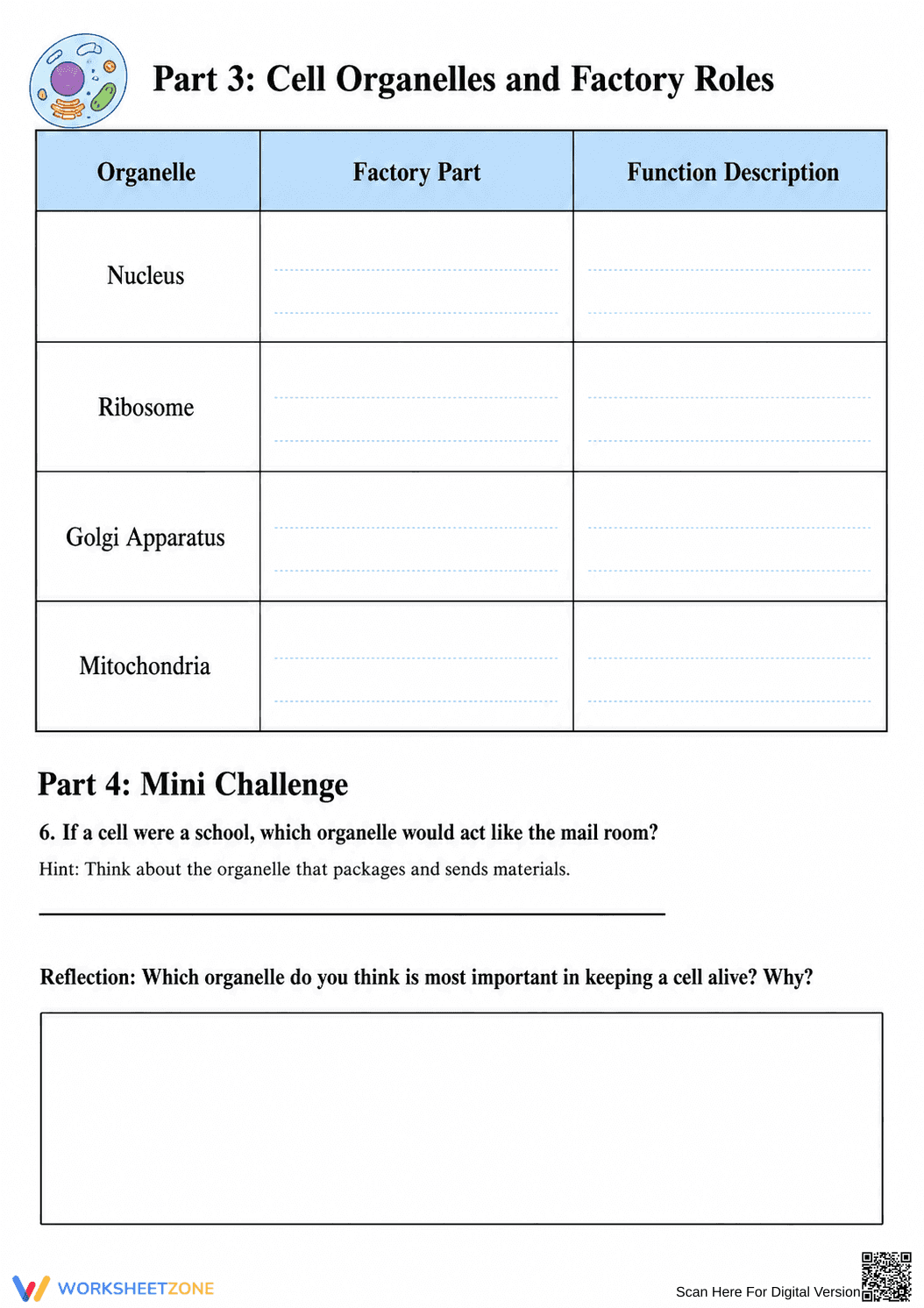
What's Inside: This 2-page PDF includes a structured word bank, matching exercises, and a detailed "Factory Roles" comparison table. Students engage with 11 distinct tasks, including a "Mini Challenge" that applies knowledge to a school-based analogy. A dedicated "Teacher Feedback Loop" section highlights common student misconceptions regarding ribosomes and mitochondria.
Zero-Prep Workflow: Teachers can implement this resource in three simple steps. First, print the double-sided PDF (under 1 minute). Second, distribute the worksheet as a guided practice activity following a cell structure lecture. Third, review the reflection responses as a formative exit ticket to gauge conceptual mastery. The total teacher preparation time is less than 2 minutes, making it an ideal sub plan or ready-to-go lesson supplement.
Standards Alignment: This resource is aligned with MS-LS1-2, requiring students to develop and use a model to describe the function of a cell as a whole and ways the parts of cells contribute to the function. It also supports 5-LS1-1 by exploring how internal structures support survival. Both standard codes can be copied directly into lesson plans, IEP goals, or district curriculum mapping tools.
How to Use It: Use this worksheet during the "Explain" or "Elaborate" phase of a 5E lesson cycle. It serves as an excellent transition from direct instruction to independent practice. For formative assessment, observe students during the "Factory Roles" table completion to see if they can accurately map biological functions to mechanical systems. Expected completion time is approximately 30 minutes.
Who It's For: This is ideal for 5th and 6th-grade students beginning their journey into life science. It provides enough scaffolding for general education students while offering a reflection prompt for advanced learners. Pair this with a 3D cell model or an interactive digital microscope lab for a multi-sensory learning experience.
According to the RAND AIRS 2024 report, the use of analogies in middle school science significantly improves long-term retention of complex biological systems. This worksheet leverages the "Cell as a Factory" model to meet MS-LS1-2 requirements, ensuring students understand that organelles are not just parts, but functional units working in tandem. By requiring students to identify, compare, and reflect, the resource aligns with Fisher & Frey’s (2014) gradual release of responsibility framework. The inclusion of a teacher feedback loop addresses common pedagogical hurdles identified in recent NAEP science performance reviews. This evidence-based approach ensures that Grade 5 and 6 learners move beyond rote memorization toward a functional understanding of cellular biology.


