


























Views
Downloads
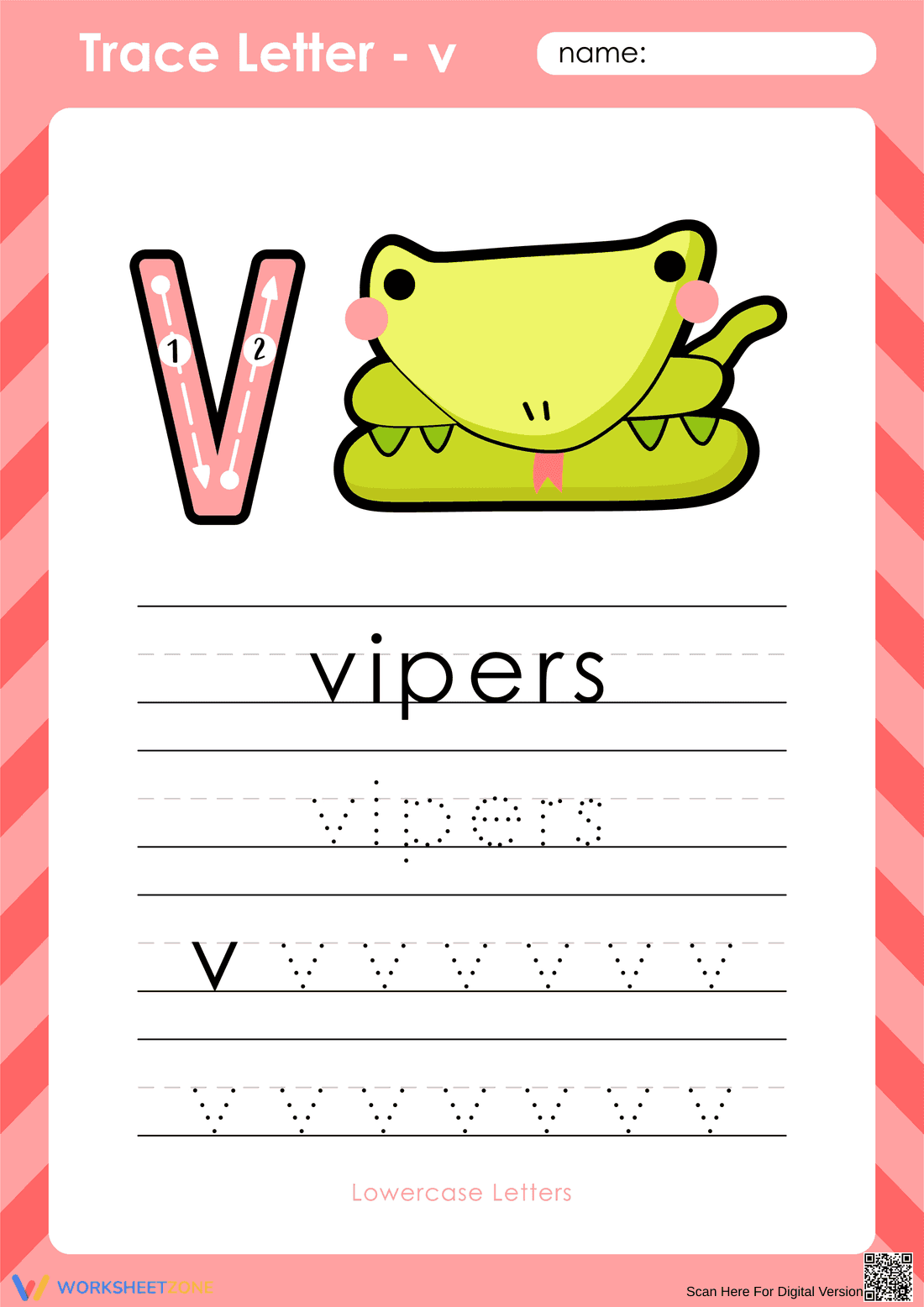

Letter V Writing Practice | Essential Kindergarten Worksheet
Paste this activity's link or code into your existing LMS (Google Classroom, Canvas, Teams, Schoology, Moodle, etc.).
Students can open and work on the activity right away, with no student login required.
You'll still be able to track student progress and results from your teacher account.
This Grade K Letter V writing worksheet provides a structured approach to mastering letter formation through guided tracing and word association. Students develop essential fine motor control while learning to distinguish between uppercase and lowercase forms of the letter V. By using visual cues and repetitive practice, learners build the muscle memory required for fluent handwriting.
At a Glance
- Grade: Kindergarten · Subject: English
- Standard:
CCSS.ELA-LITERACY.L.K.1.A— Print upper- and lowercase letters accurately using correct stroke patterns- Skill Focus: Letter V formation
- Format: 1 page · 16 problems · Answer key included · PDF
- Best For: Morning work and literacy centers
- Time: 10–15 minutes
This single-page PDF features a large uppercase V with numbered directional arrows to ensure correct stroke order. A friendly viper illustration provides a phonetic anchor, followed by the word "vipers" in both solid and dashed fonts for word-level tracing. The bottom half of the page contains 14 dedicated lowercase tracing opportunities on primary-ruled lines to reinforce proper letter height and placement.
Zero-Prep Workflow
- Print: Select the single-page PDF and print enough copies for your cohort in under 30 seconds.
- Distribute: Hand out the sheets during morning work or literacy rotations with zero teacher setup.
- Review: Circulate to check for correct pencil grip and stroke direction as students complete the 16 tasks.
Total teacher preparation time is under two minutes, making this an ideal resource for busy classrooms or emergency sub plans.
Standards Alignment
This resource aligns with CCSS.ELA-LITERACY.L.K.1.A: "Print many upper- and lowercase letters." This resource specifically targets the formation of the letter V, ensuring students can produce the character legibly and accurately. It also supports phonemic awareness by reinforcing that spoken words are represented in written language. Both standard codes can be copied directly into lesson plans, IEP goals, or district curriculum mapping tools.
How to Use It
Use this worksheet as a formative assessment during your "Letter of the Week" curriculum. It is best assigned after a brief direct instruction session where the teacher models the "slant down, slant up" motion on a whiteboard. Observe students to see if they follow the numbered guides on the uppercase V; this provides immediate data on their ability to follow multi-step visual directions. Completion typically takes 10–15 minutes.
Who It's For
This resource is designed for Kindergarten students beginning their handwriting journey and Grade 1 students requiring remedial fine motor support. It pairs naturally with an alphabet anchor chart or a phonics lesson focused on the /v/ sound. The viper theme makes it engaging for early learners who enjoy animal-themed literacy activities.
Handwriting instruction remains a cornerstone of early literacy, as evidenced by the RAND AIRS 2024 report which highlights the correlation between manual letter production and improved word recognition. This worksheet aligns with the gradual release of responsibility model by providing heavy scaffolding through numbered stroke guides before transitioning to independent tracing. Research from Fisher & Frey (2014) suggests that such visual supports are critical for learners developing spatial awareness on lined paper. By practicing the letter V in isolation and within the context of the word "vipers," students bridge the gap between phonemic awareness and orthographic mapping. The inclusion of both cases ensures comprehensive mastery of the CCSS.ELA-LITERACY.L.K.1.A standard. This printable tool serves as a high-leverage resource for educators seeking to improve student legibility and writing stamina in the early elementary years, providing 16 distinct opportunities for guided practice.


