




























Views
Downloads
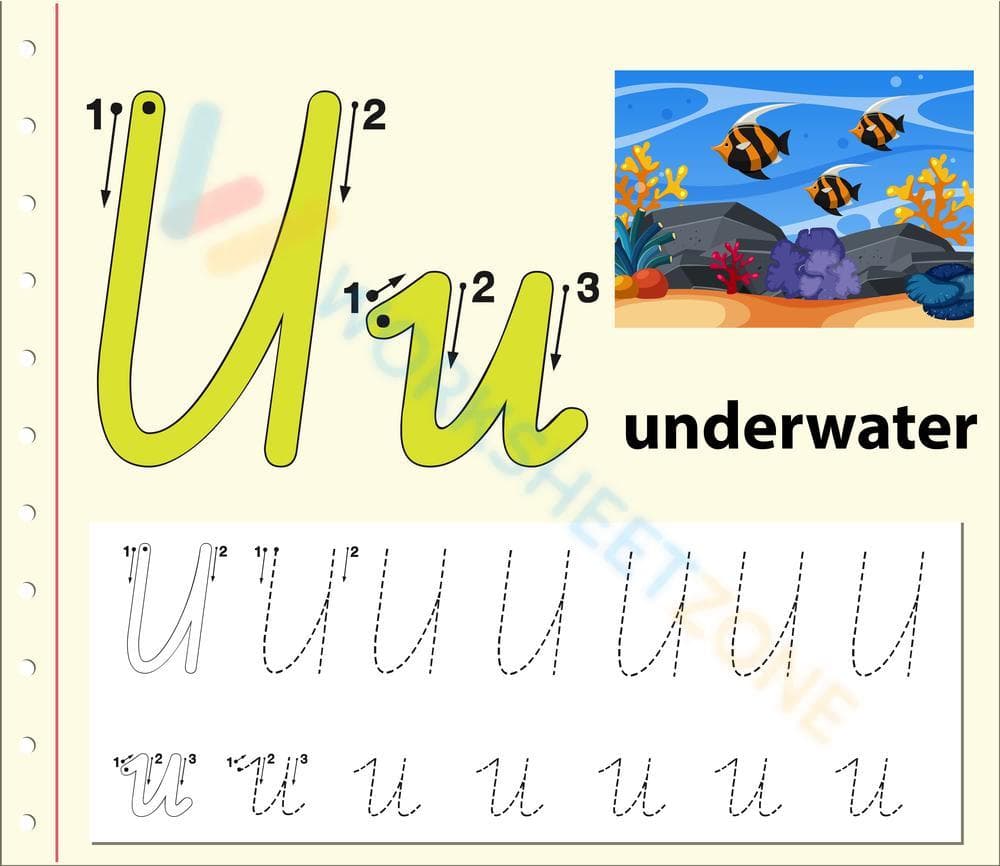

Printable Letter U Tracing Worksheet for Kindergarten

Paste this activity's link or code into your existing LMS (Google Classroom, Canvas, Teams, Schoology, Moodle, etc.).
Students can open and work on the activity right away, with no student login required.
You'll still be able to track student progress and results from your teacher account.
This printable worksheet helps early learners master the letter U through targeted tracing practice and beginning sound association. Students trace uppercase and lowercase letters to build fine motor control and handwriting confidence. By linking the letter to the word "underwater," children reinforce phonics skills essential for early reading success.
At a Glance
- Grade: Kindergarten · Subject: ELA Phonics
- Standard:
CCSS.ELA-LITERACY.RF.K.1.D— Recognize and name uppercase and lowercase letters- Skill Focus: Letter U formation and beginning sounds
- Format: 1 page · 14 tasks · No answer key · PDF
- Best For: Morning work or independent writing practice
- Time: 10–15 minutes
This single-page PDF features large, guided letter models with numbered stroke arrows to teach correct formation. It contains 7 uppercase and 7 lowercase cursive-style tracing paths. A colorful underwater illustration anchors the beginning sound of the letter U, providing a visual cue that aids memory retention. The clean layout ensures young writers focus entirely on their pencil control without visual distractions.
Implement this resource with a simple three-step workflow. First, print the single-page PDF, which takes less than 1 minute. Second, distribute the sheets to students during morning arrival or transition times. Third, review student letter formation in real-time as they write. This zero-prep design requires under 2 minutes of teacher preparation, making it an ideal choice for emergency sub plans or quick phonics warm-ups.
This activity aligns directly with CCSS.ELA-LITERACY.RF.K.1.D, which requires students to recognize and write uppercase and lowercase letters. Additionally, it supports early phonics development by connecting letter shapes to their corresponding initial sounds. Both standard codes can be copied directly into lesson plans, IEP goals, or district curriculum mapping tools.
Use this worksheet during the independent practice portion of your phonics lesson, immediately following direct instruction on the letter U. Students will spend 10 to 15 minutes completing the tracing lines. For formative assessment, walk around the room and observe stroke direction; note if students start from the top dot as indicated by the guide arrows. Alternatively, place this sheet in a dry-erase sleeve for a reusable literacy center activity.
This resource is designed for kindergarteners and preschool students learning basic letter formation. It also serves as a helpful intervention tool for first-grade students who need extra handwriting support. Pair this worksheet with a read-aloud book about ocean life or an anchor chart displaying beginning letter sounds to create a cohesive, multi-sensory learning experience.
This instructional resource targets CCSS.ELA-LITERACY.RF.K.1.D by providing structured tracing practice for uppercase and lowercase letter U. According to research from Fisher & Frey (2014) on the gradual release of responsibility, guided tracing scaffolds the transition from modeled writing to independent letter production. By utilizing numbered stroke arrows, the worksheet helps young learners build muscle memory and correct pencil grip. The inclusion of a visual anchor, "underwater," reinforces phonemic awareness by linking the letter shape to its initial sound. This combination of motor skill practice and phonics association supports early literacy acquisition in kindergarten classrooms. Educators can integrate this tool into daily writing routines to monitor progress in fine motor development and letter recognition.


