


























Views
Downloads

Printable Letter U Writing Worksheet | Grade K
Paste this activity's link or code into your existing LMS (Google Classroom, Canvas, Teams, Schoology, Moodle, etc.).
Students can open and work on the activity right away, with no student login required.
You'll still be able to track student progress and results from your teacher account.
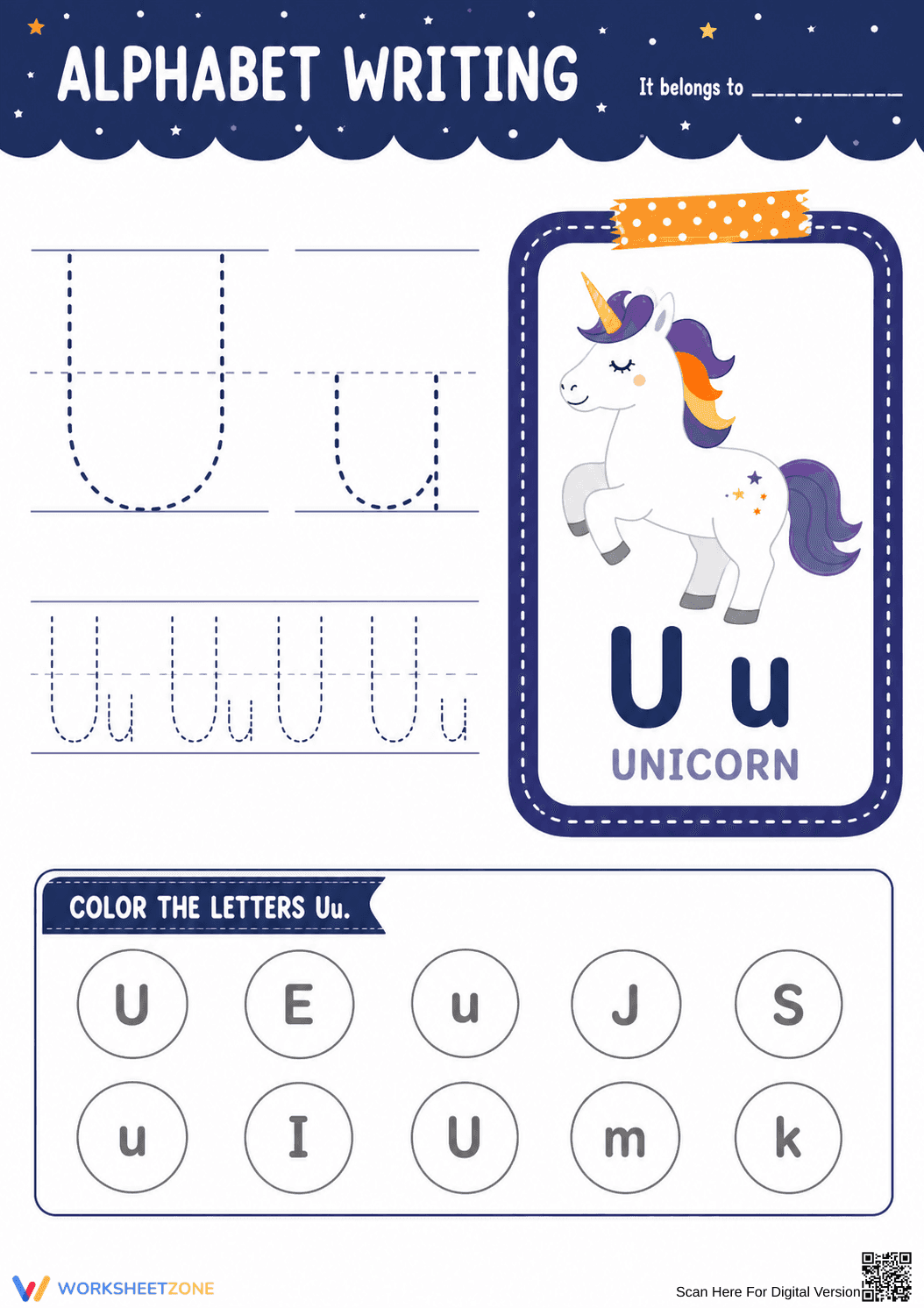
This foundational phonics worksheet helps early learners master the letter U through targeted handwriting and identification practice. Students develop fine motor control by tracing uppercase and lowercase forms, then apply visual discrimination skills to locate the target letter among distractors, building essential early literacy capabilities.
At a Glance
- Grade: K · Subject: ELA
- Standard:
CCSS.ELA-LITERACY.L.K.1.A— Print many upper- and lowercase letters- Skill Focus: Letter U Tracing and Recognition
- Format: 1 page · 3 tasks · No answer key needed · PDF
- Best For: Independent practice or morning work
- Time: 10–15 minutes
This single-page resource features three distinct activity zones designed for young learners. The top section provides large, dashed guidelines for initial uppercase and lowercase letter formation. The middle section offers repeated tracing practice on standard primary lines to build muscle memory. Finally, the bottom section includes a letter-hunt activity where students color circles containing the letter U, reinforcing visual recognition alongside a helpful "U for Unicorn" anchor image.
This resource requires zero teacher preparation.
- Print (1 minute): Generate copies directly from the PDF file. The high-contrast design prints clearly in standard grayscale.
- Distribute (1 minute): Hand out to students along with pencils and crayons. The visual instructions are intuitive for non-readers.
- Review (1 minute): Quickly scan the colored circles at the bottom of the page to check for accurate letter identification.
With a total prep time of under two minutes, this worksheet serves as an excellent emergency sub plan or quick transition activity.
This activity is directly aligned to CCSS.ELA-LITERACY.L.K.1.A, requiring students to print many upper- and lowercase letters. It also supports foundational reading skills by having students recognize and name letters of the alphabet. Both standard codes can be copied directly into lesson plans, IEP goals, or district curriculum mapping tools.
Deploy this worksheet during morning arrival as a focused entry task, or use it as an independent literacy center during small group instruction. For formative assessment, observe students as they complete the bottom section; note whether they confuse the lowercase "u" with the lowercase "n" or other visually similar letters, which can inform future targeted interventions. Most kindergarten students will complete the page within 10 to 15 minutes.
This resource is primarily designed for kindergarten students who are currently learning the alphabet and developing basic handwriting skills. It provides appropriate scaffolding for students who need explicit visual boundaries for letter formation. First graders needing fine motor remediation will also benefit. For a complete lesson, pair this worksheet with a read-aloud book featuring the short or long "U" sound and a classroom anchor chart displaying words that begin with the letter.
Early alphabet knowledge, including the ability to print and recognize letters, is a critical predictor of later reading success. According to research highlighted by Fisher & Frey (2014), explicit instruction in letter formation combined with visual discrimination tasks significantly improves early literacy outcomes. This worksheet supports these evidence-based practices by integrating handwriting mechanics with letter identification. By aligning with CCSS.ELA-LITERACY.L.K.1.A, which requires students to print many upper- and lowercase letters, the activity ensures that foundational skills are developed systematically. The combination of tracing and finding the letter U helps solidify the neural pathways necessary for fluent reading and writing. Providing structured practice in these early stages reduces cognitive load during subsequent phonics instruction, allowing young learners to focus on sound-symbol correspondence.


