




























Views
Downloads
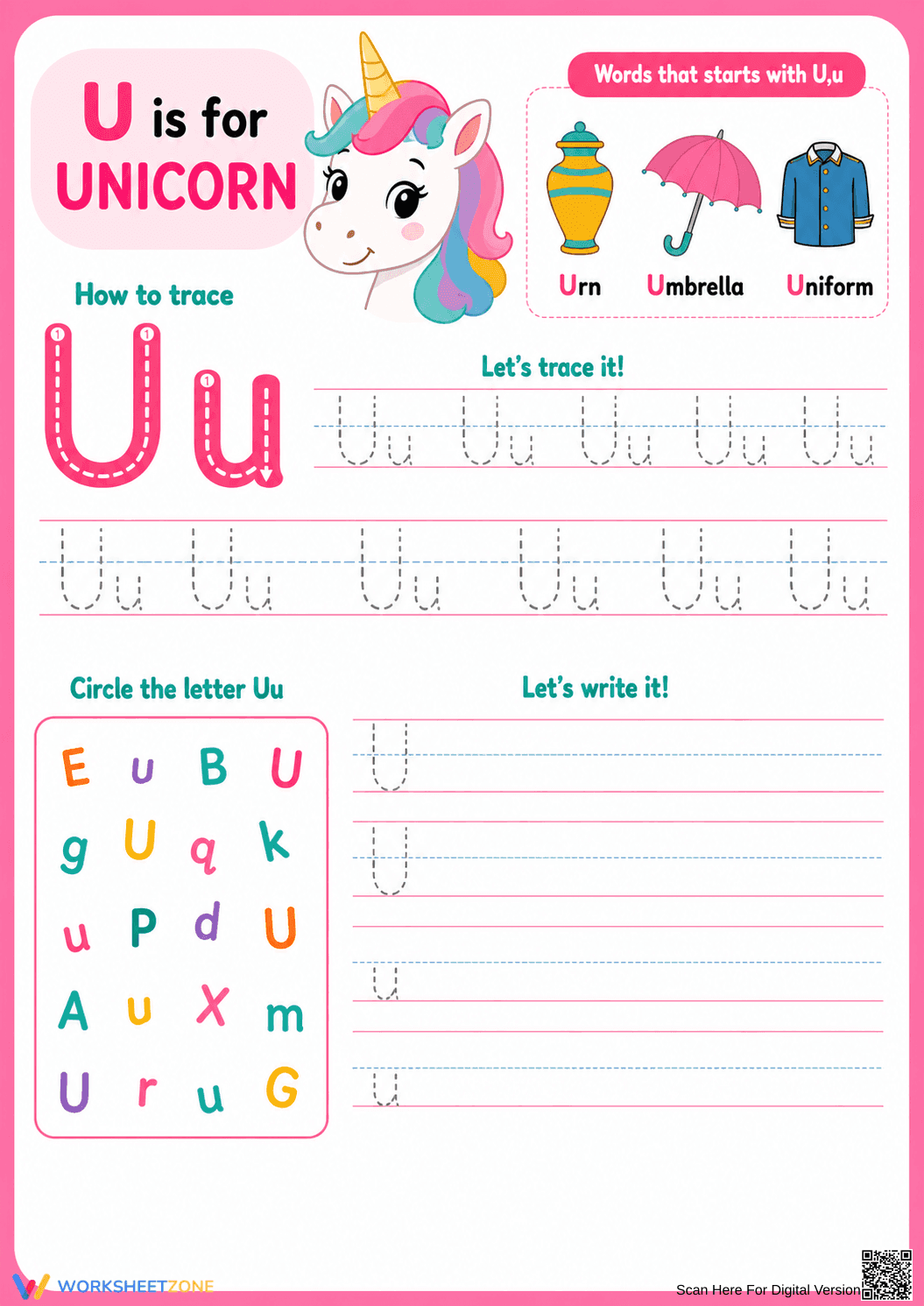

Essential Letter U Tracing & Writing Worksheet | Grade K

Paste this activity's link or code into your existing LMS (Google Classroom, Canvas, Teams, Schoology, Moodle, etc.).
Students can open and work on the activity right away, with no student login required.
You'll still be able to track student progress and results from your teacher account.
This Grade K Letter U worksheet provides students with a comprehensive path to mastering uppercase and lowercase letter formation. By combining visual cues, tracing guides, and independent writing practice, learners develop the fine motor control and phonemic awareness necessary for early literacy success. Students will identify the letter U in various contexts and connect it to familiar vocabulary.
At a Glance
- Grade: Kindergarten · Subject: ELA Phonics
- Standard:
CCSS.ELA-LITERACY.RF.K.1.D— Recognize and name all upper- and lowercase letters of the alphabet- Skill Focus: Letter U formation and recognition
- Format: 1 page · 35 tasks · Answer key included · PDF
- Best For: Morning work and literacy centers
- Time: 15–20 minutes
What's Inside
The layout includes a "How to trace" guide with numbered arrows to ensure proper stroke order. This single-page PDF features 11 pairs of uppercase and lowercase Uu for tracing, a "Circle the letter" grid containing 20 different characters to sharpen visual discrimination, and 4 dedicated lines for independent writing practice. Visual anchors like a unicorn, umbrella, and uniform reinforce the short and long U sounds.
Zero-Prep Workflow
This zero-prep workflow ensures efficiency in busy classrooms. First, print the single-page PDF (30 seconds). Second, distribute the sheets to students during your phonics block or as a transition activity (1 minute). Finally, review the letter search grid as a whole group to provide immediate feedback on recognition (30 seconds). Total teacher preparation time is under 2 minutes, making it an ideal sub-plan or emergency resource.
Standards Alignment
This resource is primarily aligned with CCSS.ELA-LITERACY.RF.K.1.D, which requires students to recognize and name all upper- and lowercase letters of the alphabet. Additionally, it supports RF.K.3.A by linking the letter U to its most common sounds through pictorial representations. Both standard codes can be copied directly into lesson plans, IEP goals, or district curriculum mapping tools.
How to Use It
Use this worksheet as a formative assessment during the "You Do" phase of a direct instruction lesson on the letter U. Observe students as they trace to ensure they follow the correct stroke order indicated by the arrows. It also serves as a quiet-time activity for early finishers, providing meaningful reinforcement without requiring additional teacher guidance during small-group rotations.
Who It's For
This worksheet is designed for Kindergarten students, though it is highly effective for Grade 1 students requiring remedial support or English Language Learners (ELL) building foundational alphabet knowledge. It pairs naturally with an anchor chart displaying the letter U or a read-aloud book focusing on the "short u" sound, such as "Umbrellabird's Umbrella."
According to the RAND AIRS 2024 report on foundational literacy, consistent exposure to multisensory letter formation activities—combining visual, motor, and auditory cues—significantly accelerates alphabet recognition in early childhood settings. This worksheet applies these findings by integrating directional tracing arrows with phonemic anchors. By engaging in the 35 discrete tasks provided, students move from guided imitation to independent production, a transition critical for long-term writing fluency. The letter-search grid reinforces visual discrimination, a prerequisite for decoding. Educators can utilize this resource to meet CCSS.ELA-LITERACY.RF.K.1.D requirements while providing the high-frequency practice necessary for mastery. Research indicates that structured, no-prep worksheets like this one allow teachers to focus more on individual student intervention rather than administrative preparation.


