


























Views
Downloads

Printable Letter G Tracing Worksheet | Kindergarten
Paste this activity's link or code into your existing LMS (Google Classroom, Canvas, Teams, Schoology, Moodle, etc.).
Students can open and work on the activity right away, with no student login required.
You'll still be able to track student progress and results from your teacher account.
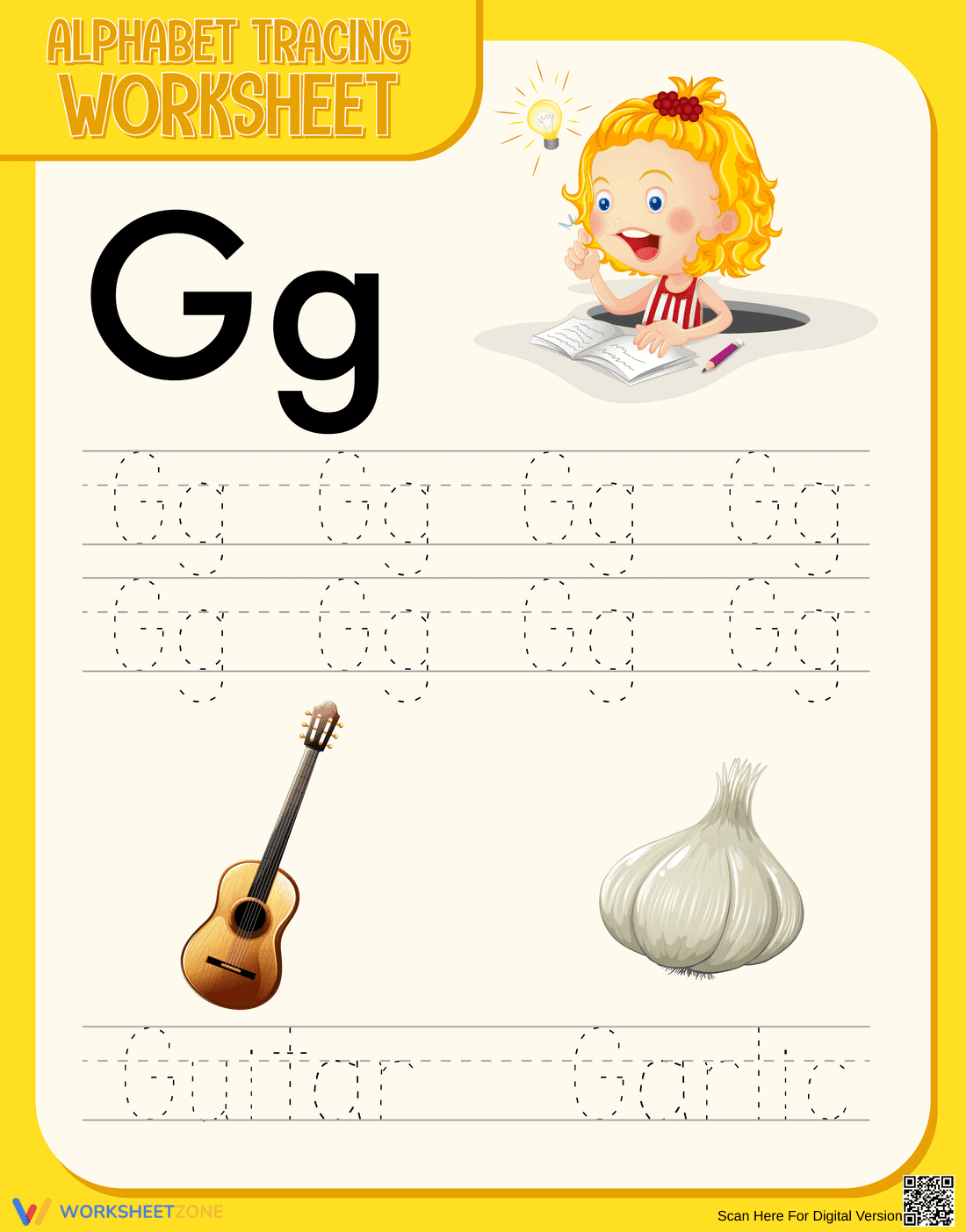
This printable letter G tracing worksheet helps early learners develop fine motor skills and proper letter formation. Students practice writing uppercase and lowercase G, connecting the letter to familiar vocabulary words like guitar and garlic. This foundational handwriting practice builds essential muscle memory for confident, legible writing.
At a Glance
- Grade: Kindergarten · Subject: ELA
- Standard:
CCSS.ELA-LITERACY.L.K.1.a— Print many upper- and lowercase letters- Skill Focus: Letter G formation and handwriting
- Format: 1 page · 10 tracing tasks · No answer key needed · PDF
- Best For: Independent morning work
- Time: 10–15 minutes
This single-page resource features clear, dashed-line models for students to trace. The layout includes eight pairs of uppercase and lowercase Gs for repetitive stroke practice, followed by two vocabulary words—guitar and garlic—accompanied by engaging illustrations. The visual cues help young learners associate the letter symbol with its corresponding initial sound while providing structured handwriting support.
Zero-Prep Workflow
- Print (1 minute): Simply download the PDF and print the required number of copies. The high-contrast dashed lines ensure clear reproduction.
- Distribute (1 minute): Hand out the worksheets alongside pencils or crayons. The intuitive tracing format requires minimal verbal instruction.
- Review (1 minute): Quickly scan completed pages to check for proper stroke direction and pencil grip.
Total teacher preparation time is under two minutes, making this an excellent, reliable option for emergency sub plans or quick transitions.
Standards Alignment
This worksheet aligns directly with CCSS.ELA-LITERACY.L.K.1.a, requiring students to print many upper- and lowercase letters. It also supports foundational reading skills by reinforcing letter-sound correspondence through the illustrated vocabulary words. Both standard codes can be copied directly into lesson plans, IEP goals, or district curriculum mapping tools.
How to Use It
Deploy this worksheet during morning arrival as a calm, focused bell-ringer activity. It also functions perfectly as an independent literacy center station while the teacher conducts small group reading instruction. While students work, observe their pencil grip and stroke sequence to provide immediate, formative feedback on their fine motor mechanics. Expect students to complete the tracing tasks within 10 to 15 minutes.
Who It's For
This resource is designed for Preschool, Kindergarten, and first-grade students mastering basic handwriting. It serves as an excellent intervention tool for occupational therapy students needing extra fine motor repetition. Pair this worksheet with a tactile letter-building activity or a read-aloud focusing on the "G" sound to create a comprehensive, multi-sensory literacy lesson.
Effective handwriting instruction remains a critical component of early literacy development. According to a 2024 report by EdReports, explicit practice with letter formation directly supports broader reading and writing fluency. This worksheet targets CCSS.ELA-LITERACY.L.K.1.a, ensuring students can print many upper- and lowercase letters with accuracy. By isolating the letter G and providing guided, dashed-line models, the resource reduces cognitive load, allowing young learners to focus entirely on their motor execution. The inclusion of vocabulary words like guitar and garlic bridges the gap between isolated stroke practice and meaningful word construction. Consistent, structured repetition of these foundational skills builds the automaticity necessary for students to eventually compose original text without struggling over basic letter mechanics. This targeted approach ensures early learners develop the physical stamina and precision required for long-term academic success.


