


























Views
Downloads
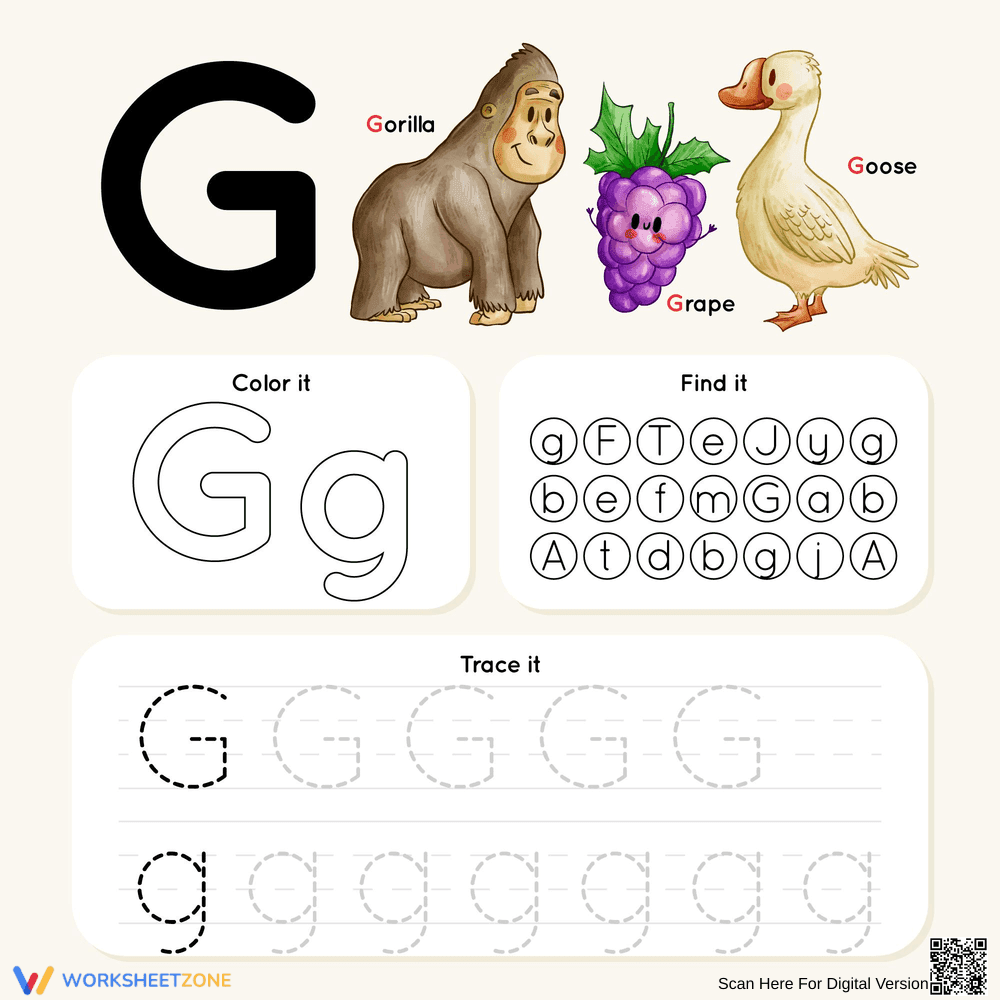

Grade K-1 Letter G — Printable No-Prep Worksheet
Paste this activity's link or code into your existing LMS (Google Classroom, Canvas, Teams, Schoology, Moodle, etc.).
Students can open and work on the activity right away, with no student login required.
You'll still be able to track student progress and results from your teacher account.
This Grade K-1 handwriting worksheet provides a comprehensive approach to mastering the letter G through three distinct activities. Students develop fine motor control and phonemic awareness by coloring, identifying, and tracing both uppercase and lowercase forms. By engaging with visual cues like grapes and gorillas, learners build the necessary orthographic foundations for early reading and writing success.
At a Glance
- Grade: Kindergarten · Subject: Handwriting
- Standard:
CCSS.ELA-LITERACY.L.K.1.A— Print many upper- and lowercase letters accurately- Skill Focus: Letter G formation and identification
- Format: 1 page · 3 activities · Answer key included · PDF
- Best For: Morning work or literacy centers
- Time: 10–15 minutes
The worksheet features three structured zones designed to build confidence. The "Color it" section provides large-format outlines of "G" and "g" for initial exposure. The "Find it" section contains a 21-character letter grid where students must discriminate between similar letter shapes to locate the target. Finally, the "Trace it" section offers 13 guided tracing opportunities on primary-ruled lines, ensuring correct stroke order and letter height.
The zero-prep design allows for immediate classroom implementation. First, print the single-page PDF (30 seconds). Second, distribute to students during independent work blocks or as a quiet morning activity (1 minute). Finally, review the "Find it" section as a whole group to check for accuracy (1 minute). Total teacher preparation time is under two minutes, making this an ideal resource for substitute folders or last-minute literacy rotations.
This resource is primary aligned to CCSS.ELA-LITERACY.L.K.1.A, which requires students to print many upper- and lowercase letters. It also supports phonological awareness by connecting the letter shape to its initial sound through high-interest illustrations. Both standard codes can be copied directly into lesson plans, IEP goals, or district curriculum mapping tools.
Use this worksheet during the "You Do" phase of a direct instruction lesson on the letter G. It serves as an excellent formative assessment tool; observe students during the "Find it" portion to identify those struggling with letter reversals or visual discrimination. The activity typically takes 10 to 15 minutes to complete, fitting perfectly into a standard literacy station rotation.
This activity is designed for Kindergarten and first-grade students who are beginning their handwriting journey. It is particularly effective for English Language Learners (ELLs) who benefit from the clear pictorial associations. Pair this worksheet with a letter G anchor chart or a short phonics passage to reinforce the "g" sound in context.
Research by Fisher & Frey (2014) emphasizes the importance of multi-modal engagement in early literacy, specifically the gradual release of responsibility through guided tracing and independent recognition. This worksheet aligns with CCSS.ELA-LITERACY.L.K.1.A by requiring students to print upper- and lowercase letters while reinforcing phonemic awareness through visual anchors like the gorilla and goose. According to NAEP data, early mastery of letter formation is a significant predictor of later writing fluency and reading comprehension. By combining tactile tracing with visual discrimination tasks, this resource provides the high-frequency practice necessary for orthographic mapping. The structured layout ensures that students transition from simple coloring to complex letter identification within a single session. This 3-in-1 approach supports diverse learners by providing multiple entry points into the alphabet, ensuring that foundational handwriting skills are solidified before moving to sentence-level composition. This resource serves as a vital bridge between letter recognition and fluent production.


