


























Views
Downloads
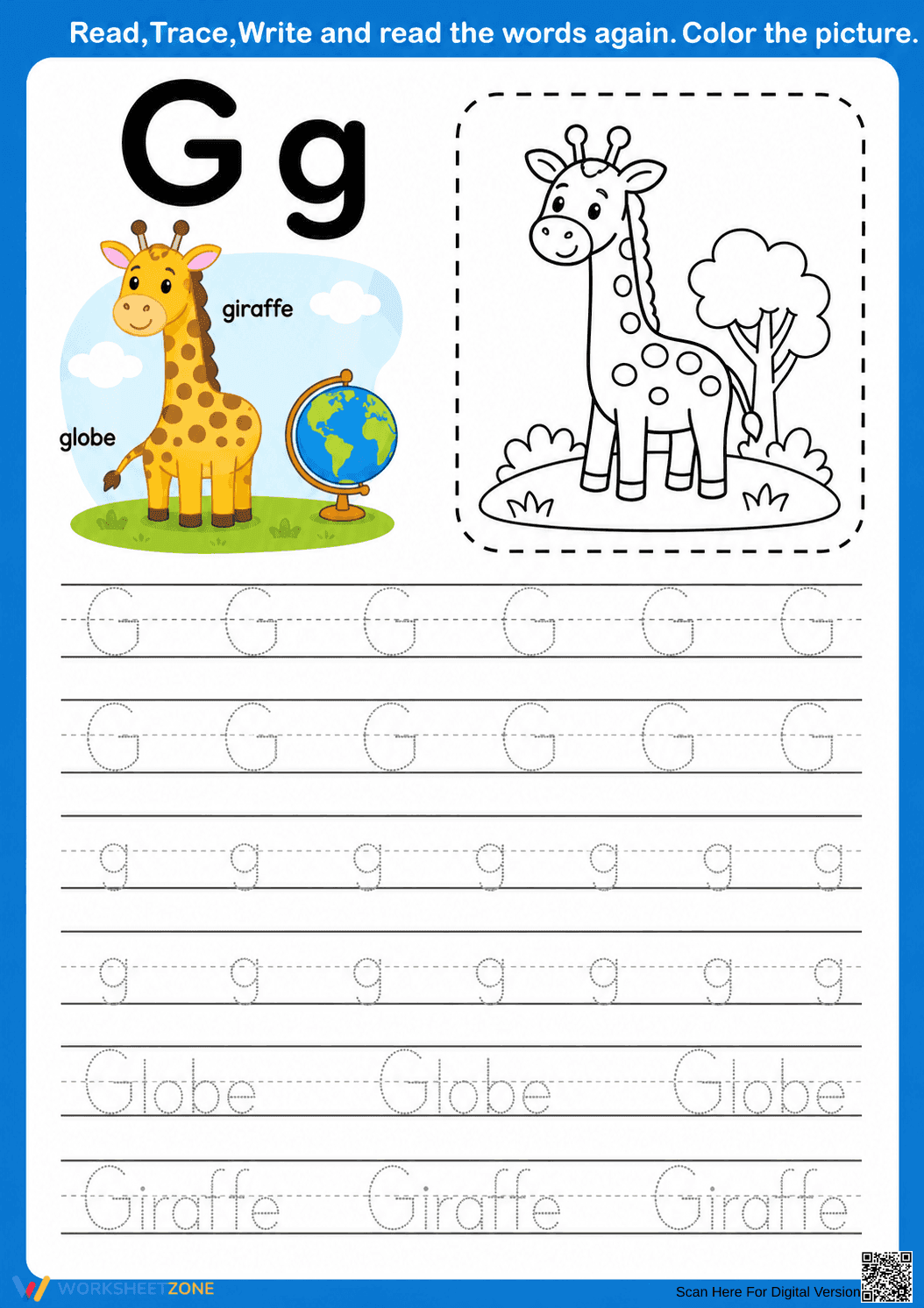

Essential Letter G Tracing Worksheet | Grade K-1
Paste this activity's link or code into your existing LMS (Google Classroom, Canvas, Teams, Schoology, Moodle, etc.).
Students can open and work on the activity right away, with no student login required.
You'll still be able to track student progress and results from your teacher account.
This Grade K-1 Letter G worksheet provides early learners with structured practice to master letter formation and beginning sound recognition. Students engage with uppercase and lowercase tracing before applying their skills to phonics-based vocabulary words. This resource ensures students develop the fine motor control necessary for legible handwriting while reinforcing phonemic awareness.
At a Glance
- Grade: Kindergarten · Subject: ELA Phonics
- Standard:
CCSS.ELA-LITERACY.RF.K.1.D— Recognize and name all upper- and lowercase letters of the alphabet- Skill Focus: Letter G formation and beginning sounds
- Format: 1 page · 33 tasks · Coloring activity · PDF
- Best For: Independent morning work or literacy centers
- Time: 10–15 minutes
The worksheet features a comprehensive layout including 12 uppercase "G" tracing prompts and 14 lowercase "g" prompts. To bridge the gap between letter recognition and reading, it includes three tracing instances for the words "Globe" and "Giraffe." A large, dashed-line giraffe illustration provides a creative coloring task that reinforces the hard and soft "G" sounds visually.
This resource is designed for a zero-prep classroom workflow. Teachers can print the single-page PDF in less than 30 seconds. Distribution takes approximately 1 minute during transition periods. Reviewing student work is simplified by the clear tracing paths, allowing for a quick visual check of letter orientation and stroke order in under 2 minutes per small group. It is an ideal solution for emergency sub plans.
This activity aligns with CCSS.ELA-LITERACY.RF.K.1.D, which requires students to recognize and name all upper- and lowercase letters of the alphabet. It also supports CCSS.ELA-LITERACY.RF.K.3.A by connecting the letter shape to its common sounds through visual anchors. Both standard codes can be copied directly into lesson plans, IEP goals, or district curriculum mapping tools.
Use this worksheet during the independent practice phase of a gradual release lesson on the alphabet. It serves as an excellent formative assessment tool; observe students as they trace to identify those struggling with top-to-bottom stroke direction. The expected completion time is 10 to 15 minutes, making it ideal for fast-finisher folders or as a quiet-time activity during literacy rotations.
This resource is tailored for Kindergarten students and Grade 1 learners needing remedial handwriting support. It is particularly effective for English Language Learners (ELL) who benefit from the pictorial representation of "Globe" and "Giraffe." Pair this worksheet with a letter G anchor chart or a tactile sand-tray tracing activity for a multi-sensory learning experience that supports diverse needs.
According to the RAND AIRS 2024 report on early literacy, consistent exposure to multisensory tracing and phonemic association is critical for developing orthographic mapping skills in young readers. This worksheet facilitates that mapping by requiring students to physically trace the letter G while viewing images that represent its phonetic value. By integrating 33 distinct tracing opportunities, the resource provides the repetition necessary for motor memory without overwhelming the learner. The inclusion of both uppercase and lowercase forms ensures students understand the dual nature of the grapheme, a foundational step in reading fluency. Research indicates that early mastery of letter names and shapes is one of the strongest predictors of later reading success, making these targeted practice sheets an essential component of any evidence-based phonics curriculum.


