


























Views
Downloads
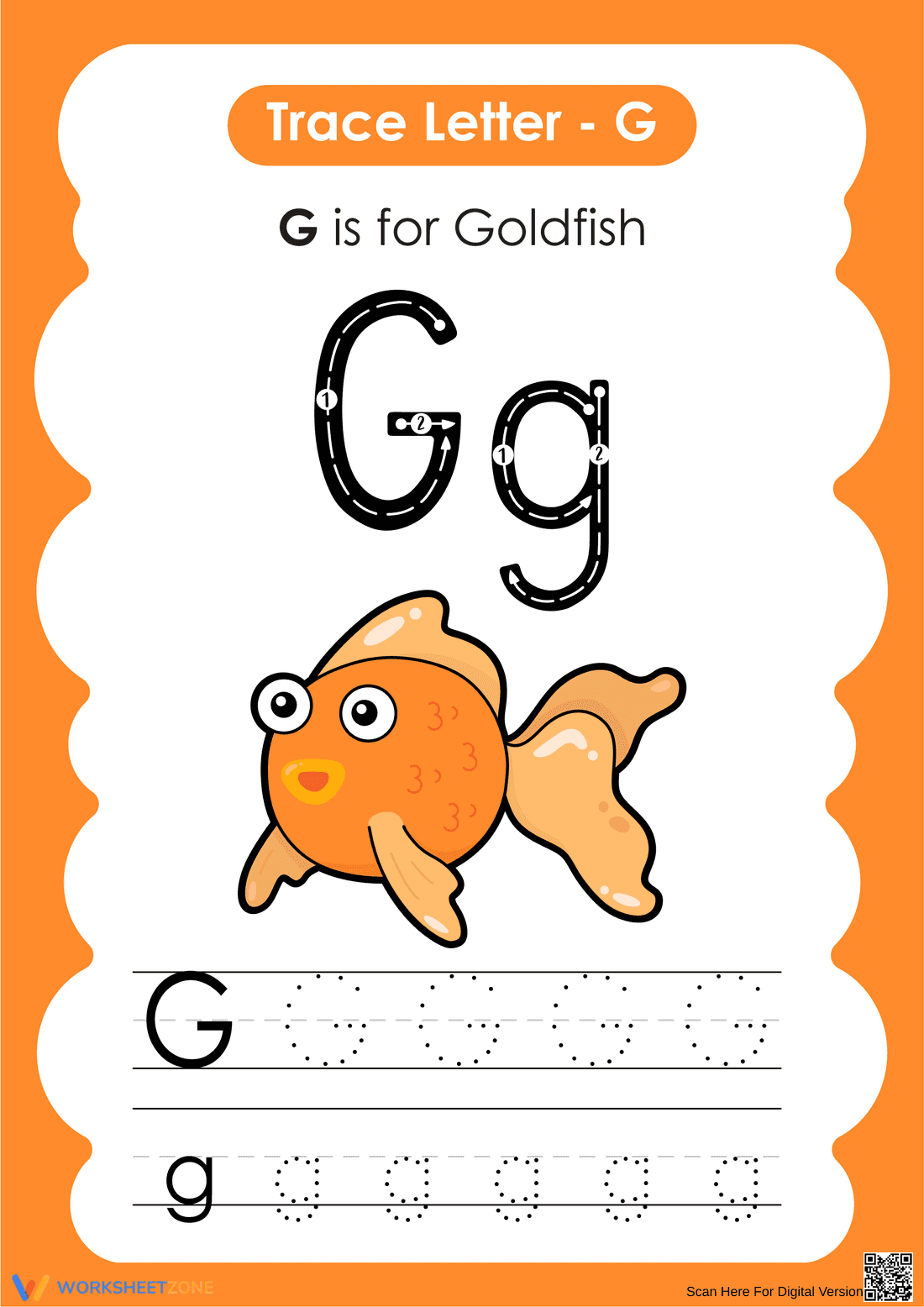

Letter G Tracing Worksheet | Essential Grade K ELA
Paste this activity's link or code into your existing LMS (Google Classroom, Canvas, Teams, Schoology, Moodle, etc.).
Students can open and work on the activity right away, with no student login required.
You'll still be able to track student progress and results from your teacher account.
This Letter G tracing worksheet helps early learners master uppercase and lowercase letter formation through guided practice. Students develop fine motor control while connecting the letter shape to the initial sound of "goldfish." This resource ensures students build the foundational handwriting skills necessary for early literacy success.
At a Glance
- Grade: Kindergarten · Subject: ELA
- Standard:
CCSS.ELA-LITERACY.RF.K.1.D— Recognize and name all upper- and lowercase letters of the alphabet- Skill Focus: Letter G Formation
- Format: 1 page · 12 tasks · Answer key included · PDF
- Best For: Daily morning work or literacy centers
- Time: 10–15 minutes
This single-page PDF features a large "G is for Goldfish" header with a vibrant illustration to support phonemic awareness. The worksheet includes two large model letters with numbered directional arrows to guide initial strokes. Below, students find two dedicated rows for independent practice: one for uppercase 'G' and one for lowercase 'g', providing 10 distinct tracing opportunities to reinforce muscle memory.
The zero-prep workflow is designed for busy educators. First, print the single-page PDF (30 seconds). Second, distribute the sheets to students during your phonics block or as a transition activity (1 minute). Finally, review the letter formation by observing student stroke order in real-time (2 minutes). This worksheet is an ideal sub-plan component due to its self-explanatory layout and clear visual cues.
This resource aligns with `CCSS.ELA-LITERACY.RF.K.1.D`, which requires students to recognize and name all upper- and lowercase letters of the alphabet. By physically tracing the characters, students reinforce the visual memory of the letter "G." This standard code can be copied directly into lesson plans, IEP goals, or district curriculum mapping tools.
Use this worksheet during the "You Do" phase of a gradual release lesson on the letter G. It works exceptionally well as a formative assessment tool; teachers can circulate and check for proper pencil grip and top-to-bottom stroke direction. Expect students to complete the tracing in approximately 12 minutes, making it perfect for short instructional blocks.
This activity is designed for Preschool, Kindergarten, and Grade 1 students who are beginning their handwriting journey. It is particularly helpful for students requiring fine motor intervention or English Language Learners. Pair this worksheet with a "Letter G" anchor chart or a short reading passage about goldfish to create a cohesive literacy lesson.
According to research by Fisher & Frey (2014) regarding the gradual release of responsibility, structured practice like tracing provides the necessary scaffolding for students to move from guided instruction to independent mastery. This worksheet targets the CCSS.ELA-LITERACY.RF.K.1.D standard by focusing on the physical mechanics of letter recognition and production. By integrating visual cues like the goldfish illustration with tactile tracing tasks, the resource supports multi-sensory learning pathways. Data from the RAND AIRS 2024 report suggests that consistent, short-burst handwriting practice significantly improves long-term letter recall in early childhood settings. This 1-page resource provides 12 specific tasks that allow for immediate feedback and correction, ensuring that students do not internalize incorrect stroke patterns. Educators can use this tool to document progress toward foundational literacy benchmarks efficiently.


