


























Views
Downloads

Printable Letter R Tracing Worksheet | Kindergarten ELA
Paste this activity's link or code into your existing LMS (Google Classroom, Canvas, Teams, Schoology, Moodle, etc.).
Students can open and work on the activity right away, with no student login required.
You'll still be able to track student progress and results from your teacher account.
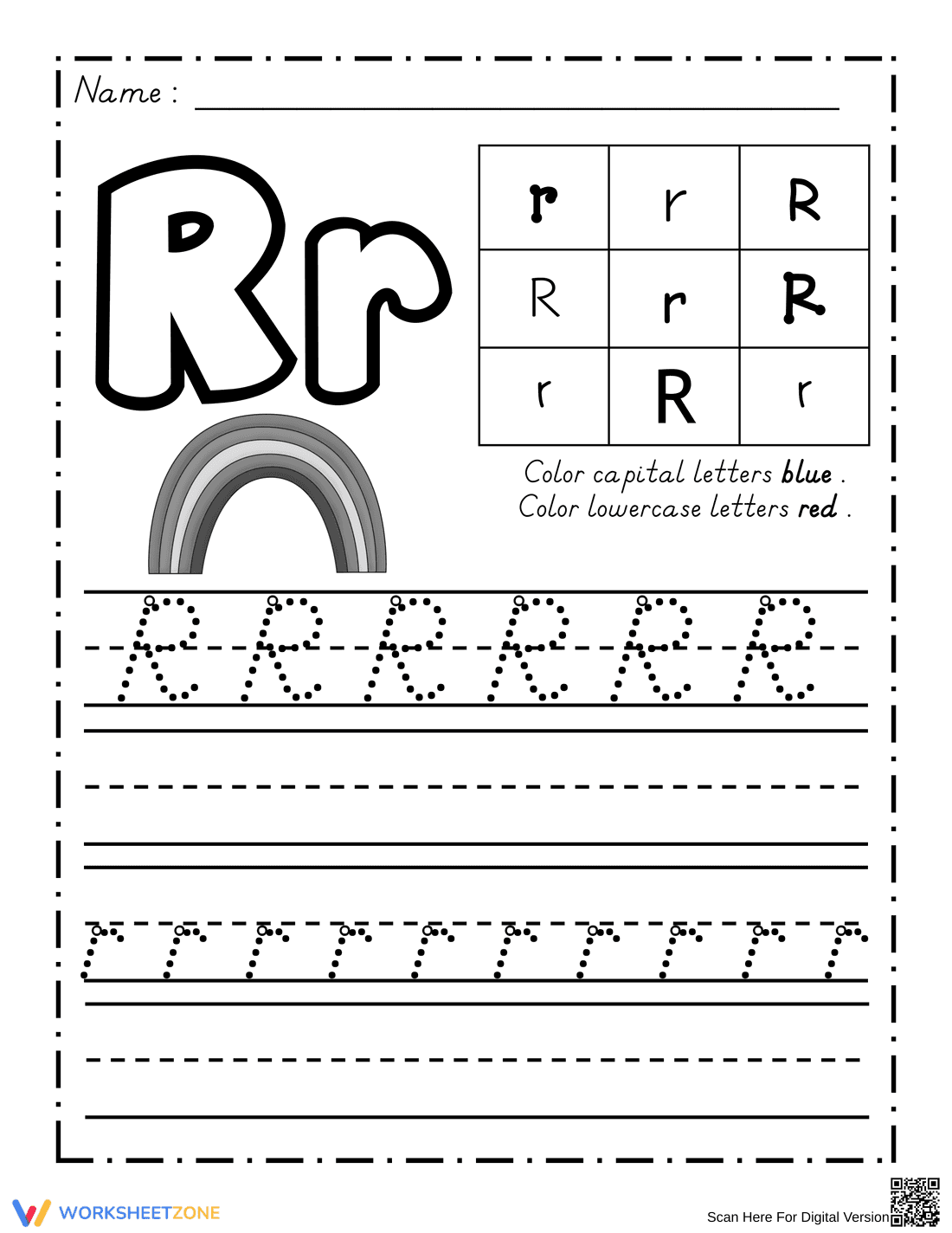
This Kindergarten handwriting worksheet provides targeted practice for forming and identifying the letter R. Students develop fine motor control and letter recognition skills through a combination of D'Nealian tracing exercises and a color-coded visual discrimination activity. The engaging rainbow theme keeps young learners focused while mastering essential print concepts.
At a Glance
- Grade: Kindergarten · Subject: ELA
- Standard:
CCSS.ELA-LITERACY.L.K.1.A— Print many upper- and lowercase letters- Skill Focus: Letter R Tracing and Recognition
- Format: 1 page · 25 tasks · No answer key · PDF
- Best For: Morning work or literacy centers
- Time: 10–15 minutes
This single-page resource features two sections to reinforce letter R mastery. The top includes a large visual reference with a rainbow graphic and a nine-square grid where students color capital letters blue and lowercase letters red. The bottom provides two structured lines for tracing the lowercase D'Nealian letter R, complete with directional arrows and dotted guidelines for proper stroke formation.
Zero-Prep Workflow
This resource is designed for immediate classroom implementation with minimal teacher preparation.
- Print (1 minute): Simply download the PDF and print the required number of copies. The black-and-white design is ink-friendly.
- Distribute (1 minute): Hand out the worksheets along with pencils and red and blue crayons.
- Review (1 minute): Briefly model the D'Nealian stroke order on the board and explain the color-coding instructions for the grid.
Total teacher prep time is under three minutes, making this ideal for sub plans.
Standards Alignment
This worksheet aligns with CCSS.ELA-LITERACY.L.K.1.A, requiring students to print many upper- and lowercase letters. It also supports foundational reading skills by having students visually discriminate between uppercase and lowercase forms. Both standard codes can be copied directly into lesson plans, IEP goals, or district curriculum mapping tools.
How to Use It
Deploy this worksheet during morning work to establish a calm, focused start to the day. It also functions perfectly as an independent literacy center activity while the teacher conducts small group guided reading. As a formative assessment tip, observe students while they trace the dotted lines; watch for proper pencil grip and correct top-to-bottom stroke direction. Most kindergarteners will complete this activity within 10 to 15 minutes.
Who It's For
This resource is primarily designed for Kindergarten students developing early handwriting and phonics skills. It is also appropriate for Preschoolers who are ready for structured tracing, or First Graders needing handwriting intervention. For differentiated support, provide a physical alphabet anchor chart for students who struggle with letter identification. Pair this worksheet with a read-aloud book featuring words that start with the letter R to reinforce the phonetic connection.
Mastering early handwriting skills, such as those aligned with CCSS.ELA-LITERACY.L.K.1.A to print many upper- and lowercase letters, is a critical component of early literacy development. According to Fisher & Frey (2014), explicit instruction in letter formation and visual discrimination significantly impacts a student's subsequent reading fluency and writing composition abilities. When young learners practice tracing letters with proper stroke order, they build the necessary fine motor pathways that make writing automatic. This automaticity reduces cognitive load, allowing students to focus on generating ideas rather than struggling with basic pencil control. Incorporating multi-sensory elements, like the specific color-coding task found in this worksheet, further solidifies letter recognition by requiring active visual sorting. Consistent, targeted practice with individual letters ensures students build a strong, reliable foundation for future academic success across all elementary subject areas.


