


























Views
Downloads
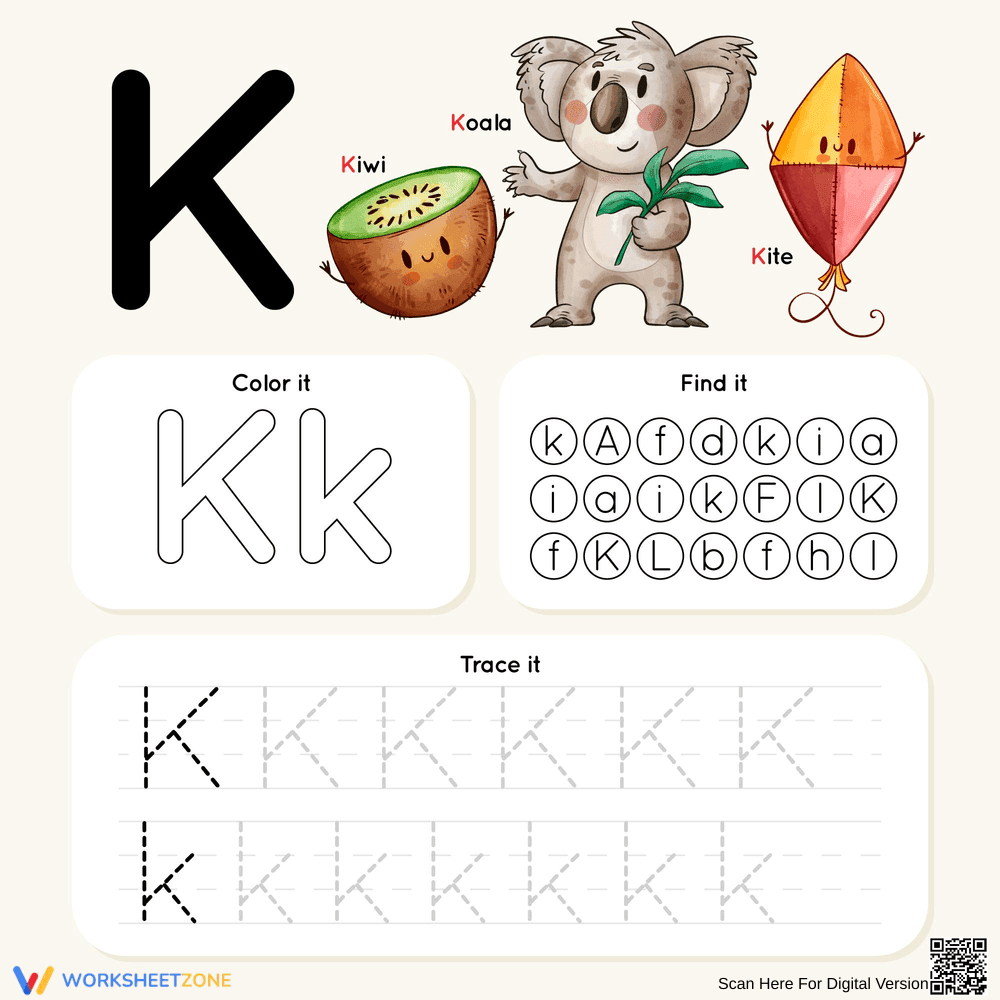

Letter K Worksheet: Printable Tracing & Recognition
Paste this activity's link or code into your existing LMS (Google Classroom, Canvas, Teams, Schoology, Moodle, etc.).
Students can open and work on the activity right away, with no student login required.
You'll still be able to track student progress and results from your teacher account.
This Letter K worksheet provides comprehensive practice for early learners to master alphabet recognition and fine motor control. By combining coloring, visual discrimination, and handwriting, students develop a multi-sensory understanding of both uppercase and lowercase forms. It is designed to build confidence in letter identification and foundational literacy skills.
At a Glance
- Grade: Kindergarten · Subject: English
- Standard:
CCSS.ELA-LITERACY.RF.K.1.D— Recognize and name all upper- and lowercase letters of the alphabet- Skill Focus: Letter K formation and identification
- Format: 1 page · 3 tasks · Answer key included · PDF
- Best For: Morning work or literacy centers
- Time: 10–15 minutes
The resource features a single-page layout divided into three distinct activity zones. It includes large bubble letters for coloring, a letter-search grid containing 21 characters for discrimination practice, and two rows of guided tracing for uppercase and lowercase 'k'. Visual anchors like a koala, kiwi, and kite reinforce the initial letter sound.
Zero-Prep Workflow
- Print: Generate the single-page PDF for your class in under 30 seconds.
- Distribute: Hand out the sheets with crayons or pencils for immediate student engagement (1 minute).
- Review: Check the "Find it" section as a whole group to verify accuracy and provide feedback (2 minutes).
Total teacher prep time is under 2 minutes, making this an ideal solution for sub-plans or quick transitions.
Standards Alignment
The primary focus is `CCSS.ELA-LITERACY.RF.K.1.D`, which requires students to recognize and name all upper- and lowercase letters of the alphabet. The worksheet also supports fine motor development necessary for legible handwriting. Both standard codes can be copied directly into lesson plans, IEP goals, or district curriculum mapping tools.
How to Use It
Use this worksheet during the independent practice phase of a letter-of-the-week lesson. It works best after students have been introduced to the sound of 'K' through an anchor chart or read-aloud. For formative assessment, observe students during the "Find it" task to identify those struggling with letter reversals or visual discrimination between 'k', 'f', and 'l'. Completion typically takes 12 minutes.
Who It's For
This resource is tailored for preschool and kindergarten students beginning their literacy journey. It is particularly helpful for English Language Learners (ELLs) who benefit from the visual cues of the koala and kite. Pair this with a tactile sand-tracing activity or a phonics song for a complete instructional block.
Mastery of letter recognition, specifically the ability to distinguish between upper and lowercase forms as targeted by CCSS.ELA-LITERACY.RF.K.1.D, is a critical predictor of future reading success. This worksheet utilizes a multi-modal approach—visual, kinesthetic, and phonological—to reinforce the letter K. According to the Fisher & Frey (2014) framework for gradual release of responsibility, providing structured independent practice like this allows students to consolidate their understanding of grapheme-phoneme correspondences. The inclusion of letter discrimination tasks helps prevent common early reading errors by forcing students to scan and identify specific features of the letter K among distractors. This targeted practice ensures that students move beyond simple rote memorization toward fluent recognition, which is essential for decoding more complex texts in later grades.


