




























Views
Downloads

Printable Cursive Letter K Worksheet | Grade 1

Paste this activity's link or code into your existing LMS (Google Classroom, Canvas, Teams, Schoology, Moodle, etc.).
Students can open and work on the activity right away, with no student login required.
You'll still be able to track student progress and results from your teacher account.
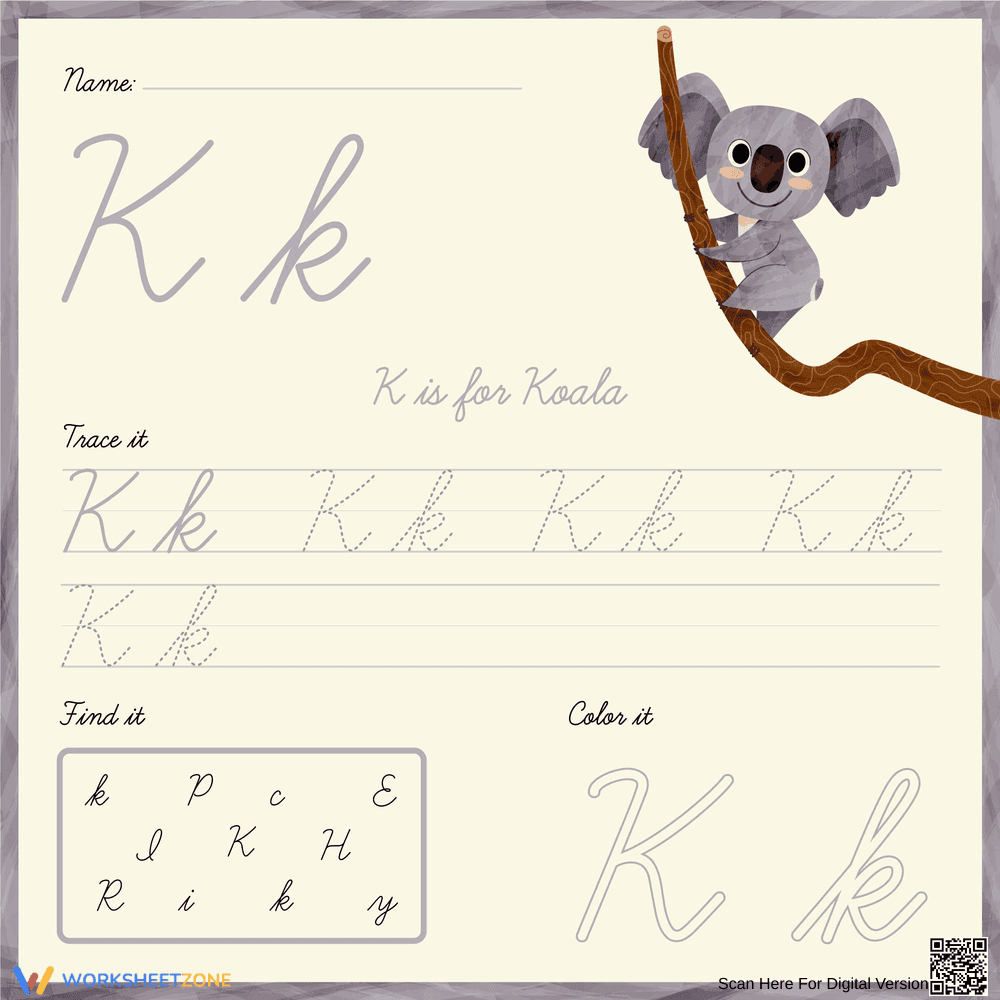
This Grade 1 handwriting worksheet helps students master the cursive letter K through targeted tracing and recognition activities. By combining fine motor practice with letter identification, young learners develop the muscle memory required for fluid cursive writing. The engaging koala theme keeps students motivated as they practice their penmanship.
At a Glance
- Grade: 1 · Subject: Handwriting
- Standard:
CCSS.ELA-LITERACY.L.1.1.A— Print all upper- and lowercase letters- Skill Focus: Cursive Letter K Formation
- Format: 1 page · 3 tasks · No answer key · PDF
- Best For: Independent practice centers
- Time: 10–15 minutes
This single-page resource features three distinct task types to reinforce cursive letter K mastery. Students begin with a "Trace it" section containing five pairs of dotted uppercase and lowercase letters on primary writing lines. Next, a "Find it" letter hunt challenges students to visually discriminate the cursive K among other letters in a mixed word bank. Finally, a "Color it" section provides large outline letters for creative reinforcement.
Zero-Prep Workflow
- Print (1 minute): Generate the PDF and print a class set directly from your computer.
- Distribute (1 minute): Hand out the single-page activity during morning work or literacy centers. The clear visual instructions mean students can begin immediately.
- Review (0 minutes): The self-contained tracing and coloring tasks require no formal grading, allowing teachers to monitor progress visually as students work.
With a total teacher prep time of under two minutes, this resource is highly suitable for emergency sub plans or quick transition activities.
Standards Alignment
This handwriting activity aligns with CCSS.ELA-LITERACY.L.1.1.A, which requires students to print all upper- and lowercase letters. While the standard focuses on print, this worksheet extends the foundational skill into early cursive formation, supporting fine motor development and letter recognition. Both standard codes can be copied directly into lesson plans, IEP goals, or district curriculum mapping tools.
How to Use It
Deploy this worksheet during morning work to establish a calm, focused start to the school day. It also serves as an excellent independent station during literacy centers while the teacher conducts small group reading instruction. As a formative assessment observation tip, watch students' pencil grip and stroke direction during the "Trace it" section to ensure they are forming the cursive K from the correct starting point. Expected completion time ranges from 10 to 15 minutes.
Who It's For
This resource is primarily designed for Grade 1 students beginning their cursive handwriting journey, though it is also appropriate for advanced Kindergarteners or Grade 2 students needing remediation. For differentiation, provide pencil grips or textured surfaces underneath the paper for students requiring additional tactile feedback. Pair this worksheet with a direct instruction lesson modeling the cursive K on a whiteboard or a classroom alphabet anchor chart.
Effective handwriting instruction remains a critical component of early literacy development. According to Fisher & Frey (2014), explicit instruction in letter formation, combined with guided and independent practice, significantly improves students' writing fluency and overall text generation. This worksheet supports that pedagogical framework by providing targeted practice on cursive letter K formation. By aligning with CCSS.ELA-LITERACY.L.1.1.A, which emphasizes the ability to print all upper- and lowercase letters, this resource ensures students build the necessary motor skills for advanced writing tasks. The structured progression from tracing to visual discrimination helps solidify letter recognition and muscle memory. Integrating focused handwriting exercises helps young learners automate letter production, freeing cognitive resources for higher-order composition.


