




























Views
Downloads
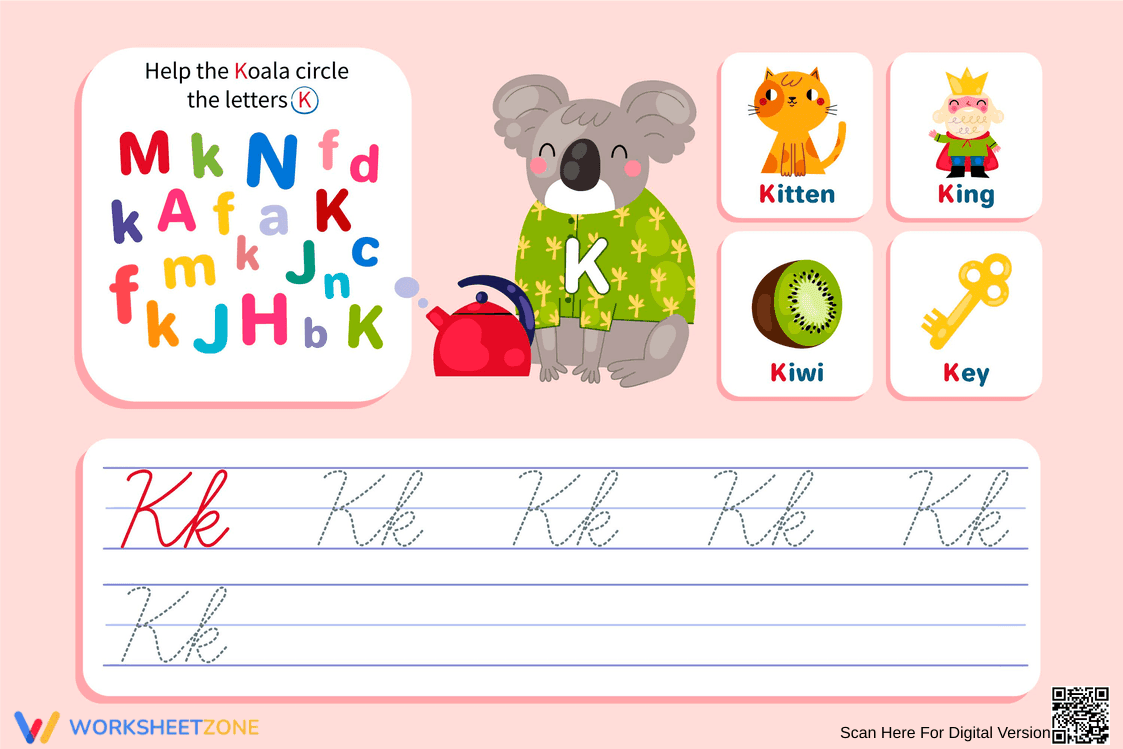

Letter K Tracing Worksheet | Grade K-1 Essential

Paste this activity's link or code into your existing LMS (Google Classroom, Canvas, Teams, Schoology, Moodle, etc.).
Students can open and work on the activity right away, with no student login required.
You'll still be able to track student progress and results from your teacher account.
This Grade K-1 handwriting worksheet provides a comprehensive approach to mastering the letter K. Students engage in visual discrimination by identifying the letter among others, connect the sound to vocabulary like "koala" and "king," and develop fine motor skills through cursive tracing. It ensures students move from recognition to production in one sitting.
At a Glance
- Grade: Kindergarten · Subject: Handwriting
- Standard:
CCSS.ELA-LITERACY.L.K.1.A— Print many upper- and lowercase letters of the alphabet- Skill Focus: Letter K recognition and cursive tracing
- Format: 1 page · 11 tasks · Answer key included · PDF
- Best For: Independent literacy center practice
- Time: 10–15 minutes
Inside this printable PDF, you will find a multi-sensory layout designed for early learners. The top left features a letter-find grid where students circle uppercase and lowercase K. The center showcases a friendly koala, while the right side provides four vocabulary anchors: kitten, king, kiwi, and key. The bottom section contains dedicated lines for tracing cursive "Kk" pairs, providing a structured path to handwriting fluency.
This resource is designed for a zero-prep classroom environment. First, print the single-page PDF (30 seconds). Second, distribute the sheets to students during your literacy block or as a morning arrival activity (1 minute). Finally, review the letter search and tracing together using a document camera to provide immediate feedback (2 minutes). Total teacher preparation time is under two minutes, making it an ideal choice for busy educators or substitute lesson plans.
This worksheet aligns with CCSS.ELA-LITERACY.L.K.1.A, which requires students to print many upper- and lowercase letters. It also supports CCSS.ELA-LITERACY.RF.K.1.D by reinforcing the recognition and naming of all alphabet letters. Both standard codes can be copied directly into lesson plans, IEP goals, or district curriculum mapping tools.
Use this worksheet as a formative assessment after introducing the letter K sound. Observe students during the letter-find task to identify those struggling with visual discrimination between similar letter forms like 'h' or 'k'. It also serves as an excellent quiet-time activity for students who finish their primary assignments early. Expected completion time ranges from 10 to 15 minutes depending on the student's fine motor development.
This resource is tailored for Kindergarten and First Grade students beginning their journey into cursive or refining their letter recognition. It is particularly helpful for English Language Learners (ELL) who benefit from the clear visual cues and vocabulary associations. Pair this with a letter K anchor chart or a read-aloud book about koalas to create a thematic learning experience.
According to Fisher & Frey (2014), the gradual release of responsibility begins with clear modeling and moves toward independent application. This worksheet facilitates that transition by providing a visual model of the letter K followed by structured tracing paths. Research from the NAEP indicates that early mastery of letter formation is a significant predictor of later writing fluency and reading success. By combining recognition, vocabulary, and motor practice, this resource addresses multiple cognitive domains simultaneously. The inclusion of the CCSS.ELA-LITERACY.L.K.1.A standard ensures that the practice remains focused on grade-level expectations for letter production. Educators can use this tool to bridge the gap between simple letter identification and the complex motor movements required for cursive writing, ensuring a solid foundation for literacy development in early childhood settings.


