


























Views
Downloads
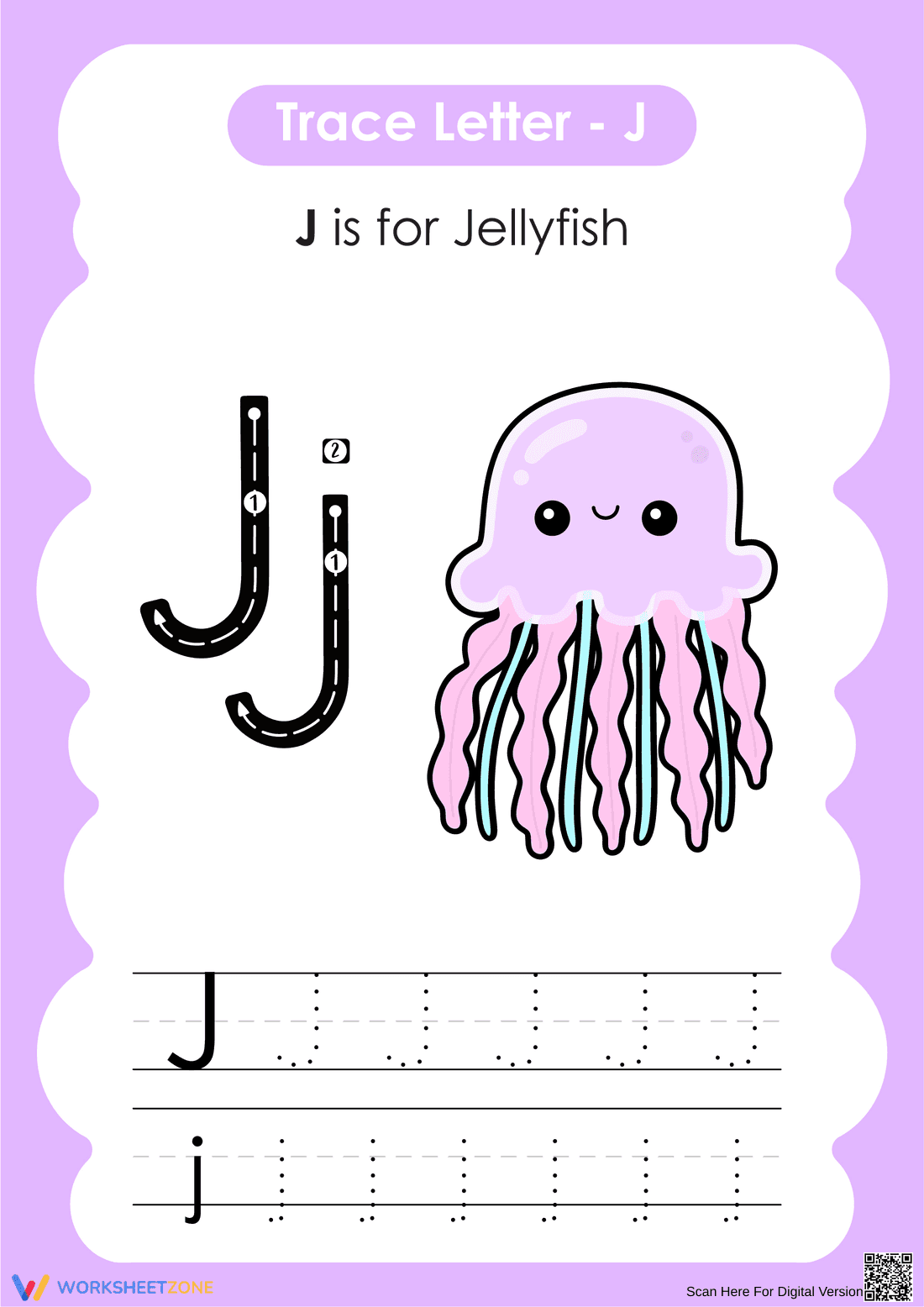

Letter J Tracing Worksheet | Essential Grade K Alphabet
Paste this activity's link or code into your existing LMS (Google Classroom, Canvas, Teams, Schoology, Moodle, etc.).
Students can open and work on the activity right away, with no student login required.
You'll still be able to track student progress and results from your teacher account.
This Letter J tracing worksheet helps early learners master uppercase and lowercase letter formation through guided stroke practice. By connecting visual recognition with fine motor movements, students build the foundational skills necessary for fluent handwriting. This resource ensures students can identify and produce the letter J with confidence and accuracy.
At a Glance
- Grade: Kindergarten · Subject: ELA Alphabet
- Standard:
CCSS.ELA-LITERACY.RF.K.1.D— Recognize and name all upper- and lowercase letters of the alphabet- Skill Focus: Letter J formation and recognition
- Format: 1 page · 14 tracing tasks · Stroke guides included · PDF
- Best For: Morning work or literacy centers
- Time: 5–10 minutes
The worksheet features a large visual anchor with a "J is for Jellyfish" illustration to reinforce phonemic awareness. It includes two distinct tracing rows: one dedicated to uppercase J and one for lowercase j. Each letter includes numbered directional arrows to guide proper pencil grip and stroke order, preventing common reversal errors in young writers.
- Print: Select the single-page PDF and print enough copies for your small group or whole class in under 30 seconds.
- Distribute: Hand out the sheets during your alphabet block; the visual cues allow students to begin immediately without verbal instructions.
- Review: Quickly scan student work for proper stroke directionality, providing instant feedback on letter height and baseline alignment. Total teacher preparation time is less than 2 minutes.
This resource is specifically designed to meet `CCSS.ELA-LITERACY.RF.K.1.D`, which requires students to recognize and name all upper- and lowercase letters of the alphabet. By focusing on the specific geometry of the letter J, students develop the muscle memory required for later writing fluency. This standard code can be copied directly into lesson plans, IEP goals, or district curriculum mapping tools.
Use this worksheet as a formative assessment during your "Letter of the Week" curriculum. Observe if students follow the numbered arrows or if they start from the bottom, which indicates a need for more direct modeling. It also serves as an excellent quiet-time activity for students who finish their primary literacy tasks early.
This worksheet is ideal for preschool, kindergarten, and first-grade students who are developing fine motor control. It is particularly helpful for English Language Learners (ELLs) who benefit from the visual jellyfish anchor. Pair this with a tactile sand tray or a letter J anchor chart for a multi-sensory learning experience.
Research from the RAND AIRS 2024 report emphasizes that explicit instruction in letter formation is a critical precursor to reading fluency and orthographic mapping. When students practice tracing letters like J using guided stroke indicators, they reduce the cognitive load required for handwriting, allowing more mental resources to be dedicated to spelling and composition. This worksheet provides the structured repetition necessary for students to move from conscious effort to automaticity in letter production. According to NAEP data, early mastery of alphabet recognition and formation is one of the strongest predictors of third-grade reading success. By providing 14 specific tracing opportunities with clear visual scaffolds, this resource supports the gradual release of responsibility, ensuring that students receive the support they need before transitioning to independent writing on blank primary lines.


